How to Master the Hidden Pairs Strategy in Sudoku
If you have already mastered Naked Pairs, it is time to upgrade your puzzle-solving arsenal. The Hidden Pairs technique is a slightly more advanced reduction strategy. It requires a keen eye because, as the name suggests, the clue is buried beneath a clutter of other numbers.
Just like in the “Hidden Single” technique, we first need to find something hidden. But this time, we are looking for the pair that appears in only two cells in a unit.
The Logic Behind the Hidden Pair
In a standard Naked Pair, you see two clean cells containing only two digits (like 2 and 6).
A Hidden Pair is different. The two cells might look crowded, filled with three or four candidates each (for example, 2, 4, 5, 6 and 1, 2, 6, 9). However, when you look closely at the entire row, column, or 3×3 block, you discover that the numbers 2 and 6 do not appear anywhere else in that entire unit.
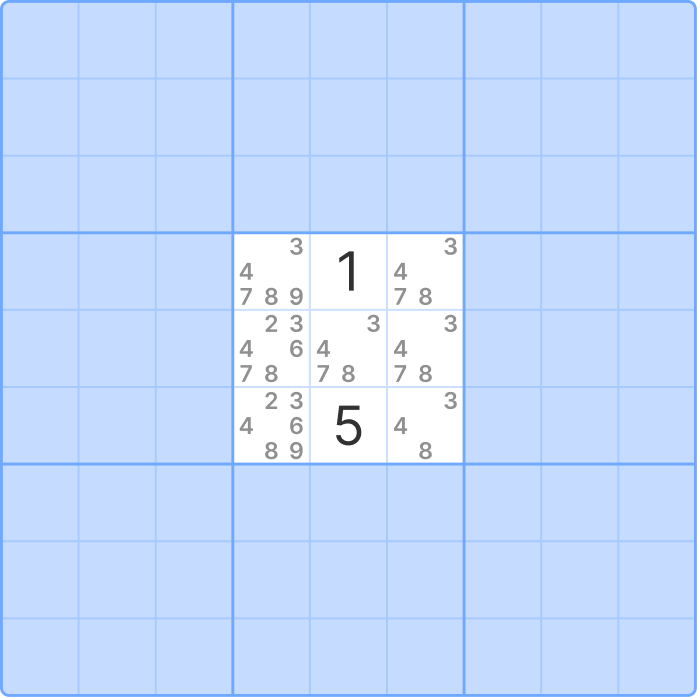
Because every Sudoku unit must contain a 2 and a 6, and you only have two potential cells that can hold them, those two cells are legally locked.
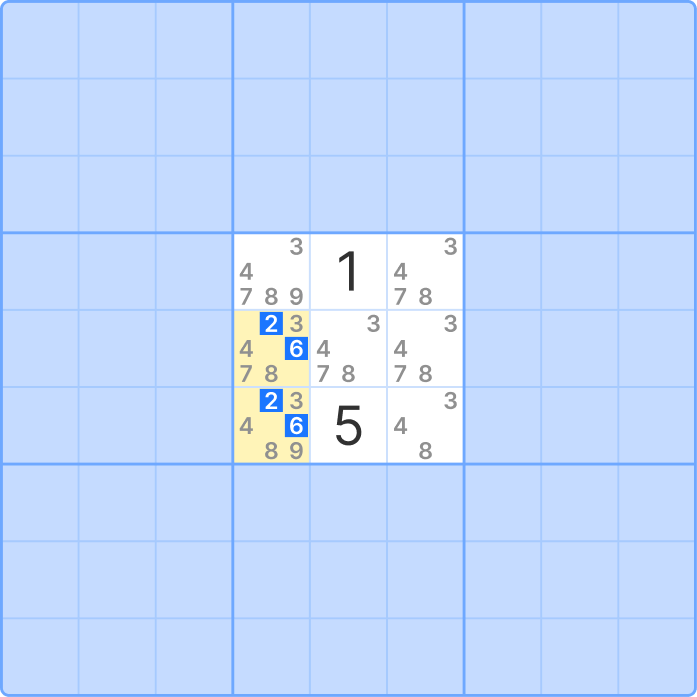
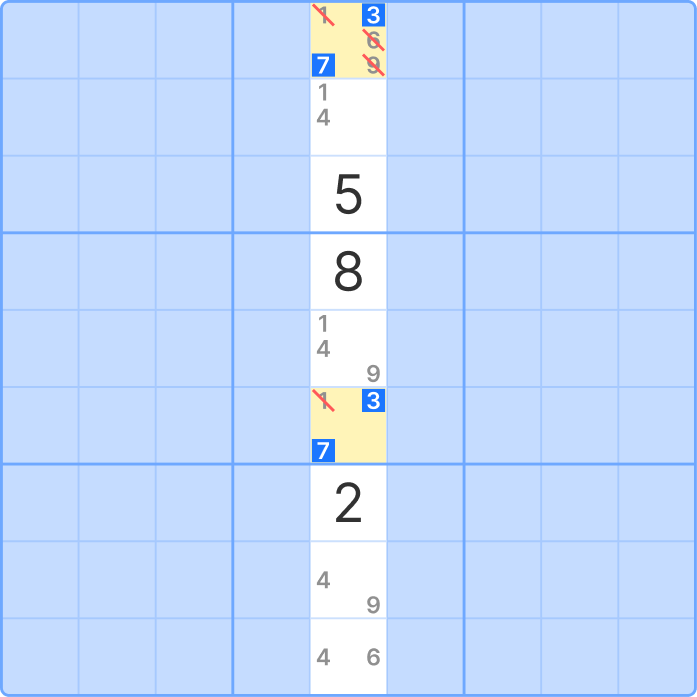
As you can see in this example, the values 2 and 6 appear only in two cells of this unit. This means 2 must occupy one of these cells, and 6 must occupy the other.
How to Apply the Strategy (Step-by-Step)
- Scan for Rare Candidates: Look across a unit and find two numbers that appear very infrequently among the pencil notes.
- Identify the Shared Cells: Notice if these two numbers always share the exact same two cells.
- Isolate the Pair: Once you confirm that these two digits appear nowhere else in the unit, you have successfully found a Hidden Pair.
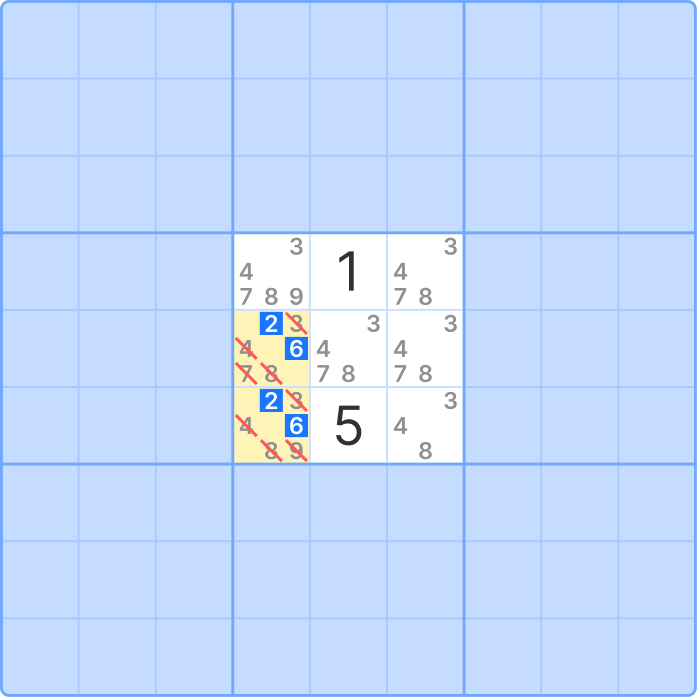
- Clear the Clutter: So you can delete any other numbers in these cells. Since these two spots are strictly reserved for 2 and 6, no other candidates (like 3, 4, 7, 8, or 9) can possibly survive there. Erase everything else to leave a clean 2 & 6 pair!
Where to Look: Rows, Columns, and Blocks
Hidden Pairs are versatile and can completely change the landscape of a gridlock depending on where they appear:
- In a 3×3 Block: Clearing out the extra candidates in a block often opens up opportunities for intersecting rows or columns.
- In Lines: Hidden Pairs can also be found in a column or a row. When you eliminate extra notes along a long vertical or horizontal line, you will frequently expose a Naked Single or a Pointing Pair in a neighboring box.
Why This Strategy Gives You an Edge
Finding Hidden Pairs is a true milestone in a Sudoku player’s journey. It forces you to look at what is missing from the rest of the unit rather than just what is present in a single cell. Clearing out those extra, impossible candidates is often the exact trigger needed to crack open Hard and Expert puzzles.
Ready to uncover hidden numbers? Test your skills today, turn on your pencil notes, and see if you can strip away the clutter!