How to Master the Last Free Cell Technique in Sudoku
The Last Free Cell strategy (often referred to as the Full House technique) is the absolute foundation of Sudoku solving. It is the easiest, fastest, and most satisfying strategy for players of all skill levels, especially beginners. If you want to speed up your solving time, mastering this technique is your very first step.
What is a “Unit” in Sudoku?
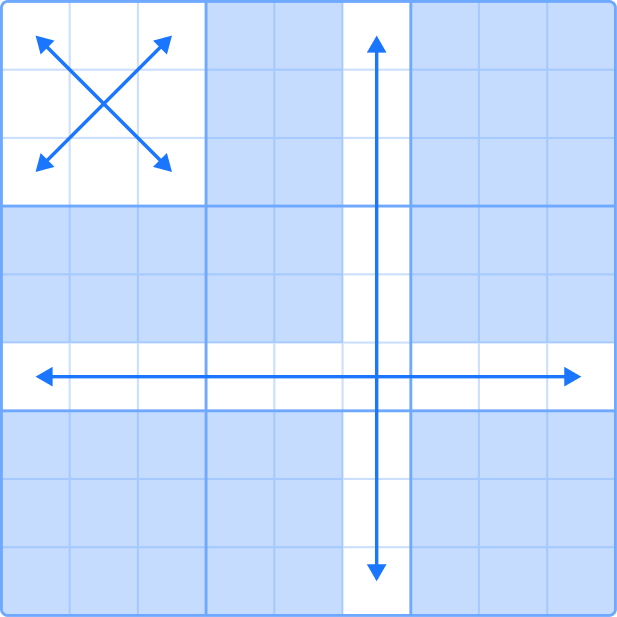
To use the Last Free Cell strategy, you first need to understand how the Sudoku grid is organized. The classic 9×9 grid is divided into three types of zones, which puzzle solvers call units:
- Rows: The 9 horizontal lines running across the grid.
- Columns: The 9 vertical lines running from top to bottom.
- Blocks: The nine distinct 3×3 squares (also called boxes or regions).
According to the golden rule of Sudoku, every single unit must contain all numbers from 1 to 9 exactly once, without any repetitions.
How the Last Free Cell Strategy Works in Sudoku
This strategy relies entirely on scanning the grid to find a row, column, or 3×3 block where only one cell is left empty.
Because you already know that every unit must contain the numbers 1 through 9, determining the missing digit is a matter of simple elimination. If a unit has 8 filled cells and only 1 free cell, there is only one possible number that can logically fit into that open spot.
A Step-by-Step Example:
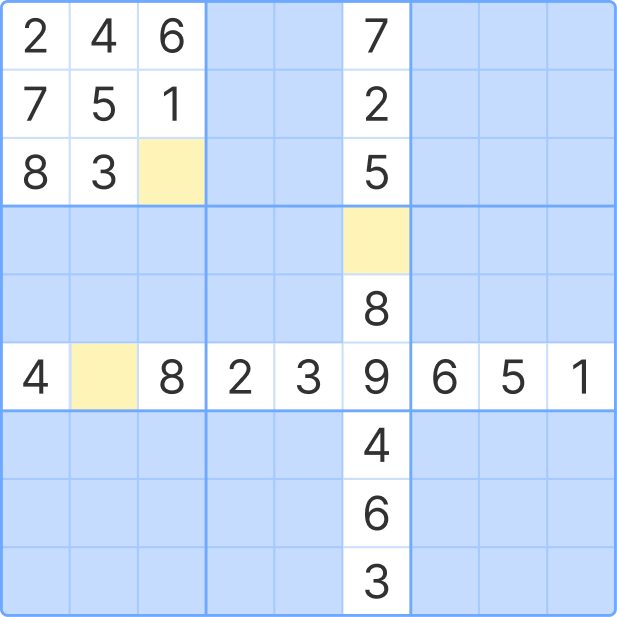
- Scan the board: Look closely at the grid and find a unit (row, column, or block) that is almost finished, with exactly 8 numbers filled in.
- List the present numbers: Check which digits are already sitting in that unit. For instance, you see: 1, 2, 3, 4, 5, 7, 8, and 9.
- Find the missing number: By looking at the sequence, it becomes instantly clear that the number 6 is missing.
- Fill the cell: Write the missing number into the last free cell to complete the unit!

Why This Strategy is Essential for Every Player
While the Last Free Cell technique is highly straightforward, it remains crucial throughout your entire Sudoku journey. Beginners use it to solve their very first easy puzzles. Advanced players rely on it to quickly clear the board after breaking through a complex bottleneck using harder strategies.
Regularly scanning for nearly completed rows, columns, and blocks keeps your eyes sharp, prevents avoidable mistakes, and significantly improves your solving speed.
Ready to practice? Put the Last Free Cell strategy to the test right now on our Easy Sudoku Puzzles.