How to Master the Swordfish Strategy in Sudoku
When even the famous X-Wing technique leaves you stuck, it is time to deploy an even more powerful pattern-based strategy. The Swordfish technique is an advanced expert-level elimination method. The Swordfish technique is pretty similar to an “X-Wing.” However, instead of tracking a rectangle across two rows and columns, you will be scanning for a structural grid that spans across three rows and three columns.
The Logic Behind the Swordfish Pattern
A Swordfish pattern is formed when a single candidate is restricted to a maximum of three cells in three parallel lines (rows or columns), and all these cells perfectly align into the exact same three perpendicular lines.
Consider the following example
Imagine we are tracking the number 6 across three horizontal rows (for example: Row 2, Row 6, and Row 9). When filling out your pencil notes, you notice that:
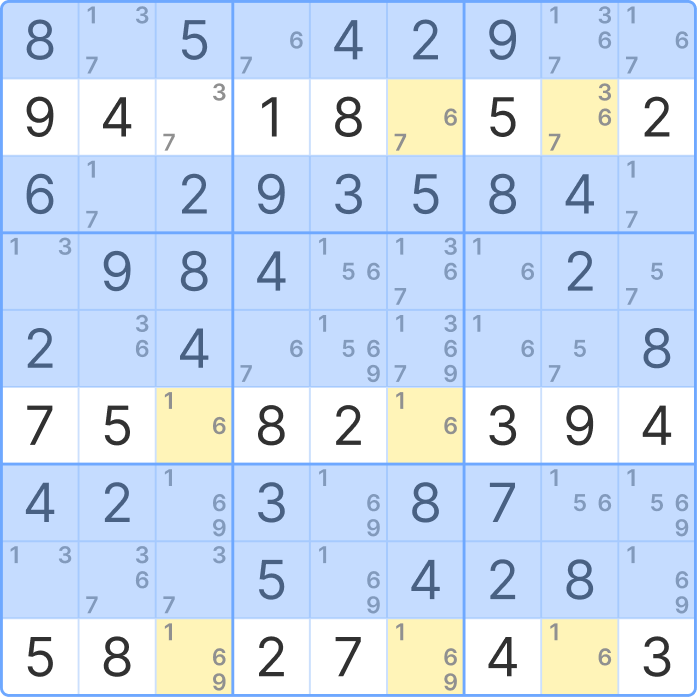
- In Row 2, the number 6 can only go into Column 6 and Column 8.
- In Row 6, the number 6 can only go into Column 3 and Column 6.
- In Row 9, the number 6 can only go into Column 3, Column 6 and Column 8.
Even though none of the rows contain three candidates, all these occurrences fit perfectly within Columns 3, 6, and 8.
Because every row must contain a 6, and these three rows share a closed loop of three columns, it is mathematically guaranteed that the 6s will occupy the intersecting corners of this 3×3 grid. No matter how you try to place them, those three rows will completely absorb the 6s for those three columns.
The Power of Elimination (Step-by-Step)
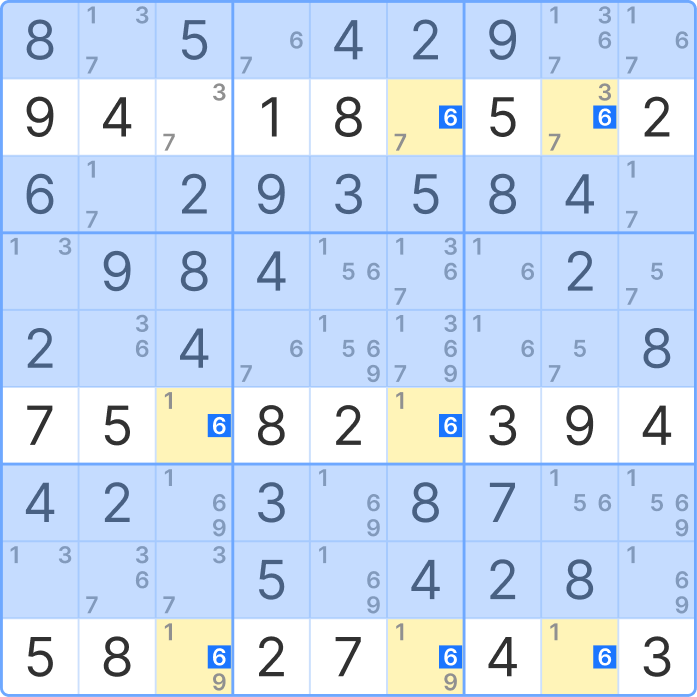
As these rows are guaranteed to contain 6 in the highlighted cells, those three vertical lines are now completely locked by the Swordfish pattern. Therefore, 6 can’t be placed in other cells within the given columns.

To apply this to your game, follow these steps:
- Pick a number: Track a stubborn candidate (like 6) across the entire board.
- Find Three Parallel Lines: Look for three rows where that candidate appears two or three times maximum.
- Verify the Alignment: Check if all these candidates fall into the exact same three vertical columns. If they do, your Swordfish is locked!
- Clear the Intersecting Lines: Go to those three columns and delete the number 6 from the pencil notes of every other cell along those lines, making sure to leave the Swordfish corners untouched.
Swordfish Variations: Rows vs. Columns
Like most advanced grid techniques, a Swordfish can develop in two ways:
- Row-Based Swordfish: The candidate is locked within three rows and aligns across three columns. You eliminate that candidate from the rest of the intersecting columns (as described above).
- Column-Based Swordfish: The candidate is restricted inside three vertical columns and aligns perfectly across three horizontal rows. In this scenario, you use the pattern to wipe out that candidate from the rest of those three rows.
Why the Swordfish Strategy is Vital
Spotting a Swordfish requires a lot of patience, as the cells are often spread out across the entire board, masked by other notes. However, finding one is incredibly rewarding. By removing multiple candidates from three full rows or columns simultaneously, you instantly trigger a massive chain reaction, opening up easy Naked Singles and Pairs to win the game.
Ready to hunt the Swordfish? Put your expert logic to the ultimate test right now on our Expert Sudoku Puzzles, fill out your candidates, and start scanning for the ultimate 3×3 trap!