
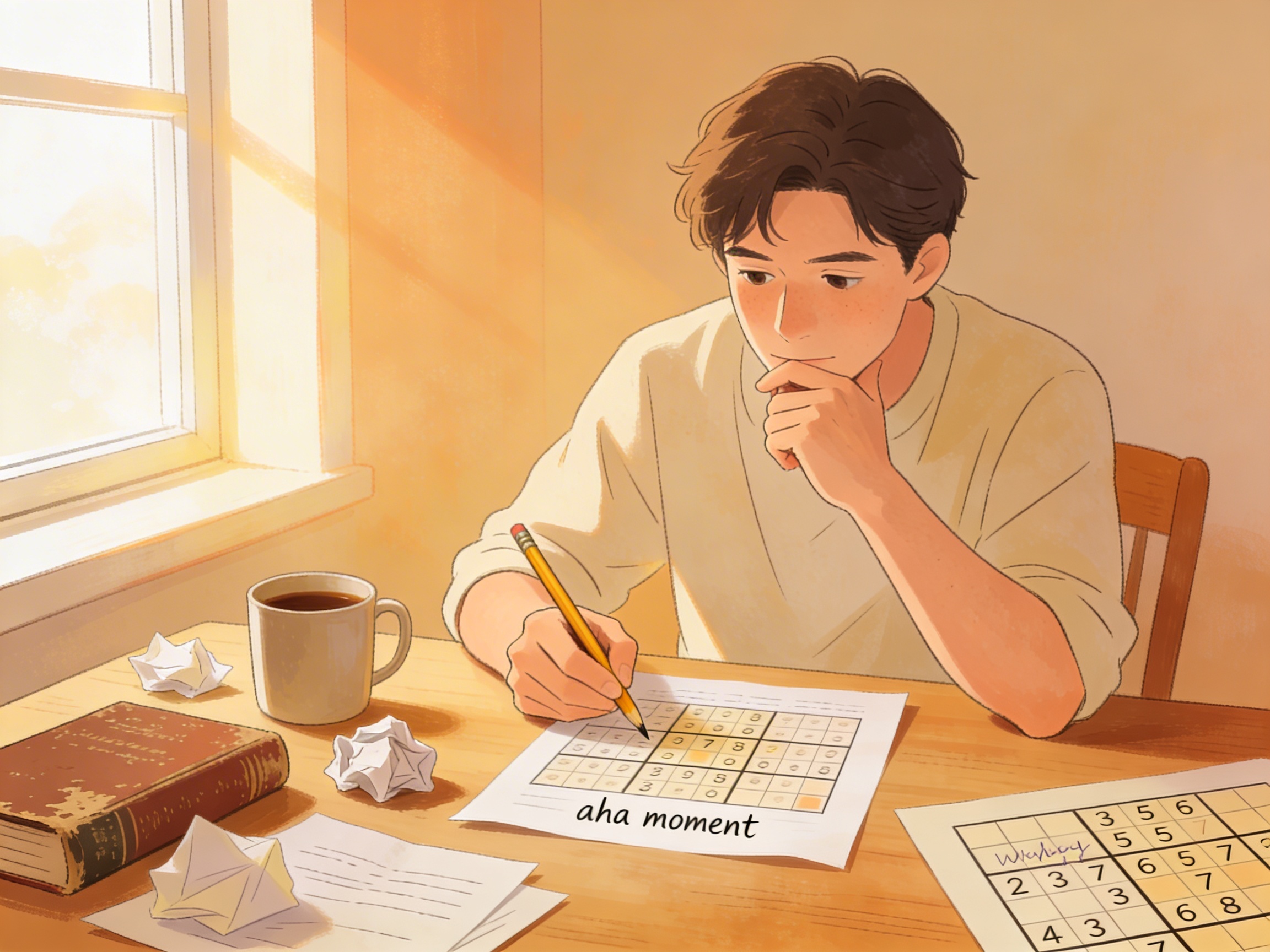
Every single time I introduce someone to sudoku for the first time, the same thing happens. They glance at the grid, spot the numbers, and immediately put their hands up: “Oh, I’m terrible at math.”
And every single time, I have to stop them right there.
Sudoku has nothing to do with math. Not even a little.
You could replace every digit with a fruit – apple, banana, mango, all the way to nine — and the puzzle would work exactly the same way. The numbers 1 through 9 are just nine symbols that are easy to tell apart. That’s it. No addition. No multiplication. No equations hiding in the corner waiting to embarrass you.
So What Is It, Then?
Sudoku is a logic puzzle. Pure and simple. You’re not calculating anything – you’re eliminating possibilities. You look at a row, see that seven of the nine symbols are already placed, and figure out where the remaining two go. That’s not arithmetic. That’s reasoning.
And reasoning, it turns out, is something humans are surprisingly good at – even when they’re convinced they’re not.
The Puzzle That Accidentally Went Global
Sudoku wasn’t invented in Japan. Most people assume it was, but the modern format was actually designed by an American puzzle constructor named Howard Garns in 1979. He called it Number Place, and it appeared quietly in a Dell puzzle magazine.
Japan discovered it a few years later, renamed it Sudoku (short for suuji wa dokushin ni kagiru – “the digits must remain single”), and turned it into a national obsession. By 2005, British newspapers had picked it up, and within months, the rest of the world followed.
It went from a forgotten corner of an American puzzle magazine to the most widely printed puzzle on the planet in under three decades. Not bad for something that “isn’t even math.”
Why Your Brain Loves It
There’s a specific feeling that happens when a sudoku puzzle clicks. You’ve been staring at a stubborn cell for a few minutes, seeing nothing – and then suddenly the answer is obvious. Where did it come from?
That moment is your brain finishing a chain of deductions it had been quietly working through in the background. Psychologists sometimes call it insight – the feeling of a solution arriving fully formed rather than being consciously constructed. Sudoku is unusually good at triggering it.
This is also why sudoku works differently for different people. Some solvers are methodical, scanning row by row, box by box. Others operate more intuitively, jumping to wherever the puzzle feels tight. Both approaches work. Both are valid. The puzzle doesn’t care how you get there.
The Skill Nobody Talks About
If you’ve solved a few hundred sudoku puzzles, you’ve built something most people don’t realize they’re building: pattern recognition under constraint.
You no longer consciously think “this row needs a 4 and a 7.” You just see it. The same way an experienced driver doesn’t think about checking mirrors – it happens automatically, without effort.
This is what makes harder puzzles interesting rather than just frustrating. A 5-star sudoku isn’t harder because the math is harder (again – there is no math). It’s harder because the logical chains are longer and the shortcuts are fewer. Your pattern recognition has to work at a higher resolution.
One Last Thing
If you’ve been avoiding sudoku because you thought it required some mathematical talent you don’t have – this is your official permission to try again.
Bring a pencil. Start with an easy grid. Don’t rush.
The numbers are just symbols. The puzzle is all yours.
Leave a Reply