Category: Blog

  • Sudoku’s Hidden Symmetry: The 3,359,232 Faces of the Same Puzzle

    Sudoku’s Hidden Symmetry: The 3,359,232 Faces of the Same Puzzle

    You’ve probably solved thousands of Sudoku puzzles without realizing something quietly strange: many of them are secretly the same puzzle. Not similar — literally identical, just wearing a disguise. The disguise has a name: symmetry transformations.

    The Moves That Change Everything — And Nothing

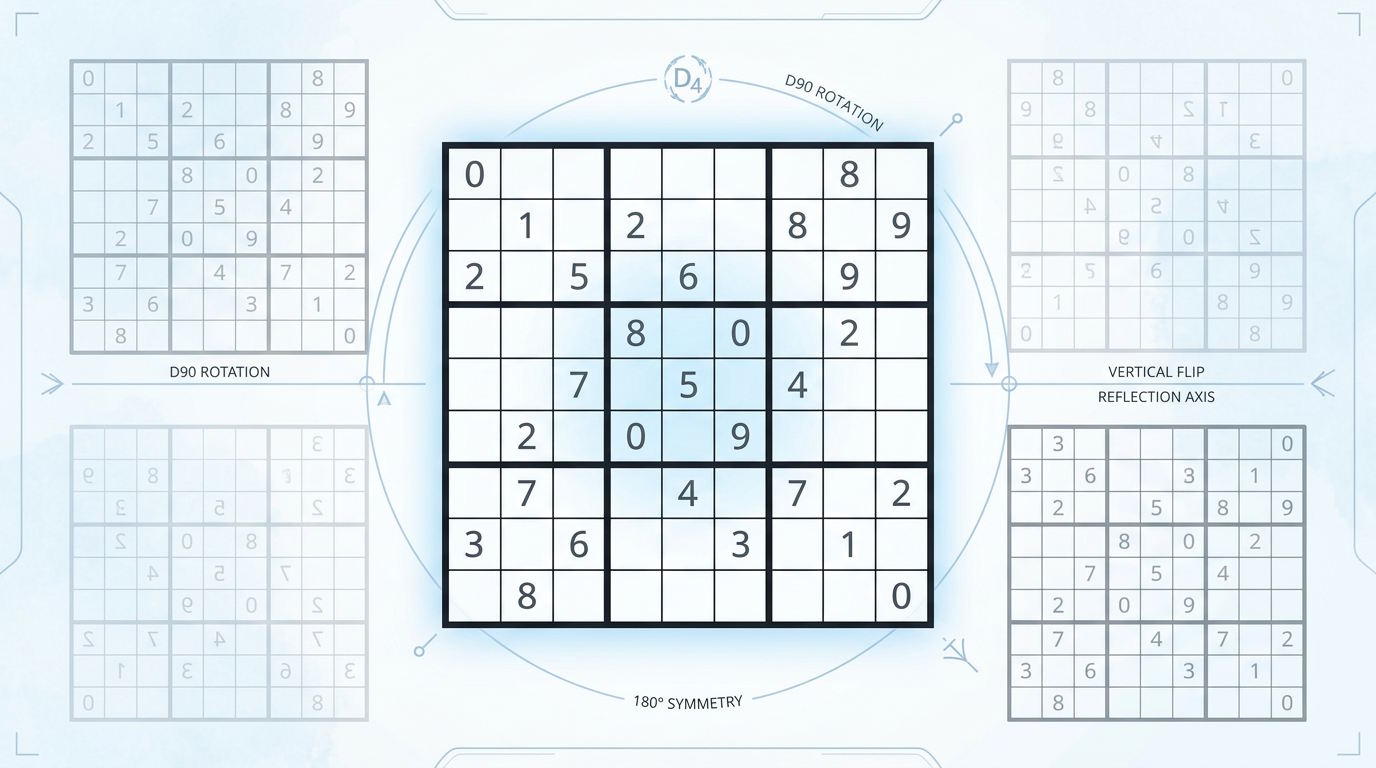
    A valid Sudoku grid remains valid under a surprisingly rich set of rearrangements. None of them break any rule:

    • Swap rows within a band — rows 1, 2, and 3 can be shuffled in any order (6 arrangements), and the same applies to rows 4–6 and 7–9
    • Swap the bands themselves — the three horizontal strips of three rows can be reordered (another 6 ways)
    • Same logic for columns and stacks — identical operations apply vertically
    • Rotate or reflect the entire grid — the 8 classical symmetries of a square all preserve validity
    • Relabel the digits — replace every 1 with a 7 and every 7 with a 1 throughout: still a perfectly valid, perfectly solved Sudoku

    Each of these seems minor in isolation. But multiply them together and the total number of distinct transformations reaches exactly 3,359,232

    The Algebra Behind the Number

    That number isn’t arbitrary. The transformation group has a precise algebraic structure written as:

    (S3S3)×C2

    Where S3 is the symmetric group on 3 elements (permutations of 3 rows or bands), is the wreath product — a way of layering one group’s action on top of another — and C2​ handles the reflection symmetry

    If you also count digit relabelling (permuting all 9 symbols), the full symmetry group expands dramatically to 1,218,998,108,160 elements. That means a single Sudoku grid has over one trillion symmetrically equivalent twins scattered across all possible grids.

    The Counterintuitive Part: Symmetry Almost Never Survives

    Here’s what’s genuinely surprising. With such a rich set of transformations, you might expect many grids to map onto themselves — to be self-symmetric, like a snowflake or a kaleidoscope image. These are called automorphic grids, and mathematically they’re the most structured, most “beautiful” solutions possible.

    In practice, they’re almost nonexistent. Only a tiny fraction of all completed grids have any nontrivial automorphism — a transformation that sends the grid back to itself. The vast majority of Sudoku solutions are completely asymmetric: no rotation, no row swap, no digit relabelling will ever reproduce the same grid.

    This is a classic example of spontaneous symmetry breaking — the same phenomenon that explains why snowflakes have six-fold symmetry while the water vapour they form from has none, or why the universe has more matter than antimatter. The rules of Sudoku are perfectly symmetric. Almost every outcome of those rules is not.

    Three Moves to Generate Everything

    Perhaps the most elegant fact about this entire system: the 3,359,232-element group can be generated by just three primitive moves — rotate 90°, swap rows 1 and 2, swap bands 1 and 2. Every other transformation in the group is just a sequence of these three, combined in different ways.

    Enormous complexity. Three instructions.

    That compression — from millions of transformations down to three generators — is exactly what mathematicians mean when they call a structure beautiful. And it’s sitting quietly underneath every Sudoku puzzle you’ve ever solved.

  • How Many Sudokus Are There?

    How Many Sudokus Are There?

    A journey into one of the most astonishing counting problems in recreational mathematics — and what it tells us about the puzzle we love.

    Every morning, millions of people worldwide open a newspaper or tap an app and face the same deceptively simple challenge: fill a 9×9 grid so that every row, column, and 3×3 box contains the digits 1 through 9 exactly once. The rules fit in a single sentence. Yet lurking beneath that elegant simplicity is a mathematical universe of almost incomprehensible scale.

    How many sudoku grids are there, exactly? The answer, computed definitively in 2005, is:

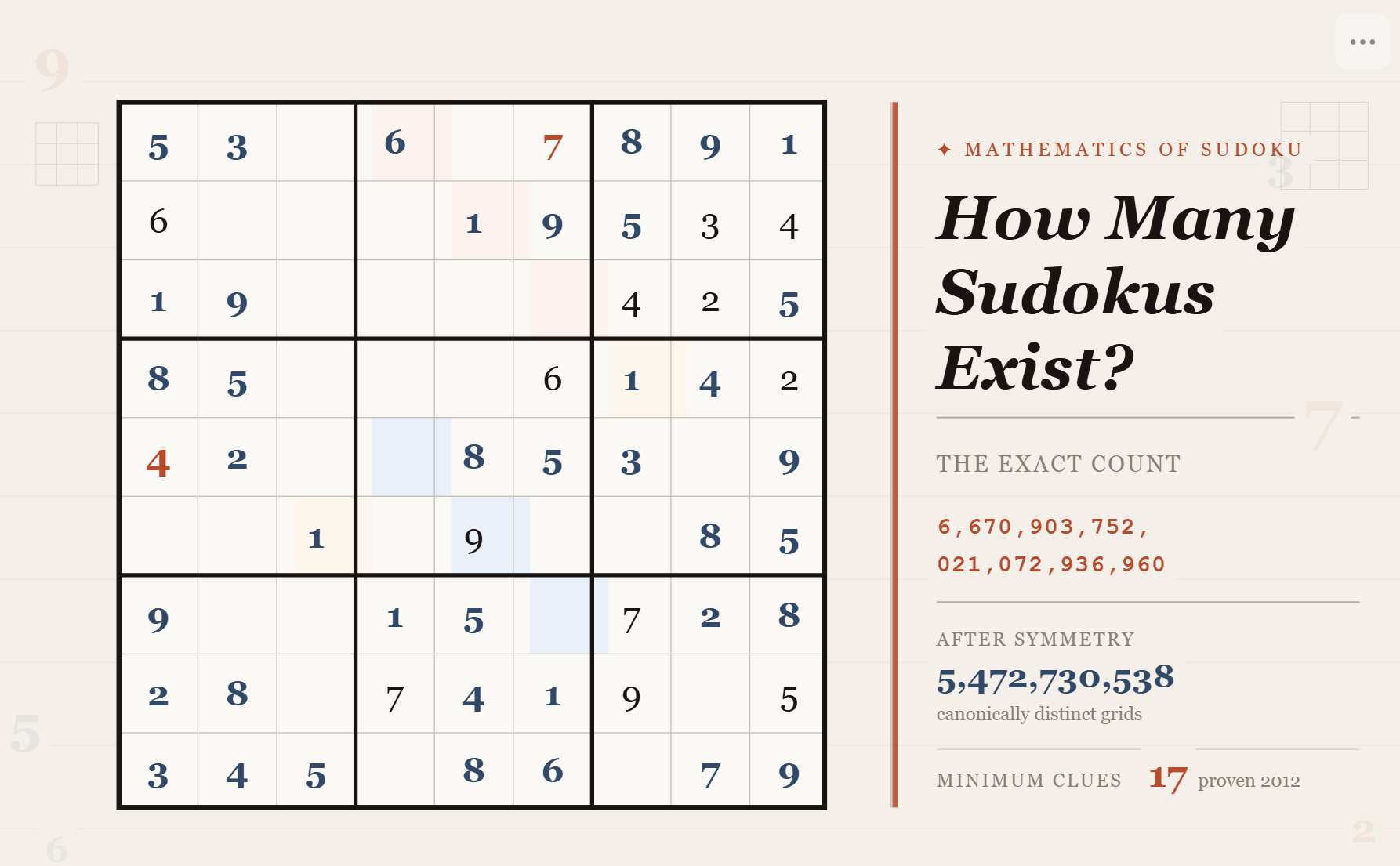
    6,670,903,752,021,072,936,960 — roughly 6.67 sextillion unique completed grids.

    That number is so large it dwarfs most human intuitions about quantity. Let’s put it in context — and explore what it really means for the puzzle you play every day.

    The Calculation That Took Months

    Before 2005, the count was unknown. Mathematicians knew sudoku was a constrained version of a Latin square — a grid where each symbol appears exactly once per row and column — but adding the box constraint made exact enumeration fiendishly difficult.

    Quick Facts

    Latin squares of order 9 number approximately 5.52 × 10²⁷ — vastly more than sudoku grids, since sudoku adds the box constraint on top.

    The first row of a Sudoku grid alone can be arranged in 9! = 362,880 ways.

    The famous minimum of 17 clues was proven in 2012 by Gary McGuire, who checked all 49,158 equivalence classes of 16-clue puzzles by computer.

    In January 2005, Bertram Felgenhauer and Frazer Jarvis published a landmark paper counting all valid, fully completed sudoku grids. Their method combined exhaustive computer search with group theory: they fixed the first row (which can take 9! = 362,880 arrangements) and then systematically counted how many ways the rest of the grid could be completed for each starting configuration. After weeks of computation and careful validation, the final tally was confirmed: 6,670,903,752,021,072,936,960.

    Shortly thereafter, Ed Russell and Frazer Jarvis tackled the deeper question: how many of those grids are truly different — not just relabelings or reflections of the same underlying structure? By accounting for all symmetry operations (rotating the grid, reflecting it, swapping equivalent rows or columns, and relabeling the digits), they found just 5,472,730,538 genuinely distinct grids. Still billions — but a factor of over a trillion smaller.

    What Does “Unique” Actually Mean?

    This distinction between raw count and canonical count is more philosophically interesting than it might appear. Consider: if you take a valid sudoku grid and swap all the 1s for 2s and all the 2s for 1s, you get another valid grid. Are these meaningfully different puzzles? From a solving perspective, no — they are structurally identical. Mathematicians call such equivalent grids members of the same equivalence class.

    The transformations that preserve sudoku’s structure include relabeling digits (9! = 362,880 ways), permuting rows within a band (6 ways per band, 3 bands = 216), permuting the bands themselves (6 ways), and the same operations on columns — plus reflections and rotations of the whole grid. Multiplying these out gives a symmetry group of size approximately 1.22 × 10¹².

    Dividing 6.67 × 10²¹ by ~1.22 × 10¹² gives us the ~5.47 billion canonical grids — a satisfying consistency check.

    The Puzzle Space Is Even Larger

    Completed grids are just one part of the story. A sudoku puzzle is a partially filled grid with a unique solution. How many such puzzles exist? This question is far harder — and the answer is staggeringly larger.

    What We’re CountingApproximate CountNotes
    Valid completed grids6.67 × 10²¹Exact, computed 2005
    Canonical completed grids5.47 × 10⁹After removing symmetries
    Puzzles with unique solutions~3 × 10³⁷Estimated, not exact
    Minimum clues for uniqueness17Proven by McGuire, 2012
    Atoms on Earth~10⁵⁰For perspective

    Even if a puzzle generator created a new, never-before-seen sudoku every millisecond since the Big Bang (13.8 billion years ago), it would have produced only around 4.4 × 10²⁰ puzzles — still less than the number of completed grids alone. You could solve a different sudoku every second for the entire history of the universe and barely make a dent.

    The Magic Number: 17

    One of the most celebrated results in sudoku mathematics is the 17-clue minimum. No sudoku puzzle can have fewer than 17 given digits and still have a unique solution — a conjecture that circulated for years before Gary McGuire of University College Dublin proved it definitively in 2012.

    His team’s computation checked all possible 16-clue configurations — there are 49,158 equivalence classes of them — and confirmed that none has a unique solution. The proof required months of distributed computing across hundreds of machines. The result: 17 is the hard floor. Below it, every grid either has no solution or multiple solutions.

    Known 17-clue puzzles number in the tens of thousands. Whether they have all been found remains an open question.

    Why This Matters for Solvers

    Beyond the mathematical elegance, these numbers carry a practical implication: you will never run out of new sudoku puzzles. Ever. The space is effectively inexhaustible by human civilization on any foreseeable timescale. Every puzzle in every newspaper, app, or book you have ever encountered is a vanishingly tiny sample from an ocean of possibilities.

    There is also something humbling in the 17-clue result. It means that a puzzle maker choosing which clues to reveal is navigating an extraordinarily constrained design space — threading a needle through a universe of sextillions to find configurations that collapse neatly to a single answer. That your daily puzzle has a unique solution is not a given; it is an achievement.

    Every puzzle in every newspaper you have ever solved is a vanishingly tiny sample from an ocean of sextillions.

    Open Questions

    Mathematics, as ever, answers some questions while opening others. Several puzzles remain unsolved:

    How many 17-clue puzzles exist in total?

    Gordon Royle’s database catalogued over 49,000 distinct 17-clue puzzles, but no one has proven this list is complete. A complete census would require computational efforts dwarfing McGuire’s proof.

    What is the maximum number of clues a non-trivially hard puzzle can have?

    A puzzle with 80 clues (leaving one empty cell) always has a unique solution trivially. The interesting ceiling question is: what is the maximum number of clues such that the puzzle still requires genuine deduction rather than just observation? This touches on computational complexity in unexpected ways.

    Can the exact count of uniquely solvable puzzles be computed?

    The ~3 × 10³⁷ figure for puzzles with unique solutions is an estimate. An exact count is considered computationally intractable with current methods — a problem that may require fundamentally new mathematical tools.

    A Final Thought

    The next time you sit down with a sudoku, consider this: the grid in front of you is one point in a space so vast it defies intuition. It was threaded together — whether by a human setter or an algorithm — from constraints that slice through sextillions of possibilities down to a single, satisfying solution. The empty cells are not gaps. They are an invitation into one of the most combinatorially rich structures humans have ever studied.

    Fill them in with confidence. There is no shortage of new ones waiting.

  • Does IQ Predict Sudoku Performance?

    Does IQ Predict Sudoku Performance?

    A deep dive into the cognitive connection between puzzle-solving and intelligence

    Sudoku is often described as a game for “smart people” — but is there actual science behind that claim? Researchers have begun exploring the link between IQ, cognitive ability, and sudoku performance, and the findings are more nuanced than you might expect.

    The Brain Regions Involved

    Solving a sudoku puzzle is not a passive activity. A 2020 fNIRS neuroimaging study published in PMC/NCBI found that the prefrontal cortex — the brain region associated with working memory, logical reasoning, and decision-making — is significantly activated during sudoku tasks. This is the same region that contributes to fluid intelligence, one of the core components measured by IQ tests.

    Sudoku Solving Ability and Intelligence

    A peer-reviewed paper titled Sudoku Solving Ability and Intelligence” (2018), available via Academia.edu, directly examined the relationship between puzzle-solving performance and standardized intelligence scores. The research found a moderate positive correlation between sudoku ability and general intelligence — particularly in the areas of:

    • Logical-deductive reasoning — the ability to eliminate possibilities and follow rule-based constraints
    • Working memory capacity — holding multiple candidate numbers in mind simultaneously
    • Processing speed — how quickly a solver can scan and evaluate the grid

    Importantly, the British Psychological Society highlighted that sudoku puzzles demonstrate deductive reasoning is a broadly human trait, not limited to high-IQ individuals — suggesting that regular play may train these skills over time.

    Does Playing Sudoku Raise Your IQ?

    This is where research gets cautious. A 2021 review by the University of New South Wales found that while brain-training games (including number puzzles) improve performance on similar tasks, the evidence for broad IQ gains is limited. The BBC similarly reported in 2018 that puzzle-solving doesn’t necessarily halt cognitive decline or dramatically boost general intelligence.

    However, this doesn’t mean sudoku is without cognitive value. Research published in PMC (NIH) in 2016 tracked cognitively stimulating leisure activities and found strong associations with sustained cognitive function and reduced risk of decline in older adults — puzzles like sudoku were part of that lifestyle cluster.

    Who Is the Sudoku Audience?

    Studies suggest the typical engaged sudoku player tends to exhibit:

    • Above-average working memory — a strong predictor of fluid IQ
    • Higher tolerance for ambiguity — essential for solving hard grids without guessing
    • Preference for systematic thinking — a personality trait linked to higher analytical scores

    A 2025 study by a UAlbany psychology senior specifically explored the psychological profile of sudoku enthusiasts, finding connections between puzzle engagement and structured, detail-oriented cognitive styles.

    The Verdict: Correlation

    ClaimWhat Research Says
    High-IQ people are better at sudokuModerate correlation confirmed 
    Sudoku raises your IQNot conclusively proven 
    Sudoku activates intelligence-related brain areasYes — prefrontal cortex 
    Regular puzzle play protects cognitive functionSupported by longitudinal data 
    Deductive reasoning is requiredYes, and it’s trainable 
  • Sudoku Is Not a Math Puzzle

    Sudoku Is Not a Math Puzzle

    Every single time I introduce someone to sudoku for the first time, the same thing happens. They glance at the grid, spot the numbers, and immediately put their hands up: “Oh, I’m terrible at math.”

    And every single time, I have to stop them right there.

    Sudoku has nothing to do with math. Not even a little.

    You could replace every digit with a fruit – apple, banana, mango, all the way to nine — and the puzzle would work exactly the same way. The numbers 1 through 9 are just nine symbols that are easy to tell apart. That’s it. No addition. No multiplication. No equations hiding in the corner waiting to embarrass you.

    So What Is It, Then?

    Sudoku is a logic puzzle. Pure and simple. You’re not calculating anything – you’re eliminating possibilities. You look at a row, see that seven of the nine symbols are already placed, and figure out where the remaining two go. That’s not arithmetic. That’s reasoning.

    And reasoning, it turns out, is something humans are surprisingly good at – even when they’re convinced they’re not.

    The Puzzle That Accidentally Went Global

    Sudoku wasn’t invented in Japan. Most people assume it was, but the modern format was actually designed by an American puzzle constructor named Howard Garns in 1979. He called it Number Place, and it appeared quietly in a Dell puzzle magazine.

    Japan discovered it a few years later, renamed it Sudoku (short for suuji wa dokushin ni kagiru – “the digits must remain single”), and turned it into a national obsession. By 2005, British newspapers had picked it up, and within months, the rest of the world followed.

    It went from a forgotten corner of an American puzzle magazine to the most widely printed puzzle on the planet in under three decades. Not bad for something that “isn’t even math.”

    Why Your Brain Loves It

    There’s a specific feeling that happens when a sudoku puzzle clicks. You’ve been staring at a stubborn cell for a few minutes, seeing nothing – and then suddenly the answer is obvious. Where did it come from?

    That moment is your brain finishing a chain of deductions it had been quietly working through in the background. Psychologists sometimes call it insight – the feeling of a solution arriving fully formed rather than being consciously constructed. Sudoku is unusually good at triggering it.

    This is also why sudoku works differently for different people. Some solvers are methodical, scanning row by row, box by box. Others operate more intuitively, jumping to wherever the puzzle feels tight. Both approaches work. Both are valid. The puzzle doesn’t care how you get there.

    The Skill Nobody Talks About

    If you’ve solved a few hundred sudoku puzzles, you’ve built something most people don’t realize they’re building: pattern recognition under constraint.

    You no longer consciously think “this row needs a 4 and a 7.” You just see it. The same way an experienced driver doesn’t think about checking mirrors – it happens automatically, without effort.

    This is what makes harder puzzles interesting rather than just frustrating. A 5-star sudoku isn’t harder because the math is harder (again – there is no math). It’s harder because the logical chains are longer and the shortcuts are fewer. Your pattern recognition has to work at a higher resolution.

    One Last Thing

    If you’ve been avoiding sudoku because you thought it required some mathematical talent you don’t have – this is your official permission to try again.

    Bring a pencil. Start with an easy grid. Don’t rush.

    The numbers are just symbols. The puzzle is all yours.

  • TheSudoku.com Major Update: New Features, Better Experience

    TheSudoku.com Major Update: New Features, Better Experience

    We’re excited to announce a significant update to TheSudoku.com that makes solving puzzles easier, more intuitive, and more enjoyable than ever before. Our team has been working hard to incorporate your feedback and deliver features that enhance your daily Sudoku experience.

    What’s New in This Update

    Redesigned Top Menu with Quick Controls

    The most noticeable change is our brand-new navigation menu at the top of the page. We’ve added intuitive difficulty level selection that lets you switch between Easy, Medium, Hard, Expert and Master puzzles instantly—no more hunting through pages to find your preferred challenge level.

    The new Play and Restart buttons are now prominently positioned for quick access. Starting a fresh puzzle or resetting your current grid is now just one click away, streamlining your solving workflow and letting you focus on what matters most: the puzzle itself.

    Comprehensive Sudoku Techniques Guide

    We’ve expanded our Rules section with detailed explanations of the most common and effective Sudoku solving techniques. Whether you’re a beginner learning the basics or an intermediate player ready to tackle advanced strategies, our new technique library provides clear, illustrated guidance for:

    • Basic scanning methods and singles identification
    • Naked and hidden pairs/triples
    • Pointing pairs and box-line reduction
    • X-Wing and other pattern-based techniques
    • Advanced logical deduction methods

    Each technique includes practical examples and tips for recognizing when to apply it, helping you build a comprehensive solving toolkit and improve your speed and accuracy.

    Bug Fixes and Performance Improvements

    Behind the scenes, we’ve squashed numerous bugs that were affecting gameplay. The result is a smoother, more reliable experience across all devices—whether you’re solving on desktop, tablet, or smartphone.

    We’ve also optimized loading times and improved overall site performance, ensuring your puzzles appear faster and run more efficiently than before.

    What’s Coming Next

    This update is just the beginning!

    Our development roadmap includes enhanced statistics tracking, new puzzle variants and special challenge modes, personalized difficulty recommendations, social features for competing with friends, and regular puzzle competitions with leaderboards.

    We’re committed to making TheSudoku.com the best place to play Sudoku online, and that means continuous improvement driven by what you, our players, need and want.

    Thank You for Playing With Us

    Your continued support means everything to us. Every puzzle you solve, every minute you spend on our site, and every piece of feedback you share helps us understand how to serve you better!

    Thank you for choosing TheSudoku.com as your daily puzzle destination. Here’s to many more puzzles, improvements, and lots of fun ahead!

    Happy solving,
    The TheSudoku.com Team

  • Sudoku for Beginners: Pointing

    Sudoku for Beginners: Pointing

    So you’ve mastered the basics of Sudoku – you can spot naked singles and fill in obvious numbers. But now you’re stuck. The puzzle seems impossible, with no clear moves. This is where your first real Sudoku technique comes in: Pointing.

    Pointing is the gateway technique that transforms you from a beginner into an intermediate solver. It’s the first “aha!” moment where you realize Sudoku isn’t just about filling boxes – it’s about understanding how numbers interact across different regions.

    What is Pointing?

    Pointing (also called “box-line reduction”) happens when a candidate number in a box is restricted to a single row or column. When this happens, you can eliminate that candidate from the rest of that row or column outside the box.

    Think of it like this: if a number can only live in one specific hallway of a building (the box), it can’t also live in other parts of that same street (the row or column).

    How Pointing Works

    Sudoku has three types of regions that must each contain the digits 1-9:

    • Nine 3×3 boxes
    • Nine rows (horizontal lines)
    • Nine columns (vertical lines)

    Pointing exploits the overlap between these regions. When candidates in a box are confined to a single line, that line “claims” those candidates, preventing them from appearing elsewhere on that line.

    A Simple Example

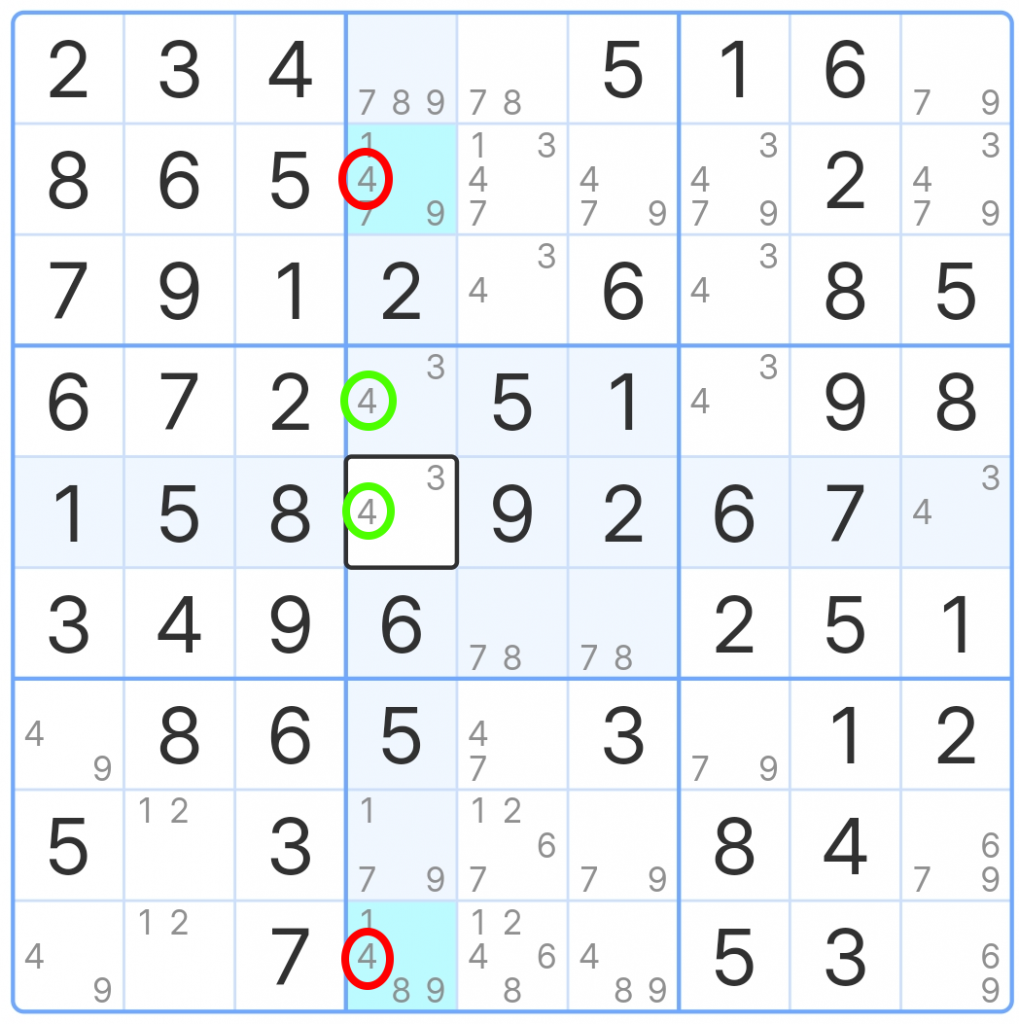
    Imagine you’re looking at central box, and the number 4 can only appear in two cells – both in the same column. Here’s what you know:

    1. One of those two cells must contain a 4 (because the box needs a 4)
    2. Both cells are in the same column
    3. Therefore, column’s 4 must be in this box
    4. This means you can eliminate 4 as a candidate from all other cells in the column

    That’s Pointing! The 4 is “pointing” along the column, claiming it for that box.

    Why Pointing is Powerful

    Pointing is your first technique that uses logical inference rather than direct observation. You’re not just seeing an obvious answer – you’re deducing where numbers can’t be based on structural constraints.

    This technique often creates a chain reaction. One Pointing elimination might expose a naked single, which fills a cell, which creates another Pointing opportunity. This cascading effect is what makes advanced Sudoku solving so satisfying.

    Common Mistakes to Avoid

    Mistake 1: Forgetting to check the whole line
    When you find Pointing candidates, make sure to eliminate from the ENTIRE row or column, not just the adjacent box.

    Mistake 2: Confusing box and line boundaries
    Only eliminate outside the box. The candidates inside the box that are pointing must stay (one of them is the answer!).

    Mistake 3: Not checking all nine boxes
    Pointing can happen in any box with any number. Check systematically: Box 1 for 1-9, Box 2 for 1-9, and so on.

    Moving Forward

    Once you’re comfortable with Pointing, you’re ready for its mirror technique called “Claiming” (or box-line reduction in reverse), and then harder techniques like “Hidden Pairs” or “Hidden Triples.”

    But master Pointing first. It’s the foundation of logical Sudoku solving, and it will appear in virtually every medium and hard puzzle you solve.

  • The Secret History of Sudoku: From 18th Century Swiss Math to Global Phenomenon

    The Secret History of Sudoku: From 18th Century Swiss Math to Global Phenomenon

    When you open your morning Sudoku grid, it feels like you are tapping into ancient Eastern wisdom. The name, the Zen-like logic, the minimalist design—everything points to Japan.

    But the truth is far more interesting. Sudoku is a “child of the world.” It has Swiss DNA, an American upbringing, a Japanese name, and—crucially—a New Zealand “godfather” who turned a niche puzzle into a global sensation.

    Here is the true story of how a simple grid of numbers conquered the planet.

    1783: Grandfather Euler and Latin Squares

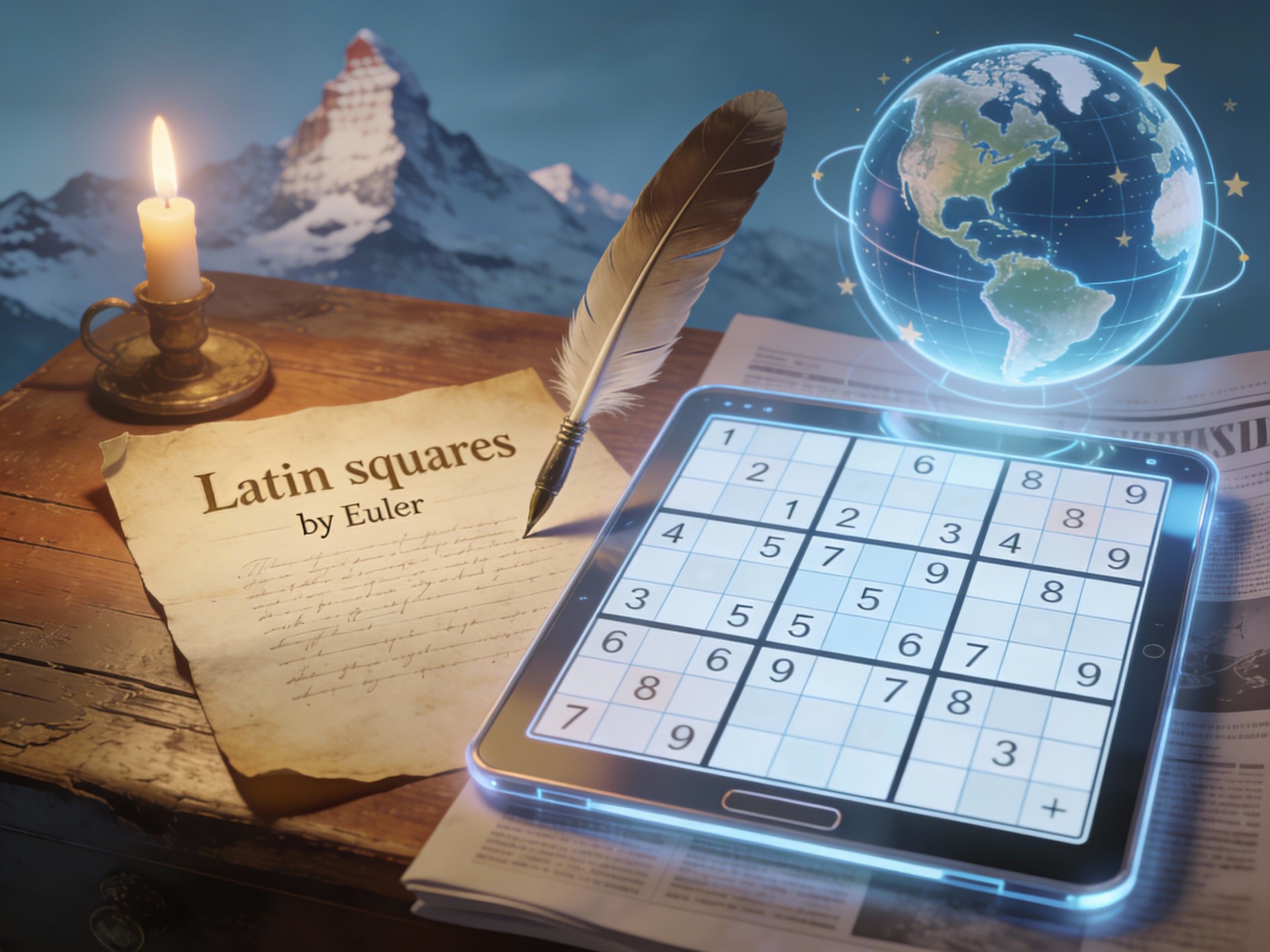
    The story begins not in Tokyo, but in St. Petersburg and Berlin with the legendary Swiss mathematician Leonhard Euler. In 1783, he explored a concept he called “Latin Squares”.

    The idea was simple: arrange symbols in a grid so they do not repeat in any row or column. This was the foundation. However, Euler’s version lacked the modern Sudoku’s defining feature – the 3×3 blocks. Without them, it was pure mathematics rather than an addictive puzzle. Euler laid the logical groundwork, but the world had to wait two centuries for the game to evolve .

    1979: The Architect Who Built “Number Place”

    Fast forward to Indiana, USA, in the late 1970s. Howard Garns, a 74-year-old retired architect, loved creating puzzles. He took Euler’s concept and added a brilliant constraint: dividing the grid into nine 3×3 sub-grids. This changed everything -now the player had to scan the board not just linearly, but spatially.

    In May 1979, Dell Pencil Puzzles and Word Games published Garns’ creation under the name “Number Place.” It became popular among American logic fans but remained a niche hobby. Sadly, Garns passed away in 1989, never knowing that his invention would eventually become the most popular puzzle in the world.

    1984: The Japanese Rebrand

    In the early 80s, a copy of the Dell magazine fell into the hands of Maki Kaji, the president of the Japanese puzzle publisher Nikoli. He loved the logic of “Number Place,” but the name felt too dry for the Japanese market.

    Kaji-san gave the game a new identity, shortening the phrase “Sūji wa dokushin ni kagiru” (the digits must remain single) to the snappy Sudoku (Su = number, Doku = single).

    Japan didn’t just rename the game; they refined it. Nikoli introduced symmetry rules (starting numbers must form a pattern) and limited the clues to ensure the puzzle required logic rather than guessing. Sudoku became a hit in Japan, but the West largely forgot about it.

    2004: The Programmer Who “Infected” the World

    This is where Wayne Gould enters history—a retired Hong Kong judge and, notably, a New Zealander.

    In 1997, while visiting a bookstore in Tokyo, Gould found a book of Sudoku. He didn’t just solve them; as a technology enthusiast, he wanted to automate them. He spent six years writing a computer program (using C++) that could generate infinite unique puzzles of varying difficulty.

    In November 2004, Gould walked into the offices of The Times in London. He had no marketing budget, but he had an algorithm. He told the editor, “I will give you these puzzles for free, just print them.”

    The Times took the risk. The effect was instant. Within three days, readers were calling the newsroom demanding more puzzles. Other papers like The Daily Mail and The Guardian realized they were losing readers and scrambled to print their own grids.

    Thanks to code written by a Kiwi, a game invented in the US, based on Swiss math, and named in Japan, became the definitive morning ritual of the 21st century.

  • How to Get Better at Sudoku

    How to Get Better at Sudoku

    You have mastered the basics. You can clear the “Easy” levels, and “Medium” puzzles are becoming a comfortable routine. But then you hit a wall. You stare at a “Hard” or “Expert” grid, and the numbers just stop flowing. You might be tempted to guess, but deep down, you know that’s not how the pros do it.

    Professional Sudoku solving isn’t about being a math genius; it’s about seeing the invisible patterns that others miss. If you are ready to leave the guesswork behind and start solving like a master, here is your roadmap to the next level.

    1. Stop “Eyeballing” and Start Noting (The Right Way)

    Beginners often try to solve the entire puzzle in their heads, afraid that using pencil marks (notes) is “cheating.” Pros know that notes are essential—but only if used correctly.

    The biggest mistake is filling every empty cell with every possible number. This creates “visual noise” that hides the solution. Instead, use Snyder Notation. This technique, favored by speed solvers, involves noting candidates in a 3×3 box only if there are exactly two possible spots for that number.

    • Why it works: If you mark that a ‘5’ can only go in two cells in a box, and later you solve one of those cells as a ‘9’, you immediately know the other cell must be the ‘5’. It turns chaos into a checklist.

    2. Master the “Pointing Pairs

    Once you are using proper notes, you will start seeing ghosts—numbers that aren’t there yet but influence the rest of the grid. This is often called “Pointing Pairs” or Locked Candidates.

    Imagine a 3×3 box where the number ‘4’ can only appear in the top row of that specific box. Even though you don’t know which of those cells is the ‘4’ yet, you know for a fact that the ‘4’ for that entire row across the whole puzzle must be inside that box.

    • The Pro Move: You can safely eliminate any ‘4’ candidates from the rest of that row outside the box. This subtle elimination often breaks a puzzle wide open when you are stuck.

    3. Spotting the “Naked Pairs

    This is the bread and butter of intermediate-to-pro play. If you find two cells in the same row, column, or box that contain only the same two candidates (e.g., both cells contain only 2 and 7), you have found a Naked Pair.

    • The Logic: Since these two cells must be 2 and 7 (in some order), no other cell in that same group can be a 2 or a 7.
    • The Result: You can erase 2 and 7 from all other pencil marks in that row/column/box. It sounds simple, but in a cluttered grid, spotting a Naked Pair is like finding a key in a haystack.

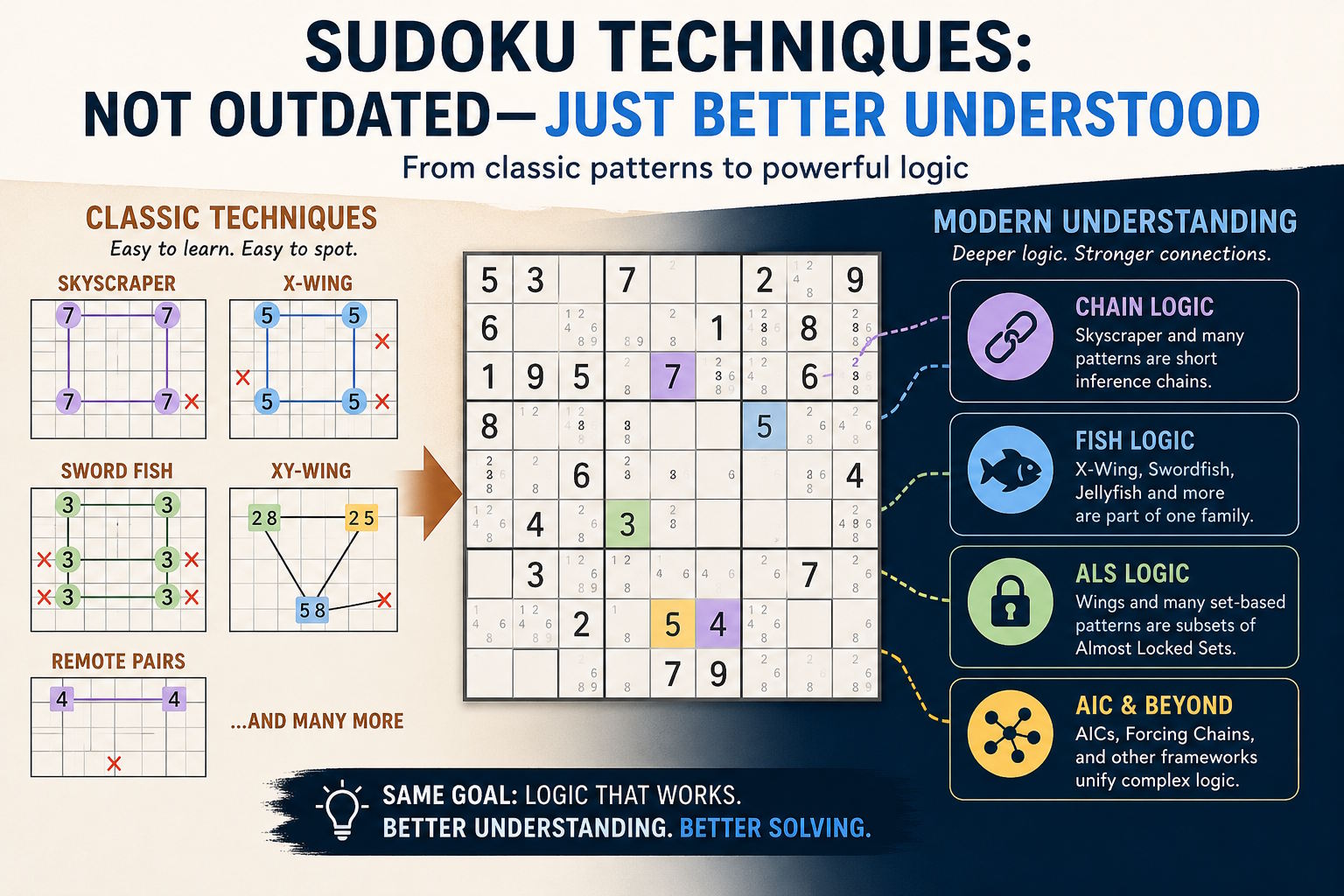
    4. The Gateway to Advanced Logic: The X-Wing

    When you are ready to truly look like a wizard, learn the X-Wing. This pattern occurs when a specific number (candidate) appears exactly twice in two different rows (or columns), and they align perfectly to form a rectangle.

    • How to spot it: Look for a candidate (say, ‘6’) that appears only in columns 3 and 7 of Row 2, and again only in columns 3 and 7 of Row 6.
    • The Elimination: Because of this alignment, you know the ‘6’ must be in one of two diagonal corners of this “X”. Therefore, you can eliminate the ‘6’ from every other cell in those two vertical columns (3 and 7).

    5. The Golden Rule: Logic Over Speed

    The final mark of a pro is patience. Beginners rush and make guesses that lead to dead ends. Pros know that every Sudoku puzzle has a purely logical path to the solution. If you are stuck, don’t guess. Instead, cycle through your techniques:​​

    1. Scan for hidden singles.
    2. Update your Snyder notes.
    3. Look for pairs and triples.
    4. Hunt for X-Wings.

    Sudoku is a game of momentum. By trusting the logic, you transform the grid from a wall of numbers into a satisfying cascade of solutions. Ready to test your new skills?


  • The Evolution of Sudoku: Old VS New Sudoku Techniques

    The Evolution of Sudoku: Old VS New Sudoku Techniques

    Sudoku seems timeless, but the way we solve it has changed radically. If you handed a modern “Expert” puzzle to a player from the 1990s, they likely couldn’t solve it. Not because they lacked intelligence, but because the technology of logic hadn’t been invented yet.

    This is the story of how Sudoku evolved from a casual newspaper game into a deep mathematical discipline—and how human players learned to think like computers to beat them.

    1. The Analog Era: Visual Intuition (1979–2004)

    Before it was a global phenomenon, Sudoku was a niche puzzle called Number Place, designed by Howard Garns in 1979. When it migrated to Japan as “Sudoku” (Nikoli), the puzzles were hand-crafted.

    The Strategy: “The Eyeball Scan”

    In this era, solving was purely visual. Puzzles were designed with artistic symmetry and “flow” in mind.

    • Cross-Hatching: The dominant technique. A player would visually “slice” rows and columns to find the only open cell for a number in a 3×3 box.
    • No Notes Needed: The “Nikoli style” prided itself on elegance. A well-made puzzle was meant to be solved without writing tiny candidates in the margins. If you had to write notes, the puzzle was considered “inelegant” or “too hard”.

    The Limit: Logic was “Constructive”—you were always looking for where a number does go. If scanning failed, most players simply guessed (bifurcation).

    2. The Digital Shift: Man vs. Machine (2005–2010)

    Everything changed in 2004 when Wayne Gould, a retired judge, wrote a computer program to mass-produce puzzles for The Times. Suddenly, newspapers had thousands of puzzles generated by code, not humans.

    Computer-generated puzzles didn’t care about “elegance.” They often produced grids that were impossible to solve by simple scanning. To survive, players had to adapt.

    The Birth of “Destructive” Logic

    Players moved from finding “Yes” (Placement) to proving “No” (Elimination). This required a new language, largely developed on the Sudoku Programmers Forum.

    • The “Fish” Names: Players discovered patterns where candidates formed rectangles.
      • X-Wing (Size 2): Named after the Star Wars fighter because of the “X” shape formed by the corners.
      • Swordfish (Size 3): Named after the WWII biplane (the Fairey Swordfish) because the pattern resembled the struts and wings of the aircraft.
    • The Shift: These were the first techniques that allowed a player to eliminate a candidate from the top of the grid based on information at the bottom. It was no longer local; it was global.

    3. The Modern Era: The “Meta” and Set Theory (2015–Present)

    Today, Sudoku has split into two high-level disciplines: Speed Solving and Variant Logic. The rise of YouTube channels like Cracking the Cryptic popularized techniques that seem like magic to outsiders.

    Speed: Snyder Notation

    World Champion Thomas Snyder introduced a notation style that prioritized speed over information.

    • The Technique: You only pencil-mark a number if it is limited to two positions in a box.
    • The Logic: This prevents “information overload.” Instead of a grid full of messy numbers, the solver sees a clean map of binary choices. When one number falls, it triggers a chain reaction.

    Theory: The “Phistomefel” Breakthrough

    The most profound modern discovery is Set Equivalence Theory (SET). It treats the grid not as rows and columns, but as algebraic sets.

    • Phistomefel’s Ring: Discovered by a German constructor named Phistomefel, this theorem proves that the 16 cells in the outer “ring” of the grid must contain the exact same digits as the four 2×2 corners.
    • Why it matters: It allows players to solve “impossible” puzzles without looking at individual numbers. By coloring regions of the grid, a solver can mathematically prove that a cell must be a 7, simply because the “purple region” needs a 7 to balance the “green region”.

    Summary: The Evolution of Thought

    EraPrimary StrategyMental ModelKey Discovery
    1980s–2004Scanning (Cross-hatching)“Where does the 5 go?”Hidden Singles
    2005–2010Pattern Matching“What pattern is this?”X-Wing, Swordfish 
    2015–PresentSet Theory & Chains“How do these regions balance?”Phistomefel Ring (SET) 

  • Mastering the X-Wing Technique

    Mastering the X-Wing Technique

    Have you ever reached a point in a Sudoku puzzle where you have filled in all the easy numbers, scanned every row and box, and hit a complete wall? You know the solution is there, but basic logic just isn’t working anymore.

    Welcome to the world of intermediate Sudoku strategies. Today, we are breaking down the X-Wing.

    The X-Wing is one of the most popular pattern-based techniques. It allows you to eliminate candidates that you couldn’t otherwise remove, often cracking the puzzle wide open.

    The Concept

    The X-Wing is based on a “locked candidates” theory. It occurs when you look at a specific number (let’s say, the number 5) and find that:

    1. In exactly two rows, the number 5 appears as a candidate in the same two columns.
    2. (Or vice versa: In exactly two columns, the number appears in the same two rows).

    When you spot this rectangle pattern, you form an “X”. Because of the logic of the grid, you can eliminate that candidate from the rest of the columns (or rows) involved.

    The Logic: Why It Works

    Let’s look at a practical example. Imagine we are hunting for the candidate 7.

    We scan the rows and find a pattern in Row 3 and Row 7.

    • In Row 3, the candidate 7 can only go in Column 2 or Column 6.
    • In Row 7, the candidate 7 can also only go in Column 2 or Column 6.

    This creates a rectangle. Here is the logic:

    • If R3C2 is a 7, then R3C6 cannot be.
    • If R3C6 is a 7, then R3C2 cannot be.

    In either scenario, one 7 will be in Column 2, and one 7 will be in Column 6. Therefore, no other cell in Column 2 or Column 6 can contain a 7.

    How to Spot an X-Wing

    Spotting an X-Wing takes practice because our eyes are trained to look at 3×3 boxes, not long-distance relationships between rows. Here is the best way to practice:

    1. Use Pencil Marks: This strategy is nearly impossible without full candidate notation.
    2. Focus on One Number: Don’t look for “any” X-Wing. Cycle through numbers 1-9. Ask yourself: “Where can the 4 go in this row?”
    3. Look for Pairs: Scan horizontal rows first. If a number only appears twice in a row, highlight those two spots. Then, scan down to see if another row has the exact same two spots for that number.

    Conclusion

    The X-Wing is a powerful tool in your Sudoku arsenal. It transitions you from guessing to true logical deduction. Next time you are stuck on a hard puzzle, stop looking at the boxes and start looking for the rectangles!

    Happy solving!