How to Master the X-Wing Strategy in Sudoku
When intermediate techniques like Pointing or Claiming fail to yield results, you are likely dealing with an advanced gridlock. To break it, you need to look at the entire board globally. The X-Wing technique is the most famous and fundamental expert strategy, acting as your gateway to high-level Sudoku solving.
X-Wing is a technique where you need to spot a rectangle with the following parameters:
- The single candidate must appear only twice in its two rows or columns;
- These occurrences are aligned with the other two rows or columns.
The Logic Behind the X-Wing Pattern
The name “X-Wing” comes from the diagonal, cross-like relationship between the four corners of the rectangle.
To better illustrate this technique, take a look at this example. The number 7 in these rows can only be found in the highlighted cells.
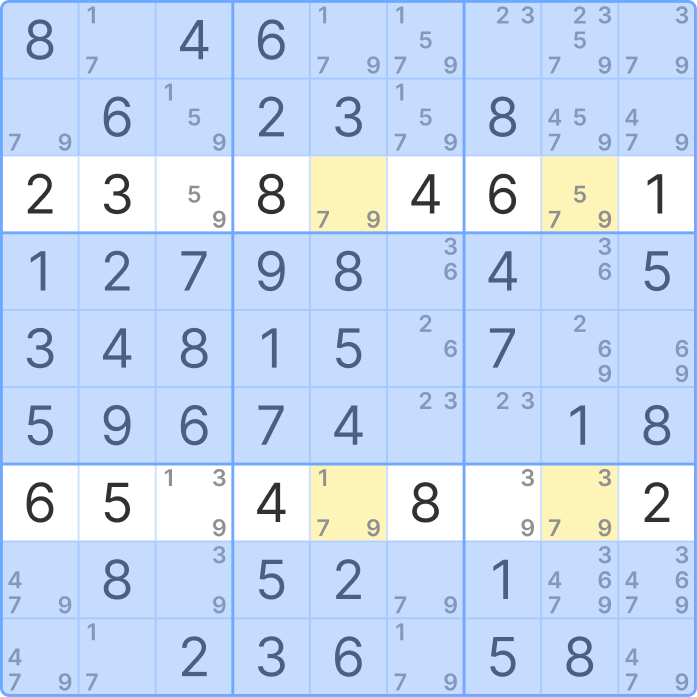
Imagine we have two horizontal rows (let’s say Row 3 and Row 7). When looking at the pencil notes for the number 7, we notice something special: in both of these rows, the 7 appears as a candidate exactly twice, and they happen to line up perfectly in the same two vertical columns (Column 5 and Column 8).
This alignment creates a tight logical trap:
- If the 7 in Row 3 is placed in Column 5… then the 7 in Row 7 must go into Column 8.
- If the 7 in Row 3 is placed in Column 8… then the 7 in Row 7 must go into Column 5.
No matter which scenario is true, the number 7 is guaranteed to occupy two opposite corners of our rectangle.
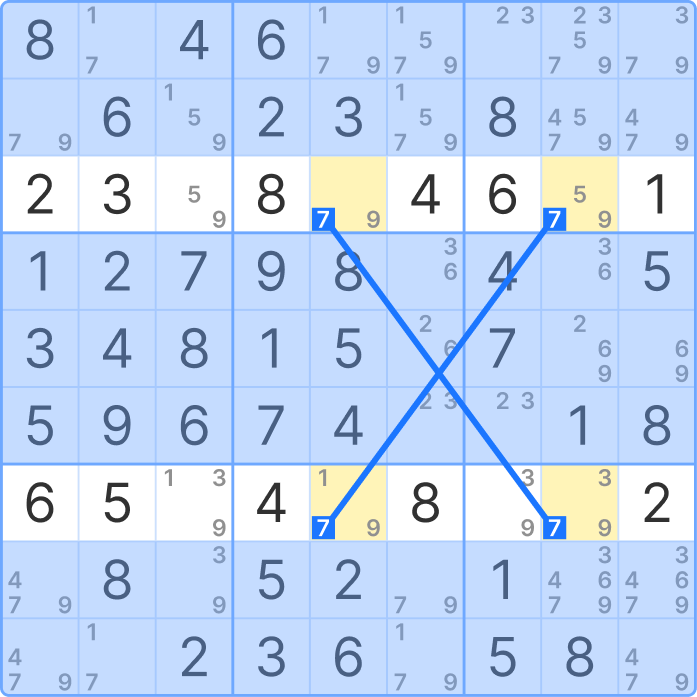
The Power of Elimination (Step-by-Step)
Because these rows are guaranteed to contain 7 in one of the highlighted cells, those two vertical columns are now completely locked by the rectangle’s corners. Therefore, 7 can’t be placed in other cells within the given columns.
To apply this to your game, follow these steps:
- Pick a candidate: Choose a number you want to track (like 7) and look at its distribution across the board.
- Find the Parallel Lines: Look for two rows where that candidate appears exactly twice.
- Check the Alignment: Verify that these four cells form a perfect square or rectangle (sharing the same two columns).
- Clear the Intersecting Lines: Go to those two columns and delete the candidate 7 from the pencil notes of every other empty cell along those lines, ignoring the four corners of your X-Wing.
X-Wing: Rows vs. Columns
This strategy works beautifully in both directions, depending on where the restriction starts:
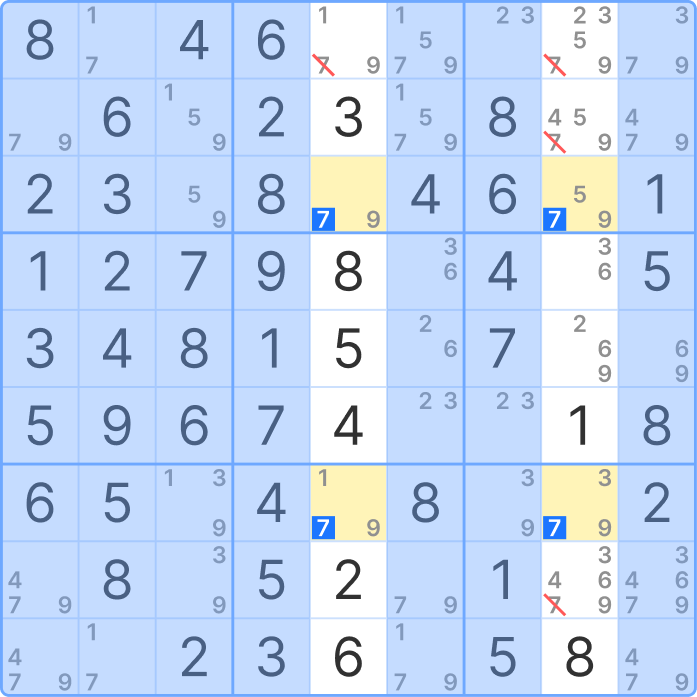
- Row-Based X-Wing: The candidate is restricted to exactly two cells in two rows. You use this pattern to eliminate that candidate from the rest of the intersecting columns (as described in our example).
- Column-Based X-Wing: The candidate appears exactly twice in two columns, aligning perfectly across two rows. In this case, you use the pattern to delete that candidate from the rest of those two rows.
Cracking the Toughest Grids
Spotting an X-Wing takes practice because the four corners are usually separated by empty space and multiple blocks. However, successfully executing an X-Wing is incredibly rewarding: stripping away those hidden candidates along entire columns or rows almost always triggers a domino effect, revealing Naked Singles and solving the puzzle.
Ready to fly the X-Wing? Put your expert logic to the test right now on our Expert Sudoku Puzzles, fill out your candidates, and start hunting for the ultimate rectangle!