How to Use the Claiming Pairs Strategy (Box-Line Reduction)
To solve hard Sudoku puzzles efficiently, you must learn to see the grid from multiple angles. The Claiming Pairs technique (also known as Box-Line Reduction) is a brilliant intermediate strategy.
While the Pointing strategy uses a 3×3 block to clear out a row or column, the Claiming strategy does the exact opposite: it uses a single row or column to eliminate useless pencil notes inside a 3×3 block.
Claiming applies when a candidate appears only in one box within a row or column. When a line claims a number like this, it cleans up the entire neighboring square.
The Logic Behind Claiming Pairs
Every single row and column across the 9×9 Sudoku grid must contain the numbers 1 through 9. As you scan a long line of pencil notes, you will sometimes notice that a specific candidate is heavily restricted.
Take a look at this example.
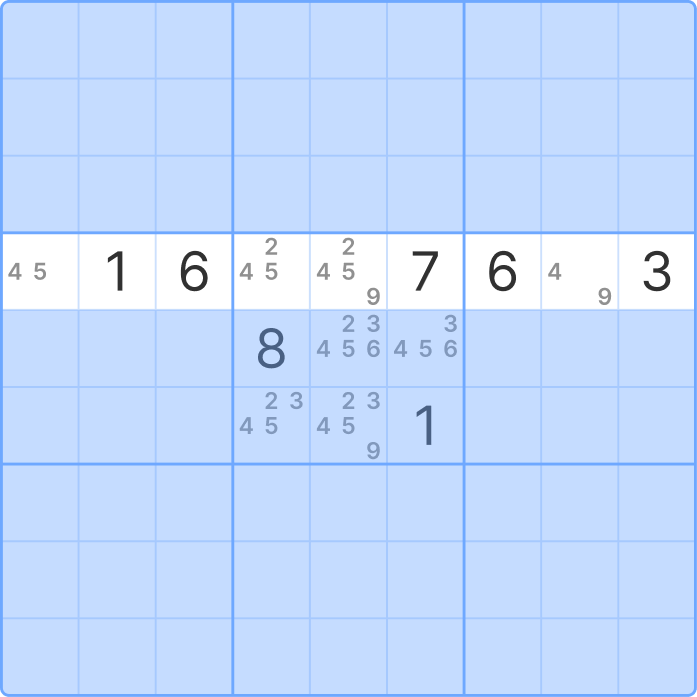
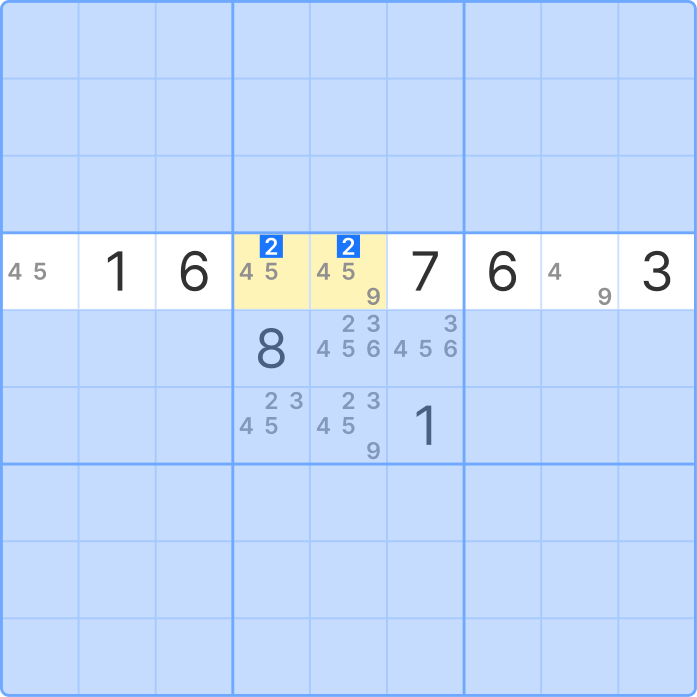
All the remaining options for the number 2 on this line happen to sit inside the same 3×3 block. Because the row must have the number 2 somewhere, and it has no other places left to go, we reach a logical certainty: 2 must definitely be placed in one of these cells.
The Power of Elimination (Step-by-Step)
Once you realize that the row has locked the number 2 into that specific block, you can use this information to clear out the surrounding cells inside that square:
- Scan the line: Look closely down a full row or column and find a candidate (like 2) that only appears within the boundaries of a single 3×3 block.
- Lock the region: Recognize that this row has “claimed” that space for the number 2.
- Clean the rest of the block: This means that 2 can’t appear anywhere in the box outside the row.
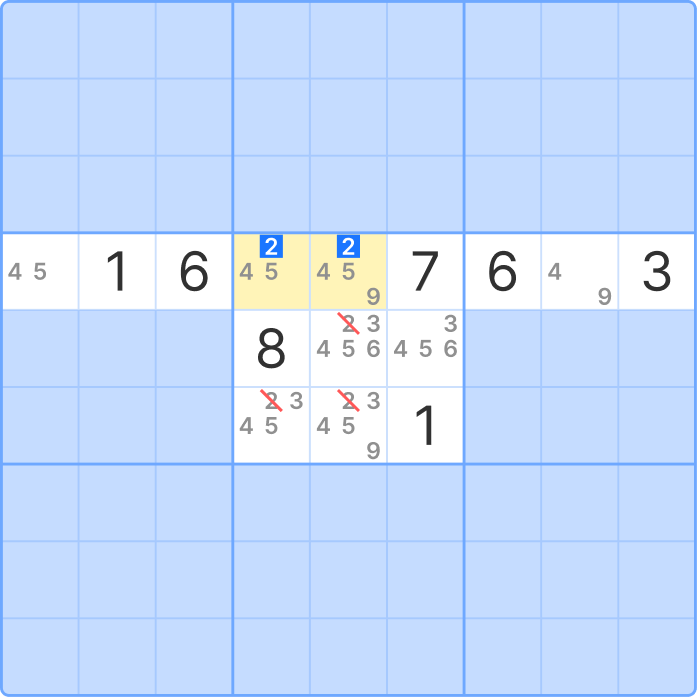
Because the target row is guaranteed to place its 2 inside that block, no other row crossing through that same block can possibly claim a 2. Therefore, you can safely delete the number 2 from the pencil notes of all other empty cells inside that 3×3 block that do not belong to your original row.
Claiming Rows vs. Claiming Columns
This strategy is incredibly versatile and can be spotted in two ways:
- Claiming Rows: As seen in our example, when a horizontal row restricts a candidate to one box, you erase that candidate from the top and bottom cells of that box.
- Claiming Columns: When a vertical column restricts a candidate to just one box, you can instantly delete that number from the left and right cells inside that same box.
Clear the Clutter and Break the Gridlock
Mastering the Claiming Pairs strategy is a major milestone. It trains your brain to notice how global constraints (a whole row) affect local areas (a single box). Cleaning up the extra notes inside the block using this method is often the exact trigger needed to reveal a hidden Naked Single or Naked Pair nearby.
Ready to try it yourself? Put your logic to the test right now on our Hard Sudoku Puzzles, turn on your pencil notes, and start hunting for rows and columns that claim the grid!