The Hidden Symmetry in Sudoku Grids: The 3,359,232 Faces of the Same Puzzle
You’ve probably solved thousands of Sudoku puzzles without realizing something quietly strange: many of them are secretly the same puzzle. Not similar — literally identical, just wearing a disguise. The disguise has a name: symmetry transformations.
The Moves That Change Everything — And Nothing
A valid Sudoku grid remains valid under a surprisingly rich set of rearrangements. None of them break any rule:
- Swap rows within a band — rows 1, 2, and 3 can be shuffled in any order (6 arrangements), and the same applies to rows 4–6 and 7–9
- Swap the bands themselves — the three horizontal strips of three rows can be reordered (another 6 ways)
- Same logic for columns and stacks — identical operations apply vertically
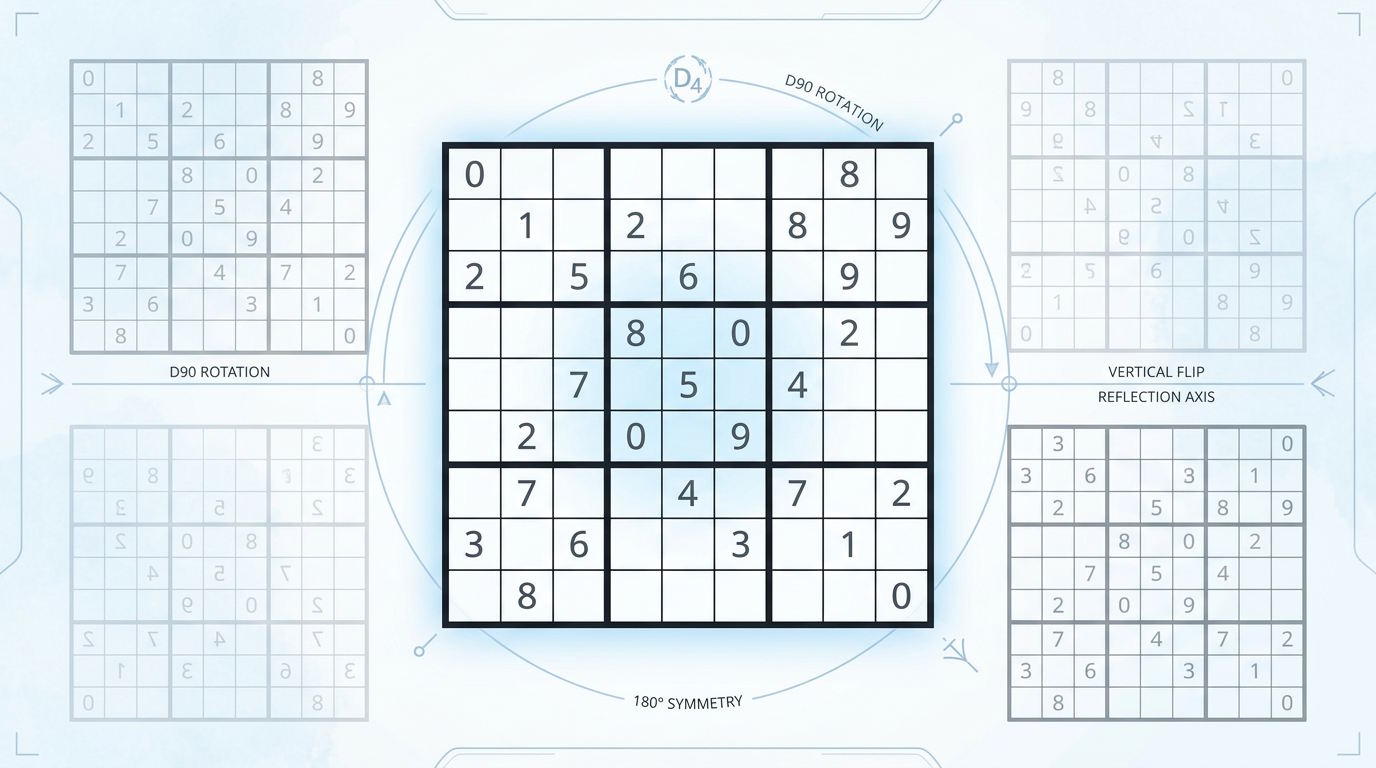
- Rotate or reflect the entire grid — the 8 classical symmetries of a square all preserve validity
- Relabel the digits — replace every 1 with a 7 and every 7 with a 1 throughout: still a perfectly valid, perfectly solved Sudoku
Each of these seems minor in isolation. But multiply them together and the total number of distinct transformations reaches exactly 3,359,232
The Algebra Behind the Number
That number isn’t arbitrary. The transformation group has a precise algebraic structure written as:
Where is the symmetric group on 3 elements (permutations of 3 rows or bands), is the wreath product — a way of layering one group’s action on top of another — and handles the reflection symmetry
If you also count digit relabelling (permuting all 9 symbols), the full symmetry group expands dramatically to 1,218,998,108,160 elements. That means a single Sudoku grid has over one trillion symmetrically equivalent twins scattered across all possible grids.
The Counterintuitive Part: Symmetry Almost Never Survives
Here’s what’s genuinely surprising. With such a rich set of transformations, you might expect many grids to map onto themselves — to be self-symmetric, like a snowflake or a kaleidoscope image. These are called automorphic grids, and mathematically they’re the most structured, most “beautiful” solutions possible.
In practice, they’re almost nonexistent. Only a tiny fraction of all completed grids have any nontrivial automorphism — a transformation that sends the grid back to itself. The vast majority of Sudoku solutions are completely asymmetric: no rotation, no row swap, no digit relabelling will ever reproduce the same grid.
This is a classic example of spontaneous symmetry breaking — the same phenomenon that explains why snowflakes have six-fold symmetry while the water vapour they form from has none, or why the universe has more matter than antimatter. The rules of Sudoku are perfectly symmetric. Almost every outcome of those rules is not.
Three Moves to Generate Everything
Perhaps the most elegant fact about this entire system: the 3,359,232-element group can be generated by just three primitive moves — rotate 90°, swap rows 1 and 2, swap bands 1 and 2. Every other transformation in the group is just a sequence of these three, combined in different ways.
Enormous complexity. Three instructions.
That compression — from millions of transformations down to three generators — is exactly what mathematicians mean when they call a structure beautiful. And it’s sitting quietly underneath every Sudoku puzzle you’ve ever solved.
Leave a Reply