Author: kraisoft admin

  • Introducing Events! Solve Puzzles, Reveal Hidden Pictures

    Introducing Events! Solve Puzzles, Reveal Hidden Pictures

    TheSudoku.com just launched a brand-new feature that turns every puzzle into a piece of something bigger — literally.


    If you’ve ever wished solving sudoku felt more like unwrapping a gift, we have exciting news. TheSudoku.com has officially launched Events — a brand-new feature that adds a whole new dimension of fun, discovery, and reward to your daily puzzle routine.


    What Are TheSudoku.com Events?

    Events are time-limited interactive experiences that activate on TheSudoku.com at specific times throughout the year. Think of them like seasonal puzzle campaigns — holiday specials, themed celebrations, community challenges — each one tied to a beautiful collectible image that you unlock piece by piece.

    Here’s the core idea: every time an Event is active, you can earn pieces of exclusive artwork by solving sudoku puzzles. The more you solve, the more of the picture you reveal. It’s sudoku meets jigsaw puzzle — and it’s incredibly satisfying.


    How Events Work: Step by Step

    1. Wait for an Event to Activate

    Events go live at scheduled times — keep an eye on the Events section of TheSudoku.com so you don’t miss a limited-time run. Each Event has its own theme, artwork, and time window.

    2. Solve Sudoku Puzzles to Unlock Pieces

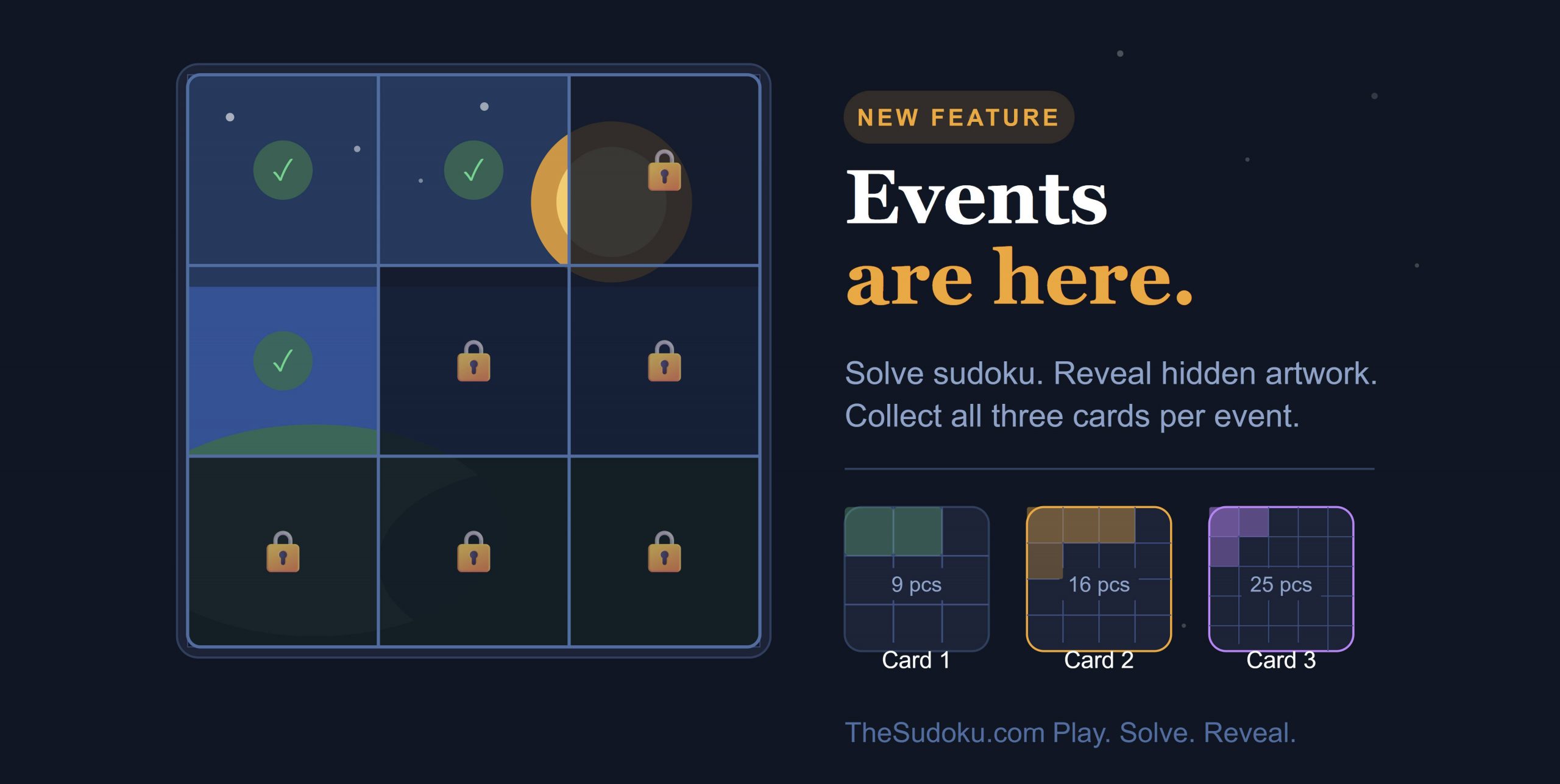
    During an active Event, solving puzzles earns you image fragments. Each fragment reveals a portion of a hidden collectible card. The puzzle difficulty scales with the card complexity — making each unlock feel genuinely earned.

    3. Collect All Three Cards Per Event

    Each Event features three unique collectible cards, and each card has a different level of detail:

    CardPieces to UnlockChallenge Level
    Card 19 piecesBeginner-friendly
    Card 216 piecesIntermediate
    Card 325 piecesAdvanced

    Completing all three cards means you’ve fully experienced the Event — and assembled three stunning pieces of themed artwork.


    Why Events Make Sudoku More Rewarding

    Traditional sudoku is deeply satisfying on its own — the logic, the clarity, the “aha” moment when the grid clicks into place. But Events layer something new on top of that: a visual reward you can see growing with every puzzle you complete.

    This matters for a few reasons:

    • Progress feels tangible. Watching a hidden image emerge piece by piece gives you a clear, visual sense of how far you’ve come.
    • There’s always something to work toward. Whether you have five minutes or an hour, every puzzle moves you closer to completing a card.
    • It adds variety and urgency. Because Events are time-limited, each one feels special — a reason to play today, not just someday.
    • It’s accessible at every skill level. The three-card structure means beginners can celebrate completing Card 1 while seasoned solvers chase the full 25-piece challenge of Card 3.

    Who Are Events For?

    Everyone. Seriously.

    • Casual players who want more motivation to solve daily puzzles will love the gentle progression of Card 1.
    • Regular players who already solve multiple puzzles a day will naturally accumulate pieces across all three cards.
    • Competitive and completionist players who want to collect every card from every Event will have a long-term goal to chase across the entire Events calendar.

    If you’ve ever put down a sudoku app because it started to feel repetitive, Events are exactly the kind of fresh layer that keeps the experience alive.


    Tips for Getting the Most Out of Events

    1. Check the Events section regularly — new Events activate at specific times, so checking in daily ensures you never miss the start of a new one.
    2. Start with Card 1 if you’re new to the feature — the 9-piece card is a perfect introduction to how the reveal mechanic works.
    3. Set a daily puzzle goal during active Events — even solving three or four puzzles per day will steadily build your collection.
    4. Don’t leave Events to the last minute — time-limited means they end, so pace yourself through the full card set rather than rushing at the deadline.

    The Bigger Picture

    At TheSudoku.com, we’ve always believed that sudoku is more than a pastime — it’s a way to sharpen your mind, practice patience, and find calm in structured thinking. Events don’t change that. They celebrate it.

    Every piece you unlock is a small trophy. Every completed card is proof that you showed up, thought clearly, and solved something hard. The image at the end is a bonus — but it’s a beautiful one.


    Try Events on TheSudoku.com Today

    Events are live now on TheSudoku.com. Head to the Events section, check which Event is currently active, and start solving. Your first pieces are waiting.

    Whether you collect all three cards or just enjoy the journey, we think Events will make your sudoku experience richer, more rewarding, and a whole lot more fun.

    Happy solving — and happy collecting.


    Tags: sudoku events, TheSudoku.com, online sudoku, sudoku puzzles, collectible cards, puzzle games, sudoku feature, new sudoku update, free sudoku online

  • Old Classic Sudoku Techniques vs. the Newer Understanding

    Old Classic Sudoku Techniques vs. the Newer Understanding

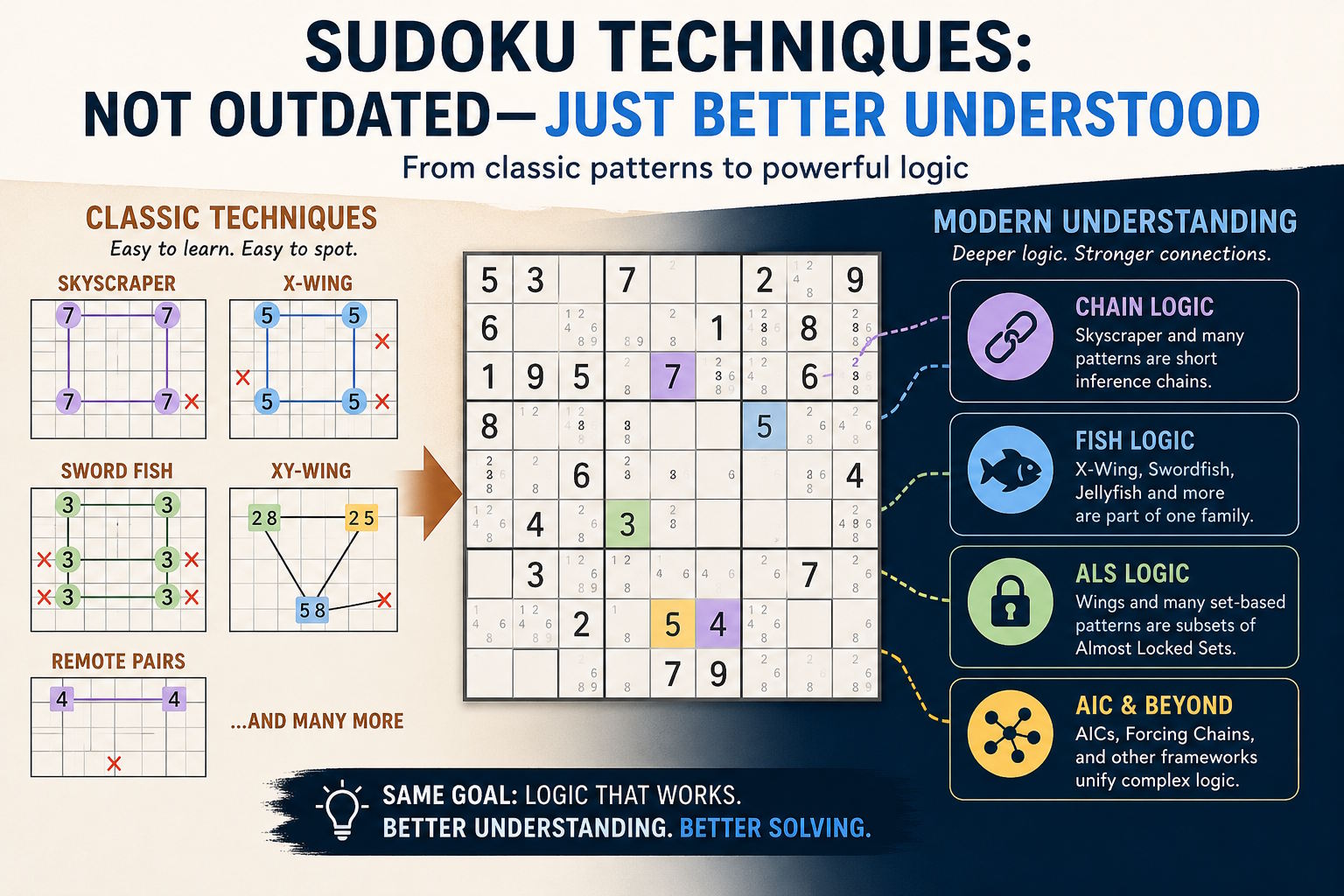
    Are Classic Sudoku Techniques Outdated? Not Exactly — The Way We Understand Them Has Changed. For many Sudoku players, techniques like Skyscraper, X-Wing, Swordfish, XY-Wing, and Remote Pairs feel like a long catalogue of separate tricks. Learn enough of them, and harder puzzles begin to open up.

    But in more advanced Sudoku solving, something interesting has happened: many of these “classic” techniques are no longer treated as isolated patterns. They are increasingly understood as specific examples of broader logical systems, especially chains, fish structures, and Almost Locked Sets.

    That does not mean the old techniques are obsolete. It means they are often better understood as human-friendly names for recurring patterns inside deeper logic.

    The old way: a toolbox of named patterns

    Traditional Sudoku teaching often presents techniques one by one:

    • Naked and hidden singles
    • Locked candidates
    • Naked and hidden pairs/triples
    • X-Wing
    • Swordfish
    • Skyscraper
    • 2-String Kite
    • XY-Wing
    • XYZ-Wing
    • Remote Pairs
    • Simple Coloring

    This approach is still useful because humans are good at recognising visual patterns. A Skyscraper, for example, is easier to teach as a shape than as an abstract chain of strong and weak links.

    HoDoKu, one of the classic human-style Sudoku solving references, still lists Skyscraper, 2-String Kite, Turbot Fish, Empty Rectangle, Wings, Coloring, Chains, and ALS as separate technique families. That reflects how human solvers usually learn and spot them on the grid.

    The newer understanding: many techniques are part of larger families

    Modern advanced solving often asks a different question:

    What is the underlying logic behind this technique?

    When you look under the hood, many named strategies are not independent inventions. They are special cases of broader ideas.

    For example, HoDoKu explains that chains are built from two types of inference: weak links and strong links. A weak link means two candidates cannot both be true; a strong link means they cannot both be false. An Alternating Inference Chain, or AIC, is formed by alternating these link types.

    This is why many older chain-like techniques can be reinterpreted as AICs or simpler chain patterns.

    Andrew Stuart’s SudokuWiki solver makes this overlap explicit: it notes that X-Cycles are a subset of Alternating Inference Chains, and that if X-Cycles are disabled, the same elimination may appear under AICs instead.

    That one sentence captures the whole shift: the old technique did not become wrong; it became part of a more general framework.

    Example: Skyscraper is not dead — it is a simple chain pattern

    A Skyscraper is usually taught as a single-digit pattern involving two rows or columns, each with two possible positions for the same candidate. If the “roofs” see a common candidate, that candidate can be eliminated.

    For a human, “Skyscraper” is a memorable visual pattern.

    For a solver engine, however, it can be represented more generally as a short chain using strong links. It is not necessary to hard-code “Skyscraper” as a completely separate logical universe. The engine can often find the same elimination through chain logic.

    So the practical truth is:

    • For players, Skyscraper is still worth learning.
    • For advanced theory, Skyscraper is a named example of broader single-digit chain logic.
    • For software solvers, it may be cleaner to implement a general chain engine than dozens of separate pattern detectors.

    Example: X-Wing and Swordfish belong to the Fish family

    X-Wing, Swordfish, and Jellyfish are often taught as different techniques. But structurally, they belong to the same family: Fish.

    HoDoKu groups X-Wing, Swordfish, Jellyfish, finned fish, sashimi fish, Franken Fish, Mutant Fish, and Siamese Fish under broader fish categories.

    So again, the “new” understanding is not that X-Wing is obsolete. It is that X-Wing is the 2×2 version of a more general fish idea.

    That matters because once a player understands the general fish principle, Swordfish and Jellyfish stop feeling like unrelated tricks.

    Example: XY-Wing and XYZ-Wing can be seen through ALS logic

    Almost Locked Sets, or ALS, are another important modern framework.

    SudokuWiki defines an Almost Locked Set as a group of N cells containing N+1 candidates. It also notes that ALS logic is strongly related to XYZ-Wings and WXYZ-Wings, which can be treated as subsets of ALS.

    This is a major conceptual shift. Instead of memorising every “wing” as a separate pattern, advanced solvers can understand many of them as small ALS structures.

    Again, this does not make wings useless. It explains why they work.

    So are classic techniques outdated?

    No — not for human solving.

    A better way to say it is:

    Classic techniques are not outdated. They are often simplified, named versions of broader logical ideas.

    For beginners and intermediate players, named techniques are still the best learning path. “Look for a Skyscraper” is much easier than “search the candidate graph for a short alternating inference chain.”

    But for advanced solvers, puzzle setters, and software developers, the deeper frameworks matter more:

    • Fish logic explains X-Wing, Swordfish, Jellyfish, and their variants.
    • Chain logic explains many coloring and single-digit patterns.
    • AIC explains a large class of advanced eliminations.
    • ALS explains many wing-like and set-based techniques.
    • Forcing Chains and Forcing Nets go even further, though they can feel less elegant to many human solvers.

    SudokuWiki also groups strategies by families rather than only by difficulty, including chaining strategies, AIC with groups, AIC with ALSs, AIC with URs, and AIC with exotic links. This reflects the broader trend toward family-based understanding.

    Why this matters for Sudoku apps and hint systems

    For a Sudoku website or app, this distinction is important.

    A good hint system should not simply say:

    “AIC removes 7 from r4c6.”

    That may be technically correct, but it is often not helpful to a normal player.

    A better hint system might detect that the AIC is actually a familiar pattern and explain it as:

    “This is a Skyscraper on 7s. Because these two strong links force one of the roof cells to be 7, any cell that sees both roof cells cannot be 7.”

    In other words, the engine can use general logic internally, while the user interface presents the result in a human-friendly way.

    That is probably the best modern approach:

    • Use broad logic engines underneath.
    • Explain moves using the simplest recognisable technique.
    • Avoid overwhelming players with abstract terminology too early.

    The real evolution: from memorising tricks to understanding logic

    The evolution of Sudoku solving is not that old techniques disappeared. It is that the community has become better at seeing the relationships between them.

    A Skyscraper is still a Skyscraper.
    An X-Wing is still an X-Wing.
    An XY-Wing is still an XY-Wing.

    But now we can also say:

    • Skyscraper belongs to chain-based logic.
    • X-Wing belongs to fish logic.
    • XY-Wing and XYZ-Wing are related to ALS logic.
    • Many “different” eliminations are different faces of the same underlying inference structure.

    That is not the death of classic Sudoku techniques. It is the maturation of Sudoku theory.

    Conclusion

    Classic Sudoku techniques are not obsolete. They remain useful because they are visual, teachable, and practical for human solvers.

    What has changed is the level of abstraction. Advanced Sudoku solving now often treats named techniques as members of larger families: Fish, Chains, AICs, ALS, and forcing structures.

    For players, the best path is still to learn the classic patterns first. For developers and advanced solvers, the next step is to understand the deeper logic behind them.

    The future of Sudoku solving is not about throwing away old techniques. It is about connecting them.

  • Why Large Language Models Still Struggle With games like Sudoku – and Why That Matters

    Why Large Language Models Still Struggle With games like Sudoku – and Why That Matters

    Sudoku is often dismissed as a pastime – a commuter’s distraction or a quiet ritual over morning coffee. But beneath its minimalist design lies something more fundamental, a pure test of reasoning.

    No external knowledge is required. No ambiguity exists. Every valid solution emerges from a strict set of constraints. That makes Sudoku not just a puzzle, but a near-perfect laboratory for studying intelligence – human or artificial.

    And in the age of large language models (LLMs), that laboratory is revealing something uncomfortable.

    A clean test that AI keeps failing

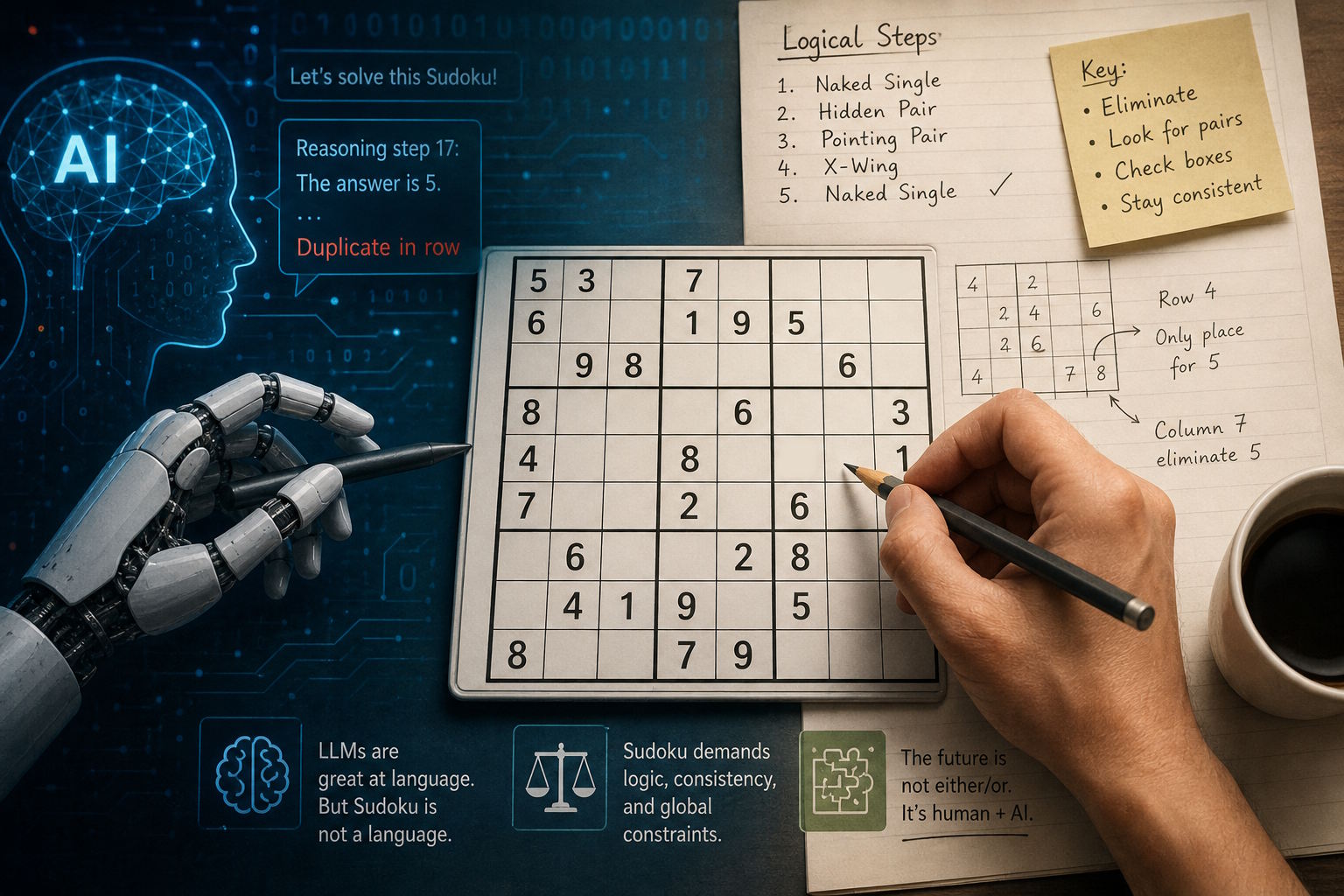
    Modern LLMs, such as ChatGPT and its peers, have demonstrated remarkable fluency. They write essays, generate code, and mimic structured reasoning. But when asked to solve Sudoku, their performance drops sharply.

    For a task that many humans treat as a warm-up exercise, this gap is hard to ignore.

    The real issue: constraint satisfaction vs. language prediction

    The problem is not Sudoku. It is architecture.

    Sudoku belongs to a class of problems known as constraint satisfaction problems (CSPs), where a solution must satisfy a set of global rules simultaneously. This class includes scheduling, planning, and many industrial optimization tasks.

    LLMs, however, operate differently.

    They generate text token by token, predicting what is likely to come next. This works well for language, but poorly for problems where:

    • constraints must be globally consistent
    • earlier decisions may need revision
    • correctness is binary, not probabilistic

    Recent work presented at venues like International Conference on Learning Representations shows that even when transformer-based models are adapted for structured reasoning, they require additional mechanisms—such as recurrence or constraint-aware architectures—to perform reliably (https://openreview.net/forum?id=udNhDCr2KQe).

    In other words, Sudoku exposes a fundamental mismatch:
    LLMs simulate reasoning. They do not enforce it.

    Attempts to fix the gap

    Researchers are actively working to bridge this gap.

    There is also growing interest in alternative architectures—such as energy-based models—that evaluate solutions more holistically rather than sequentially.

    The direction is clear:
    Pure language models are not enough.

    A deeper implication: reasoning is not fluency

    Sudoku highlights a broader issue in modern AI discourse.

    Fluency—the ability to produce coherent text—is often mistaken for reasoning. But the two are fundamentally different.

    Sudoku, by contrast, demands:

    • global consistency
    • step-by-step deduction
    • error correction

    These are exactly the areas where LLMs remain fragile.

    And yet, this is not a failure story

    It would be easy to frame this as a limitation of AI. But that misses the more interesting point.

    LLMs may not be reliable solvers—but they are powerful communicators.

    In practice, this suggests a different role:

    • Not as the engine that solves Sudoku
    • But as the system that explains it

    In hybrid systems, this division is already emerging:

    • Algorithms ensure correctness
    • LLMs provide explanations, hints, and teaching

    For consumer-facing products, that distinction matters.

    Sudoku as a mirror

    Sudoku is not important because of the puzzle itself. It matters because of what it reveals.

    It shows that:

    • Intelligence is not just pattern generation
    • Reasoning requires structure, not just probability
    • Current AI systems excel at communication—but still struggle with consistency

    In a field often driven by hype, that clarity is valuable.

  • Sudoku’s Hidden Symmetry: The 3,359,232 Faces of the Same Puzzle

    Sudoku’s Hidden Symmetry: The 3,359,232 Faces of the Same Puzzle

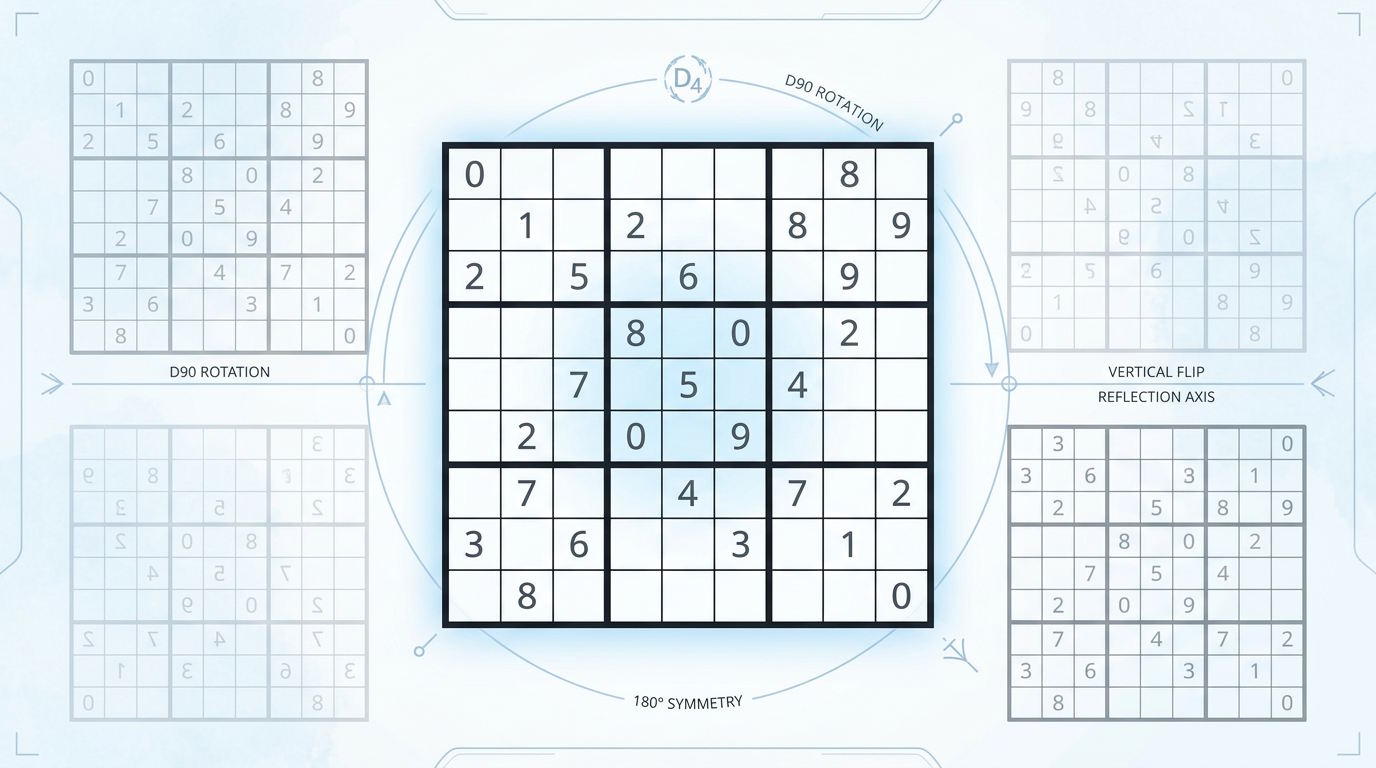
    You’ve probably solved thousands of Sudoku puzzles without realizing something quietly strange: many of them are secretly the same puzzle. Not similar — literally identical, just wearing a disguise. The disguise has a name: symmetry transformations.

    The Moves That Change Everything — And Nothing

    A valid Sudoku grid remains valid under a surprisingly rich set of rearrangements. None of them break any rule:

    • Swap rows within a band — rows 1, 2, and 3 can be shuffled in any order (6 arrangements), and the same applies to rows 4–6 and 7–9
    • Swap the bands themselves — the three horizontal strips of three rows can be reordered (another 6 ways)
    • Same logic for columns and stacks — identical operations apply vertically
    • Rotate or reflect the entire grid — the 8 classical symmetries of a square all preserve validity
    • Relabel the digits — replace every 1 with a 7 and every 7 with a 1 throughout: still a perfectly valid, perfectly solved Sudoku

    Each of these seems minor in isolation. But multiply them together and the total number of distinct transformations reaches exactly 3,359,232

    The Algebra Behind the Number

    That number isn’t arbitrary. The transformation group has a precise algebraic structure written as:

    (S3S3)×C2

    Where S3 is the symmetric group on 3 elements (permutations of 3 rows or bands), is the wreath product — a way of layering one group’s action on top of another — and C2​ handles the reflection symmetry

    If you also count digit relabelling (permuting all 9 symbols), the full symmetry group expands dramatically to 1,218,998,108,160 elements. That means a single Sudoku grid has over one trillion symmetrically equivalent twins scattered across all possible grids.

    The Counterintuitive Part: Symmetry Almost Never Survives

    Here’s what’s genuinely surprising. With such a rich set of transformations, you might expect many grids to map onto themselves — to be self-symmetric, like a snowflake or a kaleidoscope image. These are called automorphic grids, and mathematically they’re the most structured, most “beautiful” solutions possible.

    In practice, they’re almost nonexistent. Only a tiny fraction of all completed grids have any nontrivial automorphism — a transformation that sends the grid back to itself. The vast majority of Sudoku solutions are completely asymmetric: no rotation, no row swap, no digit relabelling will ever reproduce the same grid.

    This is a classic example of spontaneous symmetry breaking — the same phenomenon that explains why snowflakes have six-fold symmetry while the water vapour they form from has none, or why the universe has more matter than antimatter. The rules of Sudoku are perfectly symmetric. Almost every outcome of those rules is not.

    Three Moves to Generate Everything

    Perhaps the most elegant fact about this entire system: the 3,359,232-element group can be generated by just three primitive moves — rotate 90°, swap rows 1 and 2, swap bands 1 and 2. Every other transformation in the group is just a sequence of these three, combined in different ways.

    Enormous complexity. Three instructions.

    That compression — from millions of transformations down to three generators — is exactly what mathematicians mean when they call a structure beautiful. And it’s sitting quietly underneath every Sudoku puzzle you’ve ever solved.

  • Sudoku for Beginners: Pointing

    Sudoku for Beginners: Pointing

    So you’ve mastered the basics of Sudoku – you can spot naked singles and fill in obvious numbers. But now you’re stuck. The puzzle seems impossible, with no clear moves. This is where your first real Sudoku technique comes in: Pointing.

    Pointing is the gateway technique that transforms you from a beginner into an intermediate solver. It’s the first “aha!” moment where you realize Sudoku isn’t just about filling boxes – it’s about understanding how numbers interact across different regions.

    What is Pointing?

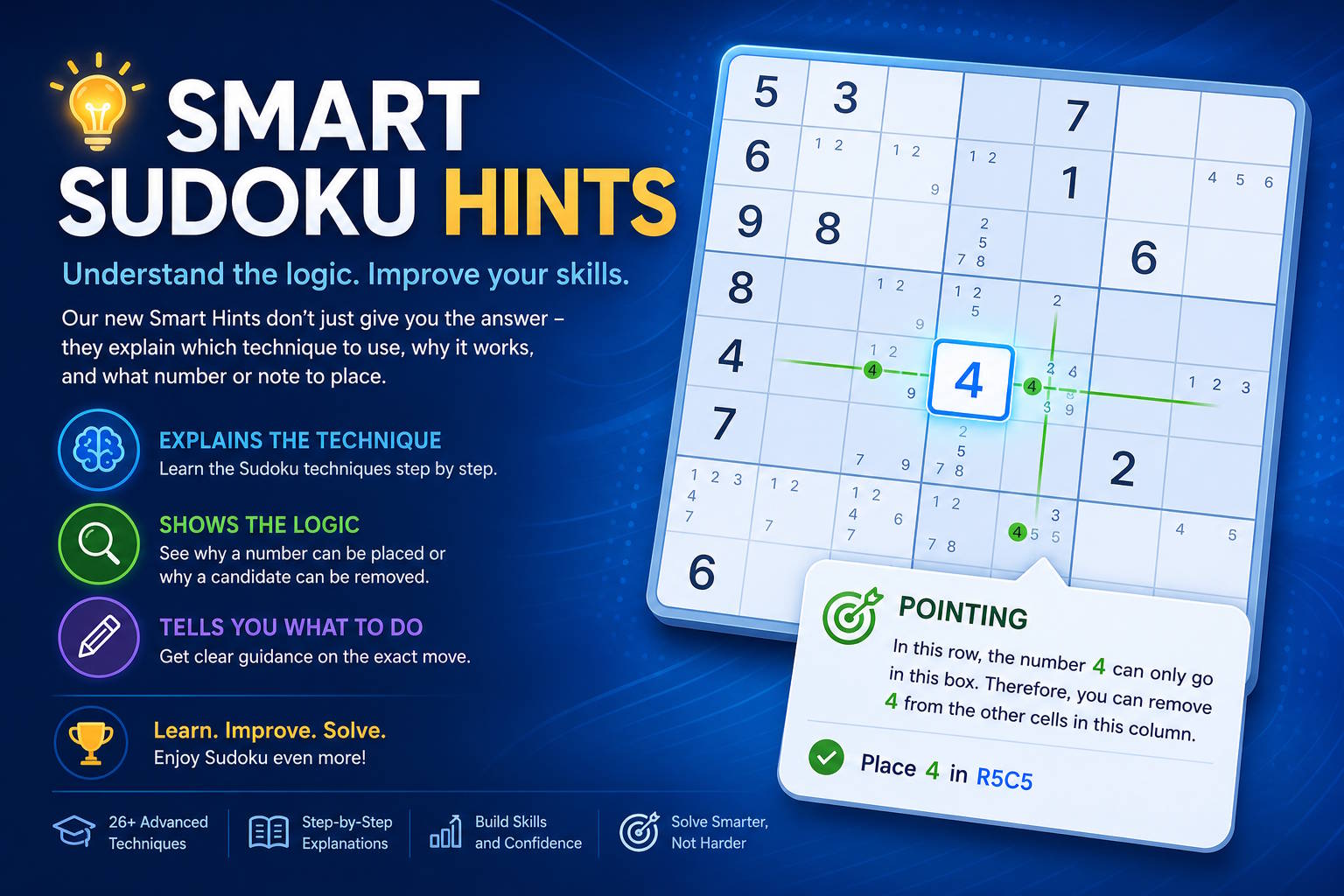
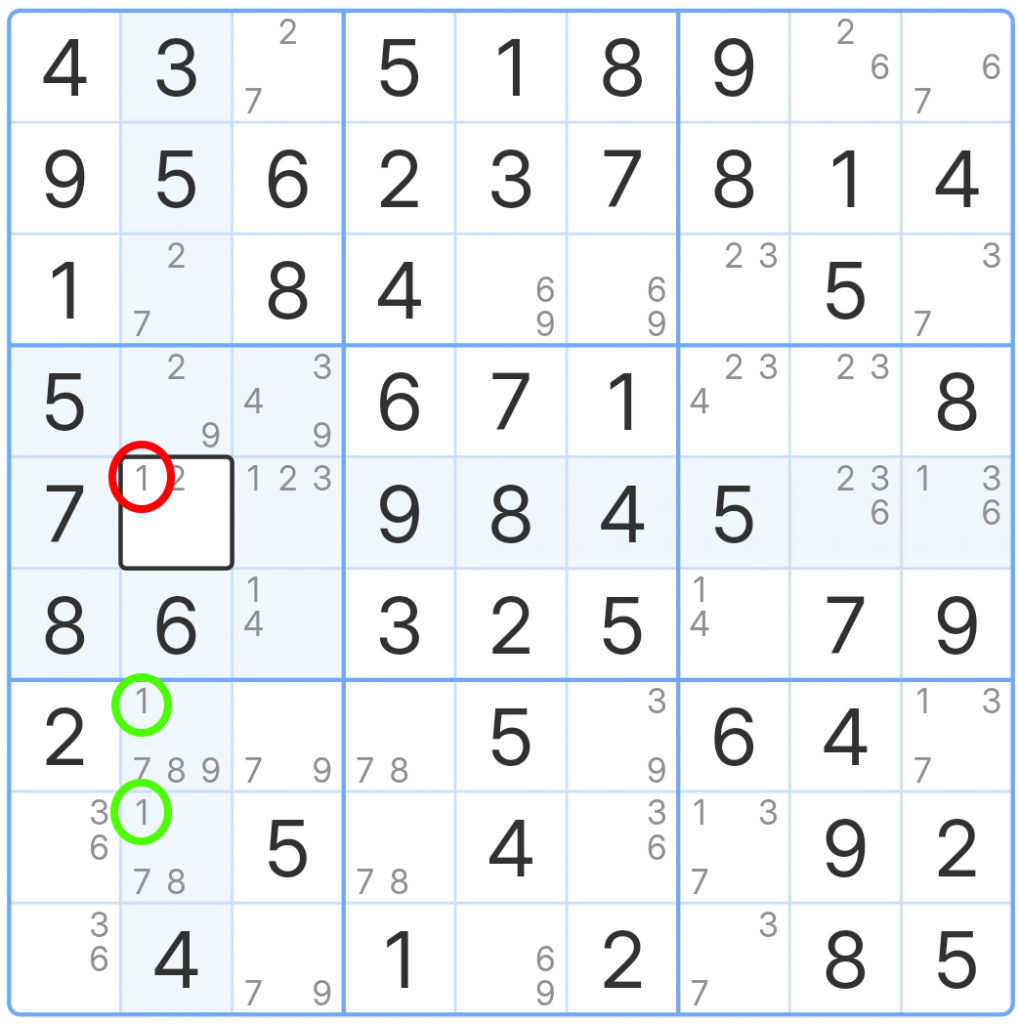
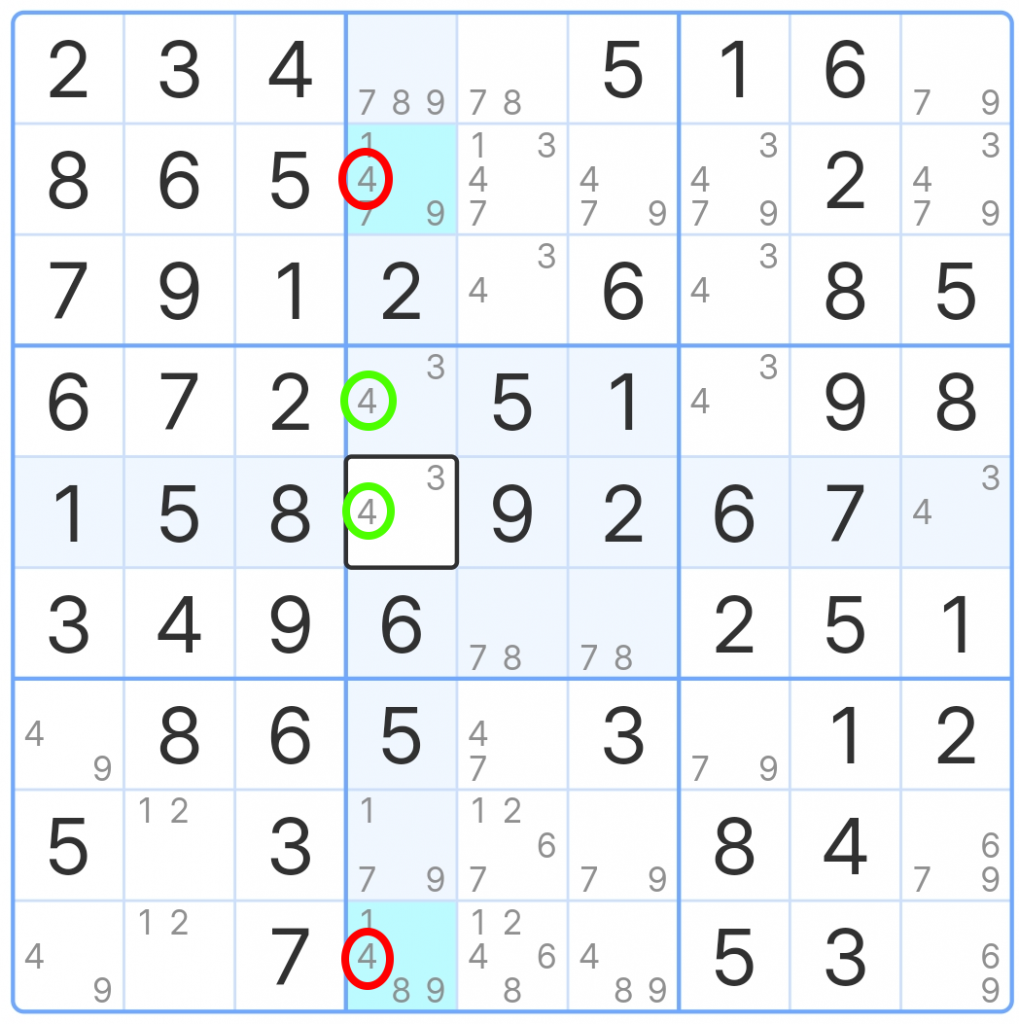
    Pointing (also called “box-line reduction”) happens when a candidate number in a box is restricted to a single row or column. When this happens, you can eliminate that candidate from the rest of that row or column outside the box.

    Think of it like this: if a number can only live in one specific hallway of a building (the box), it can’t also live in other parts of that same street (the row or column).

    How Pointing Works

    Sudoku has three types of regions that must each contain the digits 1-9:

    • Nine 3×3 boxes
    • Nine rows (horizontal lines)
    • Nine columns (vertical lines)

    Pointing exploits the overlap between these regions. When candidates in a box are confined to a single line, that line “claims” those candidates, preventing them from appearing elsewhere on that line.

    A Simple Example

    Imagine you’re looking at central box, and the number 4 can only appear in two cells – both in the same column. Here’s what you know:

    1. One of those two cells must contain a 4 (because the box needs a 4)
    2. Both cells are in the same column
    3. Therefore, column’s 4 must be in this box
    4. This means you can eliminate 4 as a candidate from all other cells in the column

    That’s Pointing! The 4 is “pointing” along the column, claiming it for that box.

    Why Pointing is Powerful

    Pointing is your first technique that uses logical inference rather than direct observation. You’re not just seeing an obvious answer – you’re deducing where numbers can’t be based on structural constraints.

    This technique often creates a chain reaction. One Pointing elimination might expose a naked single, which fills a cell, which creates another Pointing opportunity. This cascading effect is what makes advanced Sudoku solving so satisfying.

    Common Mistakes to Avoid

    Mistake 1: Forgetting to check the whole line
    When you find Pointing candidates, make sure to eliminate from the ENTIRE row or column, not just the adjacent box.

    Mistake 2: Confusing box and line boundaries
    Only eliminate outside the box. The candidates inside the box that are pointing must stay (one of them is the answer!).

    Mistake 3: Not checking all nine boxes
    Pointing can happen in any box with any number. Check systematically: Box 1 for 1-9, Box 2 for 1-9, and so on.

    Moving Forward

    Once you’re comfortable with Pointing, you’re ready for its mirror technique called “Claiming” (or box-line reduction in reverse), and then harder techniques like “Hidden Pairs” or “Hidden Triples.”

    But master Pointing first. It’s the foundation of logical Sudoku solving, and it will appear in virtually every medium and hard puzzle you solve.

  • The Secret History of Sudoku: From 18th Century Swiss Math to Global Phenomenon

    The Secret History of Sudoku: From 18th Century Swiss Math to Global Phenomenon

    When you open your morning Sudoku grid, it feels like you are tapping into ancient Eastern wisdom. The name, the Zen-like logic, the minimalist design—everything points to Japan.

    But the truth is far more interesting. Sudoku is a “child of the world.” It has Swiss DNA, an American upbringing, a Japanese name, and—crucially—a New Zealand “godfather” who turned a niche puzzle into a global sensation.

    Here is the true story of how a simple grid of numbers conquered the planet.

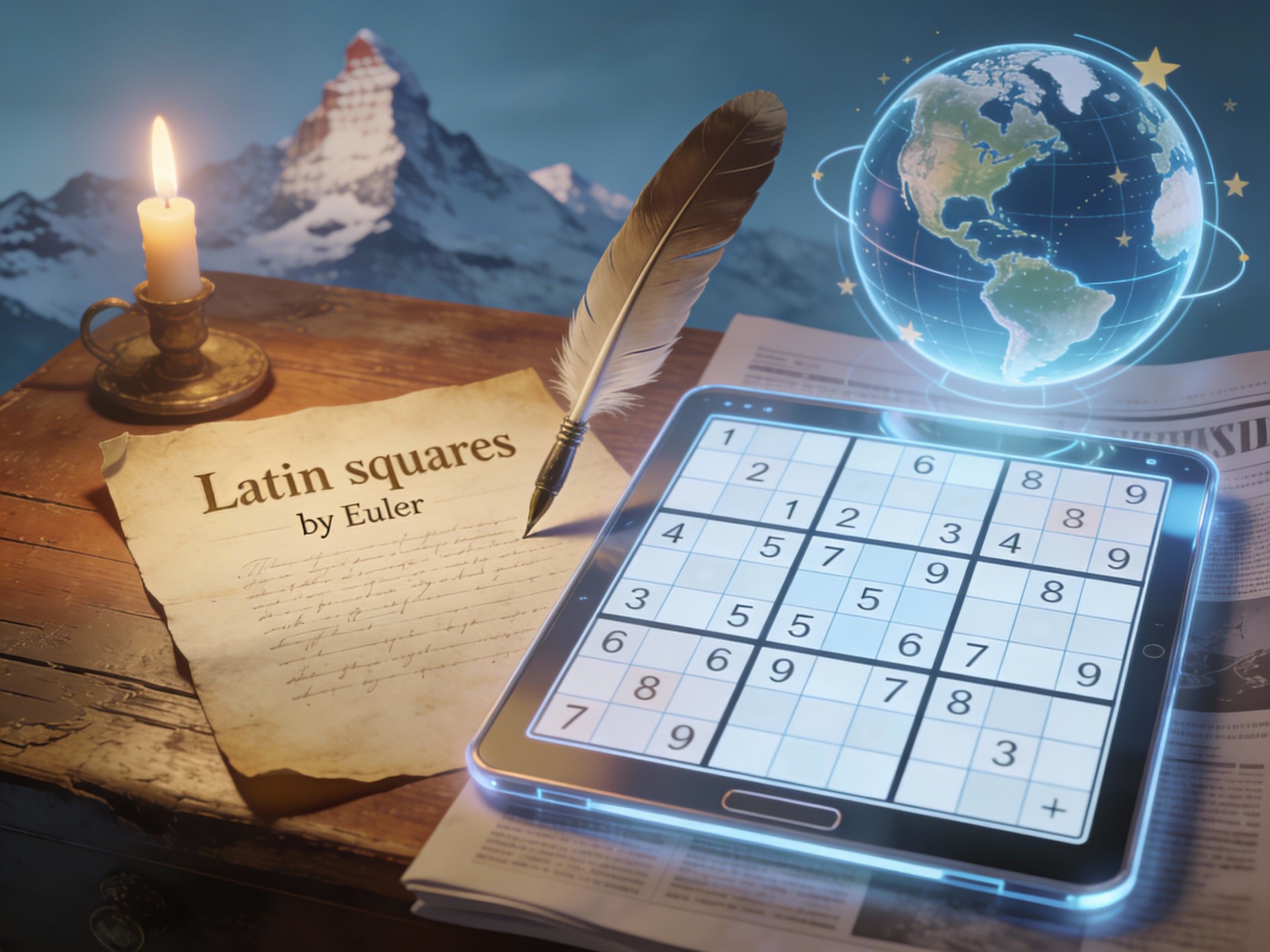
    1783: Grandfather Euler and Latin Squares

    The story begins not in Tokyo, but in St. Petersburg and Berlin with the legendary Swiss mathematician Leonhard Euler. In 1783, he explored a concept he called “Latin Squares”.

    The idea was simple: arrange symbols in a grid so they do not repeat in any row or column. This was the foundation. However, Euler’s version lacked the modern Sudoku’s defining feature – the 3×3 blocks. Without them, it was pure mathematics rather than an addictive puzzle. Euler laid the logical groundwork, but the world had to wait two centuries for the game to evolve .

    1979: The Architect Who Built “Number Place”

    Fast forward to Indiana, USA, in the late 1970s. Howard Garns, a 74-year-old retired architect, loved creating puzzles. He took Euler’s concept and added a brilliant constraint: dividing the grid into nine 3×3 sub-grids. This changed everything -now the player had to scan the board not just linearly, but spatially.

    In May 1979, Dell Pencil Puzzles and Word Games published Garns’ creation under the name “Number Place.” It became popular among American logic fans but remained a niche hobby. Sadly, Garns passed away in 1989, never knowing that his invention would eventually become the most popular puzzle in the world.

    1984: The Japanese Rebrand

    In the early 80s, a copy of the Dell magazine fell into the hands of Maki Kaji, the president of the Japanese puzzle publisher Nikoli. He loved the logic of “Number Place,” but the name felt too dry for the Japanese market.

    Kaji-san gave the game a new identity, shortening the phrase “Sūji wa dokushin ni kagiru” (the digits must remain single) to the snappy Sudoku (Su = number, Doku = single).

    Japan didn’t just rename the game; they refined it. Nikoli introduced symmetry rules (starting numbers must form a pattern) and limited the clues to ensure the puzzle required logic rather than guessing. Sudoku became a hit in Japan, but the West largely forgot about it.

    2004: The Programmer Who “Infected” the World

    This is where Wayne Gould enters history—a retired Hong Kong judge and, notably, a New Zealander.

    In 1997, while visiting a bookstore in Tokyo, Gould found a book of Sudoku. He didn’t just solve them; as a technology enthusiast, he wanted to automate them. He spent six years writing a computer program (using C++) that could generate infinite unique puzzles of varying difficulty.

    In November 2004, Gould walked into the offices of The Times in London. He had no marketing budget, but he had an algorithm. He told the editor, “I will give you these puzzles for free, just print them.”

    The Times took the risk. The effect was instant. Within three days, readers were calling the newsroom demanding more puzzles. Other papers like The Daily Mail and The Guardian realized they were losing readers and scrambled to print their own grids.

    Thanks to code written by a Kiwi, a game invented in the US, based on Swiss math, and named in Japan, became the definitive morning ritual of the 21st century.

  • How to Get Better at Sudoku

    How to Get Better at Sudoku

    You have mastered the basics. You can clear the “Easy” levels, and “Medium” puzzles are becoming a comfortable routine. But then you hit a wall. You stare at a “Hard” or “Expert” grid, and the numbers just stop flowing. You might be tempted to guess, but deep down, you know that’s not how the pros do it.

    Professional Sudoku solving isn’t about being a math genius; it’s about seeing the invisible patterns that others miss. If you are ready to leave the guesswork behind and start solving like a master, here is your roadmap to the next level.

    1. Stop “Eyeballing” and Start Noting (The Right Way)

    Beginners often try to solve the entire puzzle in their heads, afraid that using pencil marks (notes) is “cheating.” Pros know that notes are essential—but only if used correctly.

    The biggest mistake is filling every empty cell with every possible number. This creates “visual noise” that hides the solution. Instead, use Snyder Notation. This technique, favored by speed solvers, involves noting candidates in a 3×3 box only if there are exactly two possible spots for that number.

    • Why it works: If you mark that a ‘5’ can only go in two cells in a box, and later you solve one of those cells as a ‘9’, you immediately know the other cell must be the ‘5’. It turns chaos into a checklist.

    2. Master the “Pointing Pairs

    Once you are using proper notes, you will start seeing ghosts—numbers that aren’t there yet but influence the rest of the grid. This is often called “Pointing Pairs” or Locked Candidates.

    Imagine a 3×3 box where the number ‘4’ can only appear in the top row of that specific box. Even though you don’t know which of those cells is the ‘4’ yet, you know for a fact that the ‘4’ for that entire row across the whole puzzle must be inside that box.

    • The Pro Move: You can safely eliminate any ‘4’ candidates from the rest of that row outside the box. This subtle elimination often breaks a puzzle wide open when you are stuck.

    3. Spotting the “Naked Pairs

    This is the bread and butter of intermediate-to-pro play. If you find two cells in the same row, column, or box that contain only the same two candidates (e.g., both cells contain only 2 and 7), you have found a Naked Pair.

    • The Logic: Since these two cells must be 2 and 7 (in some order), no other cell in that same group can be a 2 or a 7.
    • The Result: You can erase 2 and 7 from all other pencil marks in that row/column/box. It sounds simple, but in a cluttered grid, spotting a Naked Pair is like finding a key in a haystack.

    4. The Gateway to Advanced Logic: The X-Wing

    When you are ready to truly look like a wizard, learn the X-Wing. This pattern occurs when a specific number (candidate) appears exactly twice in two different rows (or columns), and they align perfectly to form a rectangle.

    • How to spot it: Look for a candidate (say, ‘6’) that appears only in columns 3 and 7 of Row 2, and again only in columns 3 and 7 of Row 6.
    • The Elimination: Because of this alignment, you know the ‘6’ must be in one of two diagonal corners of this “X”. Therefore, you can eliminate the ‘6’ from every other cell in those two vertical columns (3 and 7).

    5. The Golden Rule: Logic Over Speed

    The final mark of a pro is patience. Beginners rush and make guesses that lead to dead ends. Pros know that every Sudoku puzzle has a purely logical path to the solution. If you are stuck, don’t guess. Instead, cycle through your techniques:​​

    1. Scan for hidden singles.
    2. Update your Snyder notes.
    3. Look for pairs and triples.
    4. Hunt for X-Wings.

    Sudoku is a game of momentum. By trusting the logic, you transform the grid from a wall of numbers into a satisfying cascade of solutions. Ready to test your new skills?


  • Mastering the X-Wing Technique

    Mastering the X-Wing Technique

    Have you ever reached a point in a Sudoku puzzle where you have filled in all the easy numbers, scanned every row and box, and hit a complete wall? You know the solution is there, but basic logic just isn’t working anymore.

    Welcome to the world of intermediate Sudoku strategies. Today, we are breaking down the X-Wing.

    The X-Wing is one of the most popular pattern-based techniques. It allows you to eliminate candidates that you couldn’t otherwise remove, often cracking the puzzle wide open.

    The Concept

    The X-Wing is based on a “locked candidates” theory. It occurs when you look at a specific number (let’s say, the number 5) and find that:

    1. In exactly two rows, the number 5 appears as a candidate in the same two columns.
    2. (Or vice versa: In exactly two columns, the number appears in the same two rows).

    When you spot this rectangle pattern, you form an “X”. Because of the logic of the grid, you can eliminate that candidate from the rest of the columns (or rows) involved.

    The Logic: Why It Works

    Let’s look at a practical example. Imagine we are hunting for the candidate 7.

    We scan the rows and find a pattern in Row 3 and Row 7.

    • In Row 3, the candidate 7 can only go in Column 2 or Column 6.
    • In Row 7, the candidate 7 can also only go in Column 2 or Column 6.

    This creates a rectangle. Here is the logic:

    • If R3C2 is a 7, then R3C6 cannot be.
    • If R3C6 is a 7, then R3C2 cannot be.

    In either scenario, one 7 will be in Column 2, and one 7 will be in Column 6. Therefore, no other cell in Column 2 or Column 6 can contain a 7.

    How to Spot an X-Wing

    Spotting an X-Wing takes practice because our eyes are trained to look at 3×3 boxes, not long-distance relationships between rows. Here is the best way to practice:

    1. Use Pencil Marks: This strategy is nearly impossible without full candidate notation.
    2. Focus on One Number: Don’t look for “any” X-Wing. Cycle through numbers 1-9. Ask yourself: “Where can the 4 go in this row?”
    3. Look for Pairs: Scan horizontal rows first. If a number only appears twice in a row, highlight those two spots. Then, scan down to see if another row has the exact same two spots for that number.

    Conclusion

    The X-Wing is a powerful tool in your Sudoku arsenal. It transitions you from guessing to true logical deduction. Next time you are stuck on a hard puzzle, stop looking at the boxes and start looking for the rectangles!

    Happy solving!