Skyscraper Sudoku Technique
The Skyscraper Sudoku technique is an advanced candidate-elimination pattern that helps when basic scanning is no longer enough. It uses two strong links for the same digit and gets its name from the four candidate cells, which form a shape like a skyscraper. Once you recognise it, one safe elimination can unlock the next step in a difficult puzzle.
What Is a Skyscraper in Sudoku?
A Skyscraper uses four candidates for one digit in two rows or two columns. Each selected row or column must contain exactly two possible positions for that digit. One candidate from each unit is aligned in the same column or row, while the other two candidates are not aligned. These two unaligned cells are called the roof cells.
The pattern can be rotated or mirrored. The logic does not change: at least one roof cell must contain the digit, so any candidate that sees both roof cells can be removed.
How to Spot a Skyscraper
- Choose one digit and scan the grid for rows or columns with exactly two candidates.
- Find a second row or column with the same property.
- Check that one candidate from each unit is aligned.
- Use the two remaining candidates as the roof cells.
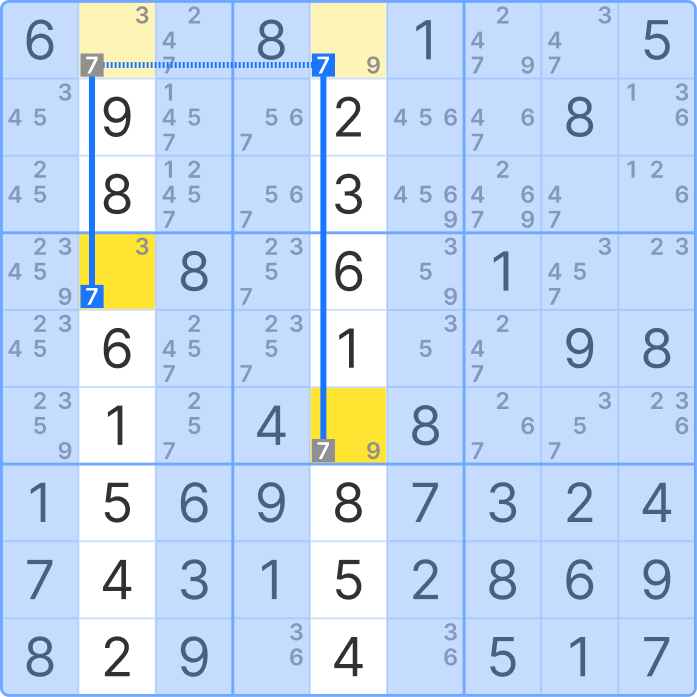
In the first diagram, the candidates for 7 create a row-based Skyscraper. The aligned candidates form one side of the pattern, while the two unaligned 7s form the roof.

Why the Skyscraper Elimination Works
One roof cell must be the digit. If the first roof cell is not 7, the strong link in its row forces the aligned candidate to be 7. That forces the second roof cell to be 7. Therefore, whether the first roof cell is 7 or not, at least one of the two roof cells contains 7.
The second diagram highlights this chain. A cell that can see both roof cells cannot also contain 7, because it would conflict with the roof cell that is necessarily 7.
How to Use the Skyscraper Technique
- Confirm that both selected units contain exactly two candidates for the same digit.
- Identify the two roof cells.
- Find every cell that sees both roof cells through a shared row, column, or box.
- Eliminate that digit from those shared peers.
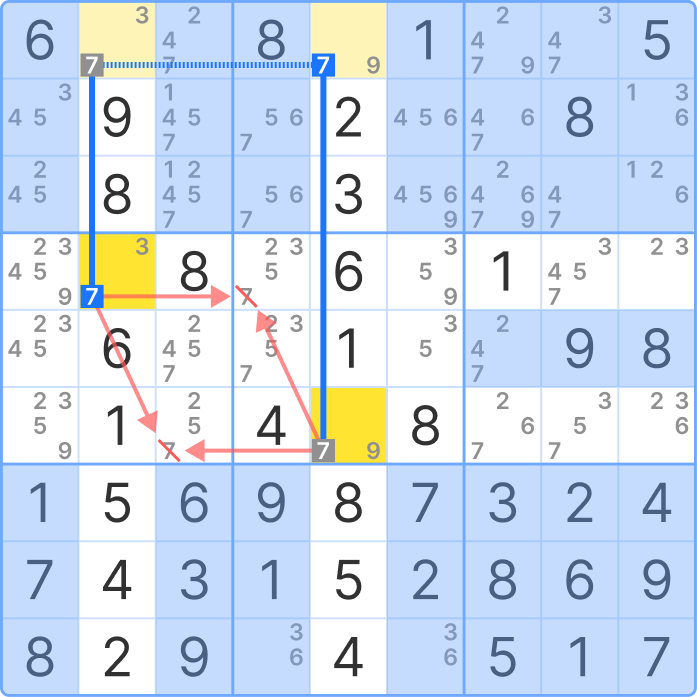
In the final diagram, the shared peers of the roof cells cannot contain 7 and can be eliminated. Those removals may reveal a single or lead to another useful Sudoku technique.
Common Skyscraper Mistakes
Do not treat every group of four candidates as a Skyscraper. The two selected rows or columns must each provide a strong link: exactly two positions for the digit. Also, remove a candidate only when it sees both roof cells. Seeing just one roof cell is not enough.
When Should You Look for a Skyscraper?
Look for a Skyscraper after simpler candidate eliminations, pairs, and basic line interactions stop producing progress. It is particularly useful in harder Sudoku puzzles because it combines a short logical chain with precise eliminations. With practice, the Skyscraper becomes a fast and reliable pattern to add to your solving toolkit.
Skyscraper Sudoku FAQ
Can a Skyscraper be based on rows or columns?
Yes. A row-based Skyscraper uses two rows with strong links, while a column-based Skyscraper uses two columns. Both follow the same elimination rule.
Which cells can be eliminated?
Only cells containing the target digit that see both roof cells can be eliminated.