How to Master the X-Cycle (Loop) Strategy in Sudoku
When isolated patterns like X-Wing or 2-String Kite aren’t enough to solve an Expert or Master grid, it is time to connect multiple links across the entire board. The X-Cycle strategy (often called a Continuous Loop) is a powerful single-digit chaining technique that tracks a single candidate through an unbroken ring of logic.
The Core Building Blocks: Strong vs. Weak Links
In this strategy, we build loops by alternately chaining weak links and strong links for a single candidate across rows, columns, and 3×3 blocks.

1. Strong Link ( Conjugate Pair )
- A strong link means that if a candidate is OFF in the first cell, it must be ON in the second cell, and vice versa.
- This occurs when a candidate appears exactly twice in a unit (row, column, or block). One of them must be true.
2. Weak Link
- Weak links are less certain: if a candidate is ON in one cell, the other must be OFF. However, if it is OFF in the first cell, the second cell could still be ON or OFF (because there are three or more instances of that candidate in the unit).
- Note: Every Strong Link can also act as a Weak Link, but a Weak Link cannot act as a Strong Link.
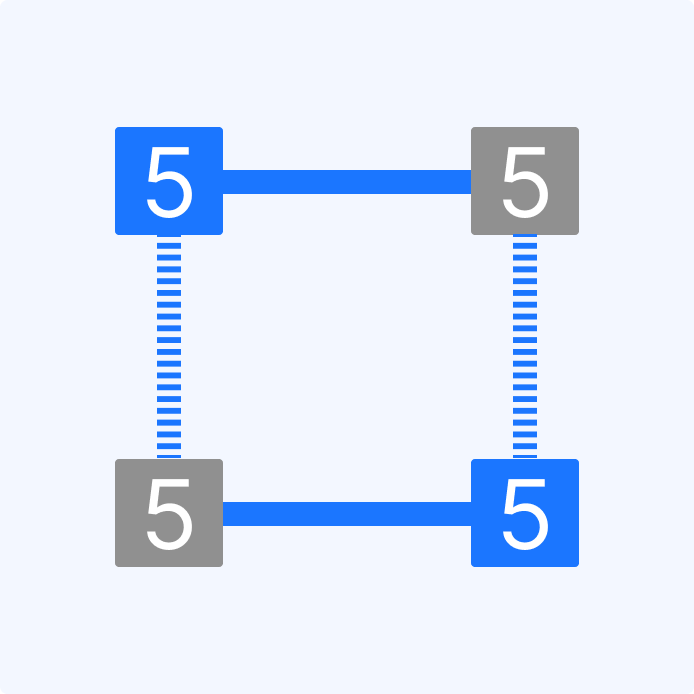
Anatomy of a Continuous Loop
Consider these cells. This chain forms a continuous loop of candidate 5.
A Continuous Loop is formed when you alternate Strong and Weak links in a closed circuit (Strong → Weak → Strong → Weak) that comes back to where it started.
Because the loop is closed and perfectly alternating, it creates a powerful logical state: the loop becomes a self-reinforcing system. Every Weak Link in a continuous loop effectively acts as a Strong Link!
The Power of the Loop (Example)
Consider these cells. This chain forms a continuous loop of candidate 5.
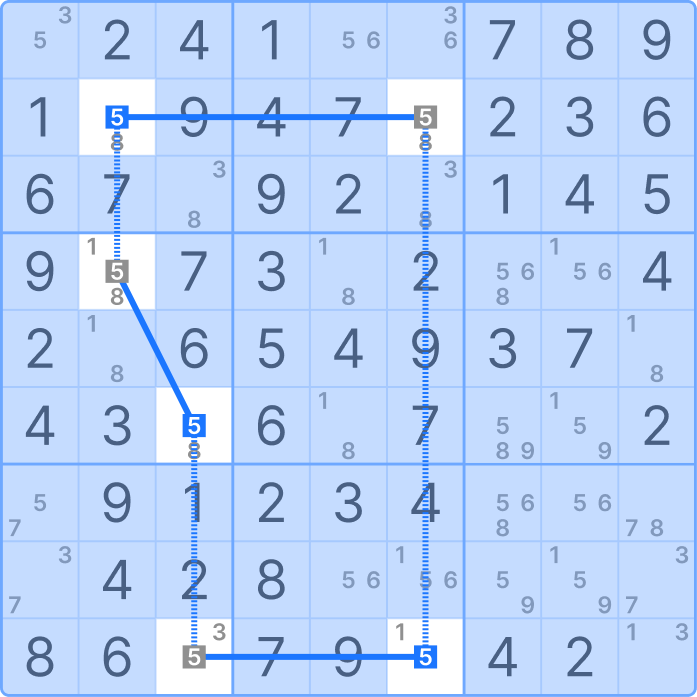
Because the chain closes in on itself by strictly alternating between strong and weak links, it locks the entire pattern into a fixed logical state:
At each end of any link, there must be a candidate 5 in one of the two cells.
The Elimination Rule
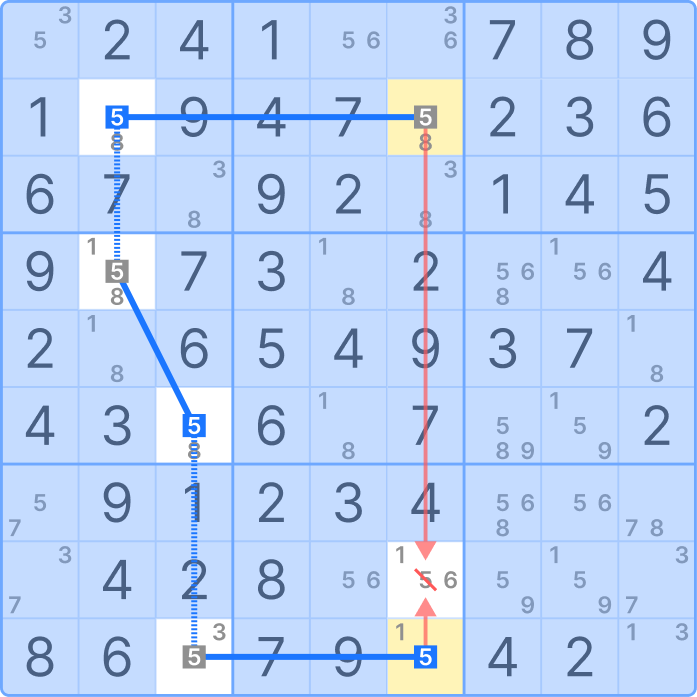
Since the two cells at the ends of a link guarantee that candidate 5 must land in one of them, any cell outside the chain that shares a unit with both ends is completely blocked.
This allows us to safely eliminate 5 from any cell that can see both of these cells at the same time.
Why X-Cycles are So Effective
Mastering the Loop strategy allows you to stop looking for simple geometric shapes and start seeing the grid as a dynamic network. Once you identify a continuous loop, you can sweep away multiple locked notes in a single move, instantly triggering a chain reaction of Naked Singles.
Ready to build your first loop? Put your logic to the test on our Master Sudoku Puzzles, activate full pencil notes, and start chaining your links!