Nishio
Nishio follows the same basic idea as a forcing chain, but instead of tracing a single uninterrupted thread, it temporarily explores the consequences of a full candidate assumption. One candidate is chosen and treated as if it were placed. From that assumption, the grid is solved forward using only ordinary Sudoku logic – naked singles, hidden singles, and any other direct deductions that become available.
Unlike a forcing chain, the working grid is not frozen. Candidates are removed, cells are filled, and each new deduction can create further deductions. The reasoning therefore branches naturally through the evolving state of the puzzle rather than along one predetermined chain.
Contradiction
Assume a candidate is placed and follow the resulting deductions. If the assumption eventually creates an impossible situation – for example:
- a cell is left with no candidates;
- a row, column, or box has no place for a digit;
- the same digit is forced twice into a house;
then the original assumption must be false, and the candidate can be eliminated.r the cell’s second candidate the opposite color (this is what lets the chain cross from one digit to another);
Confirmation
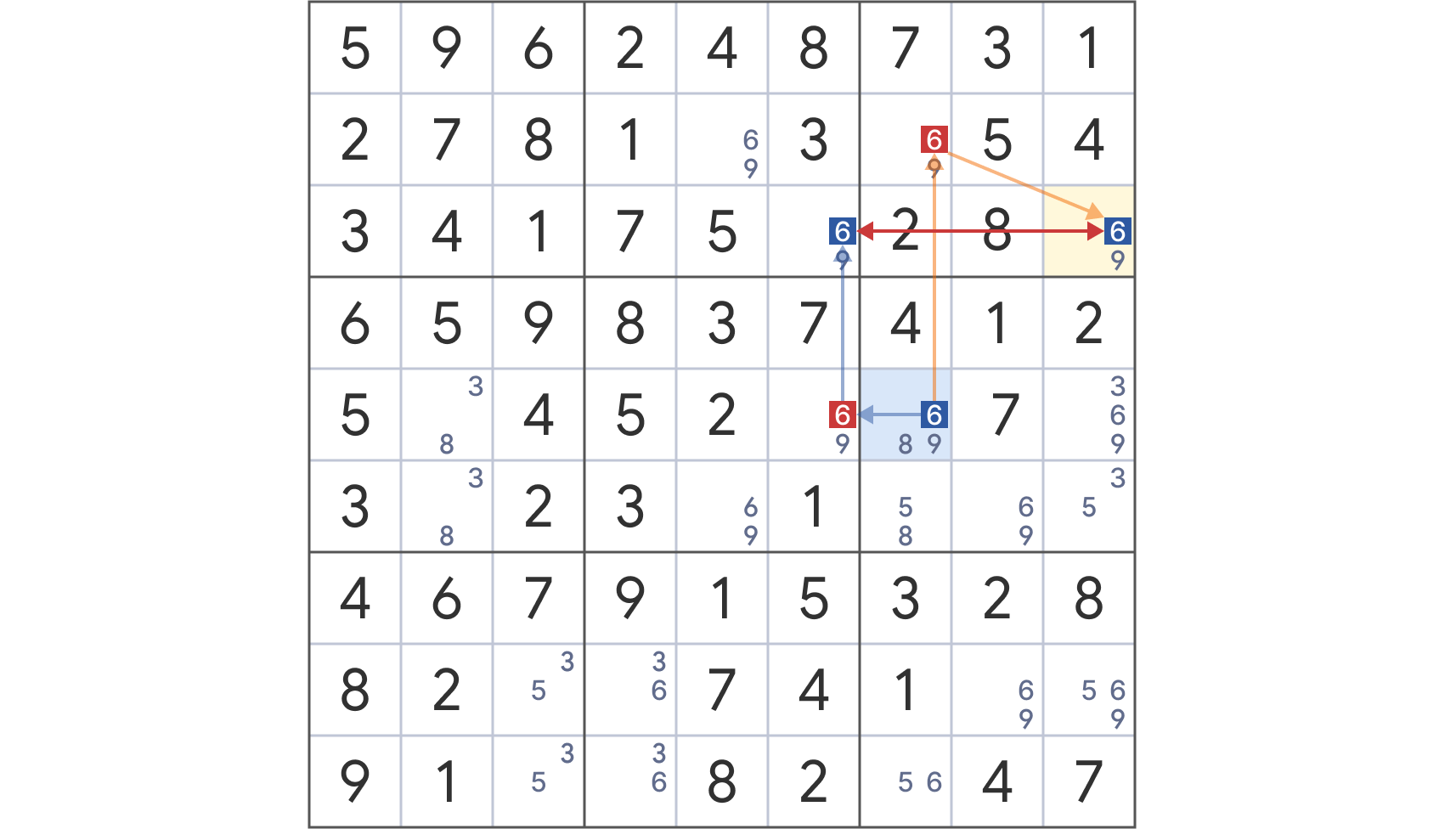
Sometimes the opposite happens. Assuming a candidate is removed eventually forces it to be placed after a chain of deductions. Since the assumption leads back to its own negation, the candidate must be true
Nishio is often described as a controlled form of trial-and-error. The difference from blind guessing is that the assumption is never accepted as correct merely because it seems to work. The assumption is used only as a temporary hypothesis, and a result is obtained only when logic proves that one of the possibilities is impossible.
In modern Sudoku terminology, Nishio can be viewed as a special case of a forcing net with a single starting assumption and a contradiction as its goal. It is generally more powerful than ordinary forcing chains because the grid is allowed to evolve, but it is also harder to analyse because the reasoning no longer follows one clean linear path.