How to Find the Last Remaining Number
The Last Remaining Number strategy—widely known in the Sudoku community as a Sole Candidate—is a powerful and essential technique for solving puzzles.
While the Last Free Cell strategy focuses on scanning a single nearly complete row, column, or block, this technique requires a broader view. You need to look at the intersection of all three units at once to figure out what belongs in a specific empty cell.
The Logic Behind the Strategy
In Sudoku, a single cell is always part of three distinct units simultaneously:
- One horizontal row
- One vertical column
- One 3×3 block
Because a number cannot repeat within any of these units, every digit that already exists in the intersecting row, column, or block is instantly eliminated as a possibility for that specific cell.
When you eliminate eight out of the nine possible digits, the last remaining number becomes the only logical answer.
Step-by-Step Example
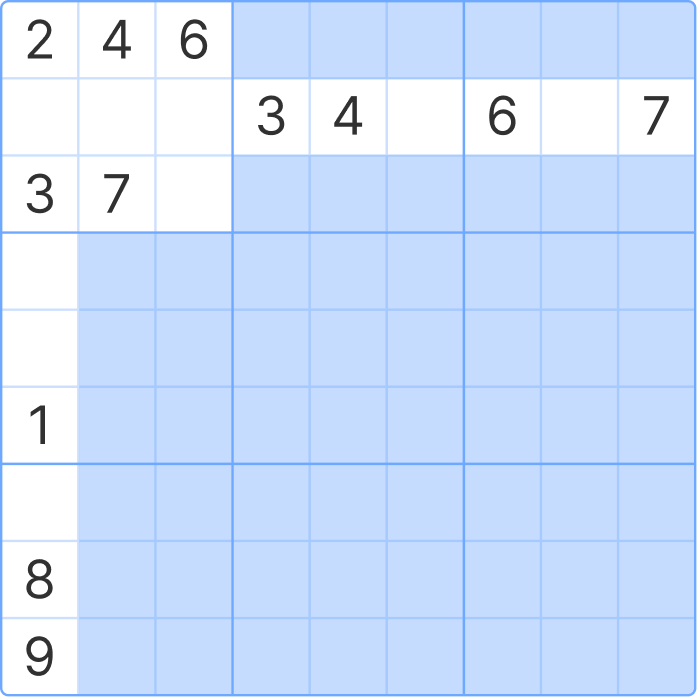
Have a look at the highlighted cell in the image below
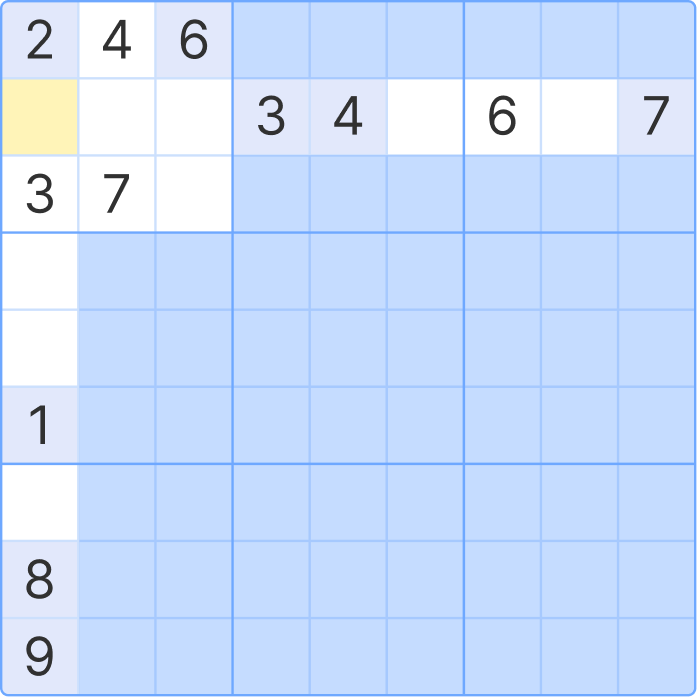
- Pick a target cell: Choose an empty cell that seems to be surrounded by a lot of numbers.
- Scan the intersections: Look at all the numbers that already exist in the target cell’s row, its column, and its 3×3 block.
- Count the eliminated digits: In our example, if we look across the intersecting units, we can see that the numbers 1, 2, 3, 4, 6, 7, 8, and 9 are already taken.
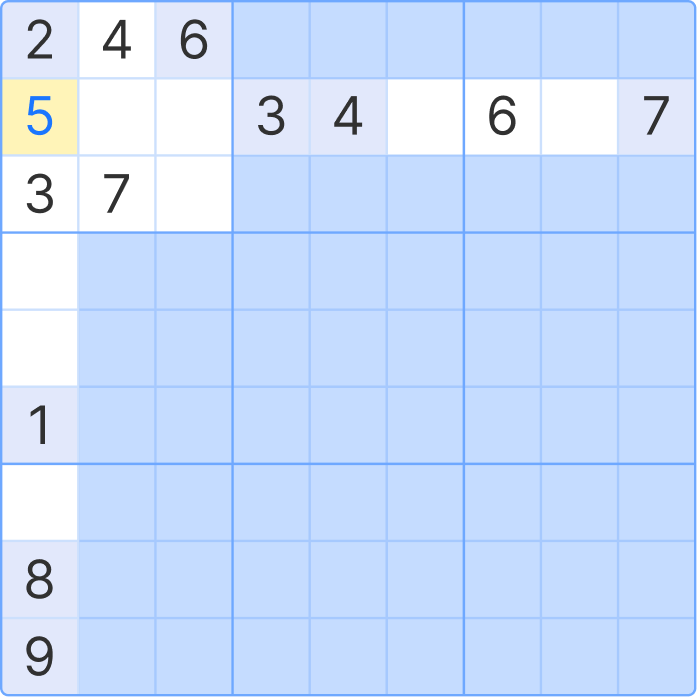
- Place the final number: Since 8 out of 9 options are blocked, only one number can logically go into this cell. The last remaining number is 5.
Why You Need to Master the Last Remaining Number
Spotting Last Remaining Numbers is the bread and butter of Sudoku solving. As puzzles move from Easy to Medium and Hard, you won’t always find obvious nearly-completed rows. Instead, you will need to rely on this cross-scanning technique to find hidden opportunities and break through complex gridlocks.