Classic vs Modern Sudoku Strategies: Which Techniques Actually Solve Faster?
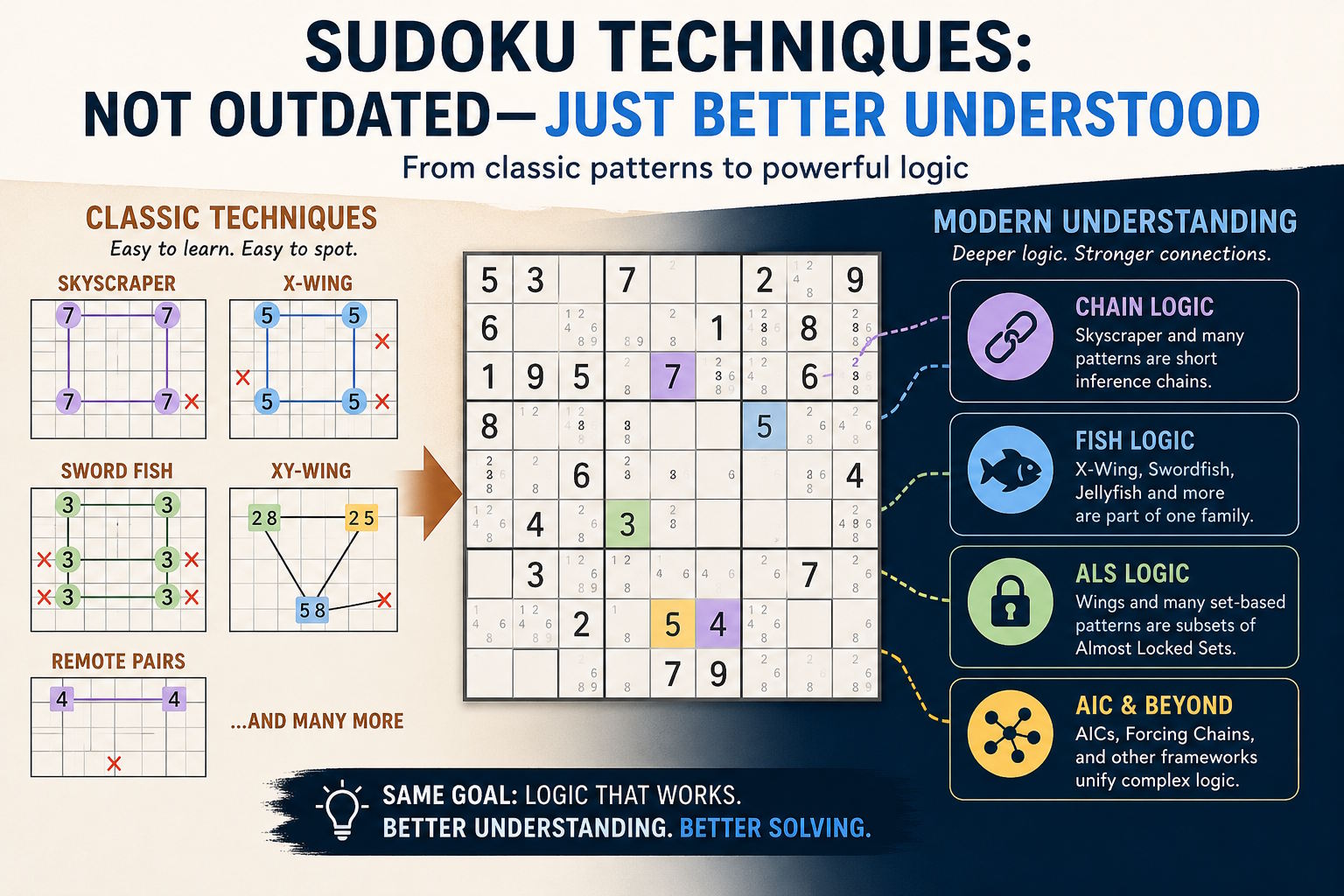
Are Classic Sudoku Techniques Outdated? Not Exactly — The Way We Understand Them Has Changed. For many Sudoku players, techniques like Skyscraper, X-Wing, Swordfish, XY-Wing, and Remote Pairs feel like a long catalogue of separate tricks. Learn enough of them, and harder puzzles begin to open up.
But in more advanced Sudoku solving, something interesting has happened: many of these “classic” techniques are no longer treated as isolated patterns. They are increasingly understood as specific examples of broader logical systems, especially chains, fish structures, and Almost Locked Sets.
That does not mean the old techniques are obsolete. It means they are often better understood as human-friendly names for recurring patterns inside deeper logic.
The old way: a toolbox of named patterns
Traditional Sudoku teaching often presents techniques one by one:
- Naked and hidden singles
- Locked candidates
- Naked and hidden pairs/triples
- X-Wing
- Swordfish
- Skyscraper
- 2-String Kite
- XY-Wing
- XYZ-Wing
- Remote Pairs
- Simple Coloring
This approach is still useful because humans are good at recognising visual patterns. A Skyscraper, for example, is easier to teach as a shape than as an abstract chain of strong and weak links.
HoDoKu, one of the classic human-style Sudoku solving references, still lists Skyscraper, 2-String Kite, Turbot Fish, Empty Rectangle, Wings, Coloring, Chains, and ALS as separate technique families. That reflects how human solvers usually learn and spot them on the grid.
The newer understanding: many techniques are part of larger families
Modern advanced solving often asks a different question:
What is the underlying logic behind this technique?
When you look under the hood, many named strategies are not independent inventions. They are special cases of broader ideas.
For example, HoDoKu explains that chains are built from two types of inference: weak links and strong links. A weak link means two candidates cannot both be true; a strong link means they cannot both be false. An Alternating Inference Chain, or AIC, is formed by alternating these link types.
This is why many older chain-like techniques can be reinterpreted as AICs or simpler chain patterns.
Andrew Stuart’s SudokuWiki solver makes this overlap explicit: it notes that X-Cycles are a subset of Alternating Inference Chains, and that if X-Cycles are disabled, the same elimination may appear under AICs instead.
That one sentence captures the whole shift: the old technique did not become wrong; it became part of a more general framework.
Example: Skyscraper is not dead — it is a simple chain pattern
A Skyscraper is usually taught as a single-digit pattern involving two rows or columns, each with two possible positions for the same candidate. If the “roofs” see a common candidate, that candidate can be eliminated.
For a human, “Skyscraper” is a memorable visual pattern.
For a solver engine, however, it can be represented more generally as a short chain using strong links. It is not necessary to hard-code “Skyscraper” as a completely separate logical universe. The engine can often find the same elimination through chain logic.
So the practical truth is:
- For players, Skyscraper is still worth learning.
- For advanced theory, Skyscraper is a named example of broader single-digit chain logic.
- For software solvers, it may be cleaner to implement a general chain engine than dozens of separate pattern detectors.
Example: X-Wing and Swordfish belong to the Fish family
X-Wing, Swordfish, and Jellyfish are often taught as different techniques. But structurally, they belong to the same family: Fish.
HoDoKu groups X-Wing, Swordfish, Jellyfish, finned fish, sashimi fish, Franken Fish, Mutant Fish, and Siamese Fish under broader fish categories.
So again, the “new” understanding is not that X-Wing is obsolete. It is that X-Wing is the 2×2 version of a more general fish idea.
That matters because once a player understands the general fish principle, Swordfish and Jellyfish stop feeling like unrelated tricks.
Example: XY-Wing and XYZ-Wing can be seen through ALS logic
Almost Locked Sets, or ALS, are another important modern framework.
SudokuWiki defines an Almost Locked Set as a group of N cells containing N+1 candidates. It also notes that ALS logic is strongly related to XYZ-Wings and WXYZ-Wings, which can be treated as subsets of ALS.
This is a major conceptual shift. Instead of memorising every “wing” as a separate pattern, advanced solvers can understand many of them as small ALS structures.
Again, this does not make wings useless. It explains why they work.
So are classic techniques outdated?
No — not for human solving.
A better way to say it is:
Classic techniques are not outdated. They are often simplified, named versions of broader logical ideas.
For beginners and intermediate players, named techniques are still the best learning path. “Look for a Skyscraper” is much easier than “search the candidate graph for a short alternating inference chain.”
But for advanced solvers, puzzle setters, and software developers, the deeper frameworks matter more:
- Fish logic explains X-Wing, Swordfish, Jellyfish, and their variants.
- Chain logic explains many coloring and single-digit patterns.
- AIC explains a large class of advanced eliminations.
- ALS explains many wing-like and set-based techniques.
- Forcing Chains and Forcing Nets go even further, though they can feel less elegant to many human solvers.
SudokuWiki also groups strategies by families rather than only by difficulty, including chaining strategies, AIC with groups, AIC with ALSs, AIC with URs, and AIC with exotic links. This reflects the broader trend toward family-based understanding.
Why this matters for Sudoku apps and hint systems
For a Sudoku website or app, this distinction is important.
A good hint system should not simply say:
“AIC removes 7 from r4c6.”
That may be technically correct, but it is often not helpful to a normal player.
A better hint system might detect that the AIC is actually a familiar pattern and explain it as:
“This is a Skyscraper on 7s. Because these two strong links force one of the roof cells to be 7, any cell that sees both roof cells cannot be 7.”
In other words, the engine can use general logic internally, while the user interface presents the result in a human-friendly way.
That is probably the best modern approach:
- Use broad logic engines underneath.
- Explain moves using the simplest recognisable technique.
- Avoid overwhelming players with abstract terminology too early.
The real evolution: from memorising tricks to understanding logic
The evolution of Sudoku solving is not that old techniques disappeared. It is that the community has become better at seeing the relationships between them.
A Skyscraper is still a Skyscraper.
An X-Wing is still an X-Wing.
An XY-Wing is still an XY-Wing.
But now we can also say:
- Skyscraper belongs to chain-based logic.
- X-Wing belongs to fish logic.
- XY-Wing and XYZ-Wing are related to ALS logic.
- Many “different” eliminations are different faces of the same underlying inference structure.
That is not the death of classic Sudoku techniques. It is the maturation of Sudoku theory.
Conclusion
Classic Sudoku techniques are not obsolete. They remain useful because they are visual, teachable, and practical for human solvers.
What has changed is the level of abstraction. Advanced Sudoku solving now often treats named techniques as members of larger families: Fish, Chains, AICs, ALS, and forcing structures.
For players, the best path is still to learn the classic patterns first. For developers and advanced solvers, the next step is to understand the deeper logic behind them.
The future of Sudoku solving is not about throwing away old techniques. It is about connecting them.
Leave a Reply