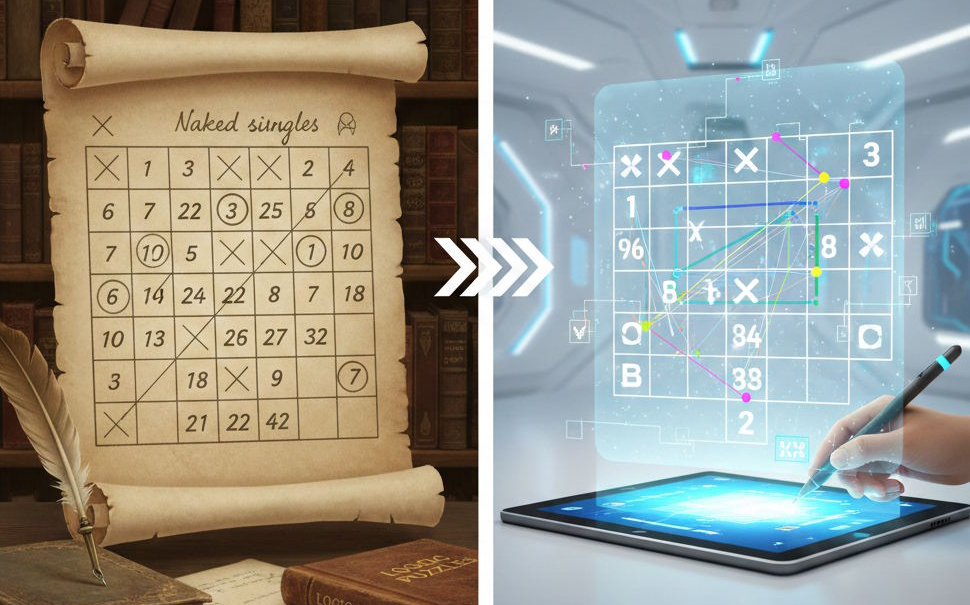
How Solving Techniques Changed From Classic to Modern
Sudoku seems timeless, but the way we solve it has changed radically. If you handed a modern “Expert” puzzle to a player from the 1990s, they likely couldn’t solve it. Not because they lacked intelligence, but because the technology of logic hadn’t been invented yet.
This is the story of how Sudoku evolved from a casual newspaper game into a deep mathematical discipline—and how human players learned to think like computers to beat them.
1. The Analog Era: Visual Intuition (1979–2004)
Before it was a global phenomenon, Sudoku was a niche puzzle called Number Place, designed by Howard Garns in 1979. When it migrated to Japan as “Sudoku” (Nikoli), the puzzles were hand-crafted.
The Strategy: “The Eyeball Scan”
In this era, solving was purely visual. Puzzles were designed with artistic symmetry and “flow” in mind.
- Cross-Hatching: The dominant technique. A player would visually “slice” rows and columns to find the only open cell for a number in a 3×3 box.
- No Notes Needed: The “Nikoli style” prided itself on elegance. A well-made puzzle was meant to be solved without writing tiny candidates in the margins. If you had to write notes, the puzzle was considered “inelegant” or “too hard”.
The Limit: Logic was “Constructive”—you were always looking for where a number does go. If scanning failed, most players simply guessed (bifurcation).
2. The Digital Shift: Man vs. Machine (2005–2010)
Everything changed in 2004 when Wayne Gould, a retired judge, wrote a computer program to mass-produce puzzles for The Times. Suddenly, newspapers had thousands of puzzles generated by code, not humans.
Computer-generated puzzles didn’t care about “elegance.” They often produced grids that were impossible to solve by simple scanning. To survive, players had to adapt.
The Birth of “Destructive” Logic
Players moved from finding “Yes” (Placement) to proving “No” (Elimination). This required a new language, largely developed on the Sudoku Programmers Forum.
- The “Fish” Names: Players discovered patterns where candidates formed rectangles.
- The Shift: These were the first techniques that allowed a player to eliminate a candidate from the top of the grid based on information at the bottom. It was no longer local; it was global.
3. The Modern Era: The “Meta” and Set Theory (2015–Present)
Today, Sudoku has split into two high-level disciplines: Speed Solving and Variant Logic. The rise of YouTube channels like Cracking the Cryptic popularized techniques that seem like magic to outsiders.
Speed: Snyder Notation
World Champion Thomas Snyder introduced a notation style that prioritized speed over information.
- The Technique: You only pencil-mark a number if it is limited to two positions in a box.
- The Logic: This prevents “information overload.” Instead of a grid full of messy numbers, the solver sees a clean map of binary choices. When one number falls, it triggers a chain reaction.
Theory: The “Phistomefel” Breakthrough
The most profound modern discovery is Set Equivalence Theory (SET). It treats the grid not as rows and columns, but as algebraic sets.
- Phistomefel’s Ring: Discovered by a German constructor named Phistomefel, this theorem proves that the 16 cells in the outer “ring” of the grid must contain the exact same digits as the four 2×2 corners.
- Why it matters: It allows players to solve “impossible” puzzles without looking at individual numbers. By coloring regions of the grid, a solver can mathematically prove that a cell must be a 7, simply because the “purple region” needs a 7 to balance the “green region”.
Leave a Reply