Counting Sudoku: How Many Unique Puzzles Can Actually Exist?
A journey into one of the most astonishing counting problems in recreational mathematics — and what it tells us about the puzzle we love.
Every morning, millions of people worldwide open a newspaper or tap an app and face the same deceptively simple challenge: fill a 9×9 grid so that every row, column, and 3×3 box contains the digits 1 through 9 exactly once. The rules fit in a single sentence. Yet lurking beneath that elegant simplicity is a mathematical universe of almost incomprehensible scale.
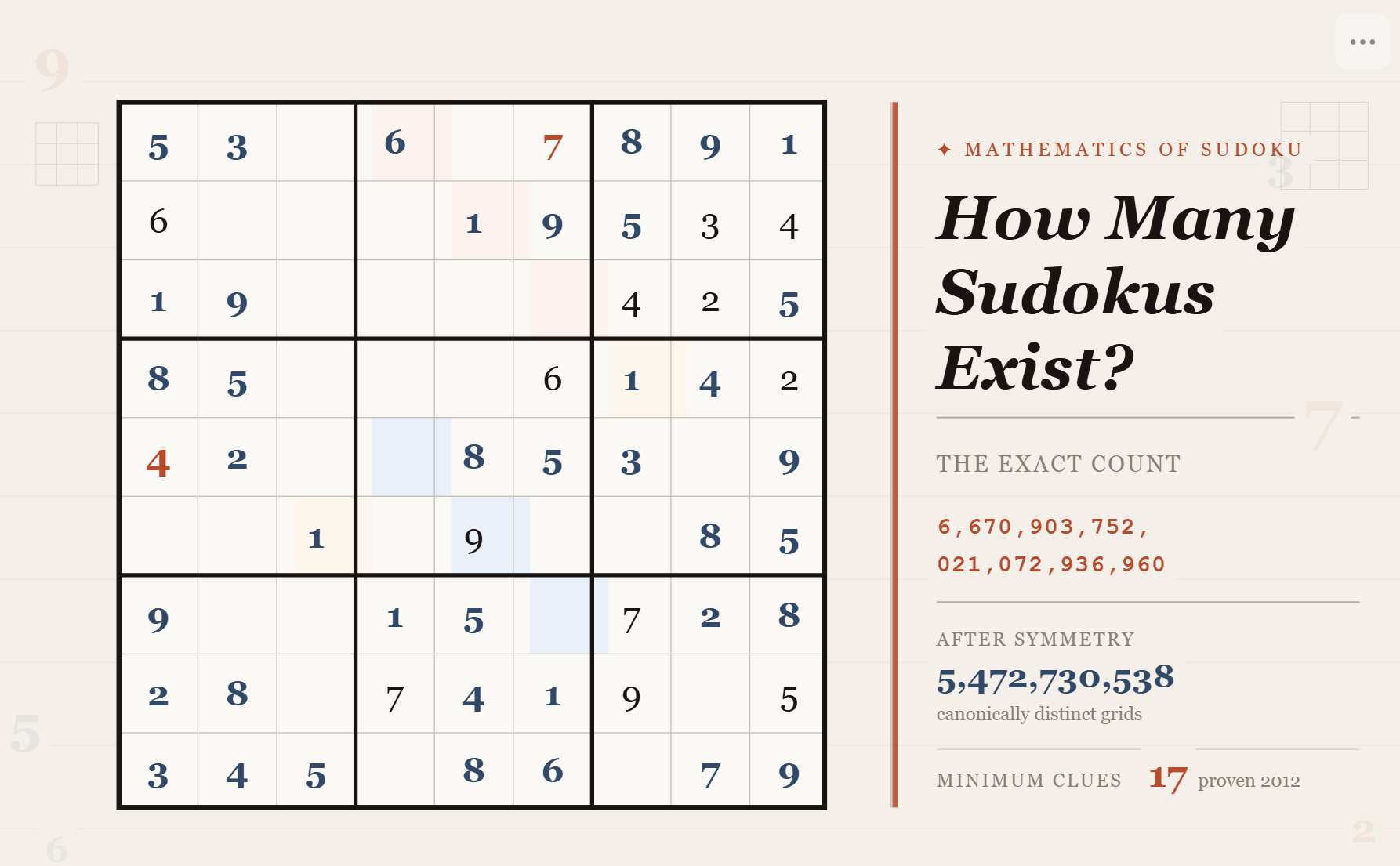
How many sudoku grids are there, exactly? The answer, computed definitively in 2005, is:
6,670,903,752,021,072,936,960 — roughly 6.67 sextillion unique completed grids.
That number is so large it dwarfs most human intuitions about quantity. Let’s put it in context — and explore what it really means for the puzzle you play every day.
The Calculation That Took Months
Before 2005, the count was unknown. Mathematicians knew sudoku was a constrained version of a Latin square — a grid where each symbol appears exactly once per row and column — but adding the box constraint made exact enumeration fiendishly difficult.
Quick Facts
Latin squares of order 9 number approximately 5.52 × 10²⁷ — vastly more than sudoku grids, since sudoku adds the box constraint on top.
The first row of a Sudoku grid alone can be arranged in 9! = 362,880 ways.
The famous minimum of 17 clues was proven in 2012 by Gary McGuire, who checked all 49,158 equivalence classes of 16-clue puzzles by computer.
In January 2005, Bertram Felgenhauer and Frazer Jarvis published a landmark paper counting all valid, fully completed sudoku grids. Their method combined exhaustive computer search with group theory: they fixed the first row (which can take 9! = 362,880 arrangements) and then systematically counted how many ways the rest of the grid could be completed for each starting configuration. After weeks of computation and careful validation, the final tally was confirmed: 6,670,903,752,021,072,936,960.
Shortly thereafter, Ed Russell and Frazer Jarvis tackled the deeper question: how many of those grids are truly different — not just relabelings or reflections of the same underlying structure? By accounting for all symmetry operations (rotating the grid, reflecting it, swapping equivalent rows or columns, and relabeling the digits), they found just 5,472,730,538 genuinely distinct grids. Still billions — but a factor of over a trillion smaller.
What Does “Unique” Actually Mean?
This distinction between raw count and canonical count is more philosophically interesting than it might appear. Consider: if you take a valid sudoku grid and swap all the 1s for 2s and all the 2s for 1s, you get another valid grid. Are these meaningfully different puzzles? From a solving perspective, no — they are structurally identical. Mathematicians call such equivalent grids members of the same equivalence class.
The transformations that preserve sudoku’s structure include relabeling digits (9! = 362,880 ways), permuting rows within a band (6 ways per band, 3 bands = 216), permuting the bands themselves (6 ways), and the same operations on columns — plus reflections and rotations of the whole grid. Multiplying these out gives a symmetry group of size approximately 1.22 × 10¹².
Dividing 6.67 × 10²¹ by ~1.22 × 10¹² gives us the ~5.47 billion canonical grids — a satisfying consistency check.
The Puzzle Space Is Even Larger
Completed grids are just one part of the story. A sudoku puzzle is a partially filled grid with a unique solution. How many such puzzles exist? This question is far harder — and the answer is staggeringly larger.
| What We’re Counting | Approximate Count | Notes |
|---|---|---|
| Valid completed grids | 6.67 × 10²¹ | Exact, computed 2005 |
| Canonical completed grids | 5.47 × 10⁹ | After removing symmetries |
| Puzzles with unique solutions | ~3 × 10³⁷ | Estimated, not exact |
| Minimum clues for uniqueness | 17 | Proven by McGuire, 2012 |
| Atoms on Earth | ~10⁵⁰ | For perspective |
Even if a puzzle generator created a new, never-before-seen sudoku every millisecond since the Big Bang (13.8 billion years ago), it would have produced only around 4.4 × 10²⁰ puzzles — still less than the number of completed grids alone. You could solve a different sudoku every second for the entire history of the universe and barely make a dent.
The Magic Number: 17
One of the most celebrated results in sudoku mathematics is the 17-clue minimum. No sudoku puzzle can have fewer than 17 given digits and still have a unique solution — a conjecture that circulated for years before Gary McGuire of University College Dublin proved it definitively in 2012.
His team’s computation checked all possible 16-clue configurations — there are 49,158 equivalence classes of them — and confirmed that none has a unique solution. The proof required months of distributed computing across hundreds of machines. The result: 17 is the hard floor. Below it, every grid either has no solution or multiple solutions.
Known 17-clue puzzles number in the tens of thousands. Whether they have all been found remains an open question.
Why This Matters for Solvers
Beyond the mathematical elegance, these numbers carry a practical implication: you will never run out of new sudoku puzzles. Ever. The space is effectively inexhaustible by human civilization on any foreseeable timescale. Every puzzle in every newspaper, app, or book you have ever encountered is a vanishingly tiny sample from an ocean of possibilities.
There is also something humbling in the 17-clue result. It means that a puzzle maker choosing which clues to reveal is navigating an extraordinarily constrained design space — threading a needle through a universe of sextillions to find configurations that collapse neatly to a single answer. That your daily puzzle has a unique solution is not a given; it is an achievement.
Every puzzle in every newspaper you have ever solved is a vanishingly tiny sample from an ocean of sextillions.
Open Questions
Mathematics, as ever, answers some questions while opening others. Several puzzles remain unsolved:
How many 17-clue puzzles exist in total?
Gordon Royle’s database catalogued over 49,000 distinct 17-clue puzzles, but no one has proven this list is complete. A complete census would require computational efforts dwarfing McGuire’s proof.
What is the maximum number of clues a non-trivially hard puzzle can have?
A puzzle with 80 clues (leaving one empty cell) always has a unique solution trivially. The interesting ceiling question is: what is the maximum number of clues such that the puzzle still requires genuine deduction rather than just observation? This touches on computational complexity in unexpected ways.
Can the exact count of uniquely solvable puzzles be computed?
The ~3 × 10³⁷ figure for puzzles with unique solutions is an estimate. An exact count is considered computationally intractable with current methods — a problem that may require fundamentally new mathematical tools.
A Final Thought
The next time you sit down with a sudoku, consider this: the grid in front of you is one point in a space so vast it defies intuition. It was threaded together — whether by a human setter or an algorithm — from constraints that slice through sextillions of possibilities down to a single, satisfying solution. The empty cells are not gaps. They are an invitation into one of the most combinatorially rich structures humans have ever studied.
Fill them in with confidence. There is no shortage of new ones waiting.
Leave a Reply