How to Master the Jellyfish Strategy in Sudoku
If you have already mastered the X-Wing and Swordfish techniques, you are ready to tackle the ultimate fish pattern. The Jellyfish technique is one of the most advanced expert-level strategies in Sudoku. This technique is a bit more complex version of a Swordfish.
Instead of searching for two or three lines, you will be scanning the entire 9×9 grid to find a massive, interconnected network spanning across four rows and four columns.
The Logic Behind the Jellyfish Pattern
A Jellyfish is formed when a single candidate number is restricted to a maximum of four cells in four parallel lines (rows or columns), and all these cells perfectly align into the exact same four perpendicular lines.
Take a look at the columns in this example:

Imagine we are tracking the number 9 across four vertical columns. When scanning your pencil notes, you notice a highly unique pattern:
- In Column A, the number 9 can only appear in Rows 1, 3, 5, or 9.
- In Column B, the number 9 can only appear in Rows 3, 5, or 9.
- In Column C, the number 9 can only appear in Rows 1, 5, or 9.
- In Column D, the number 9 can only appear in Rows 1, 3, or 5.
Here you can see that number 9 in these columns can only be found in the highlighted cells. Even though not every cell contains a 9, all these options are strictly trapped within the exact same four horizontal rows (Rows 1, 3, 5, and 9).
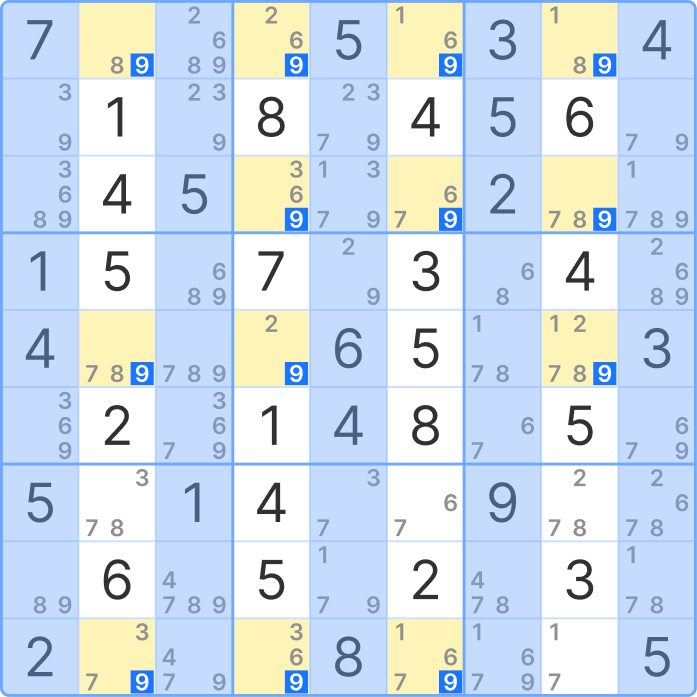
Because every column must contain a 9, and these four columns share a closed loop of four rows, it is mathematically guaranteed that the 9s will occupy the intersecting corners of this 4×4 grid. Those four columns will completely absorb the 9s for those four rows.
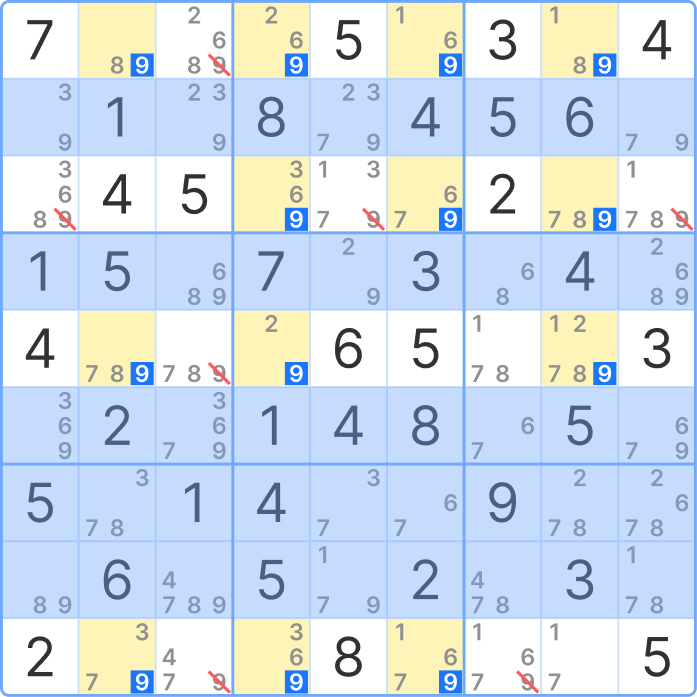
The Power of Elimination (Step-by-Step)
Because the columns lock the target digit into the grid corners, the intersecting lines are completely shut down. This means that the other cells in the same rows can’t contain the number 9.
To apply the Jellyfish strategy to your game:
- Track a high-level candidate: Choose a stubborn number (like 9) that is blocking your progress on the board.
- Find Four Parallel Lines: Look for four columns where that candidate appears a maximum of four times.
- Verify the 4×4 Alignment: Check if all these candidates fall into the exact same four horizontal rows. If they do, your Jellyfish trap is set!
- Clear the Intersecting Lines: Go to those four rows and delete the number 9 from the pencil notes of every other cell along those lines, making sure to preserve the corners of your Jellyfish.
Jellyfish Variations: Columns vs. Rows
Depending on how the puzzle is generated, a Jellyfish can develop in two directions:
- Column-Based Jellyfish: As described in our example, the candidate is locked within four columns and aligns across four rows. You eliminate that candidate from the rest of the intersecting rows.
- Row-Based Jellyfish: The candidate is restricted inside four horizontal rows and aligns perfectly across four vertical columns. In this scenario, you use the pattern to wipe out that candidate from the rest of those four columns.
The Ultimate Grid Clearance
Spotting a Jellyfish requires supreme concentration and patience, as the cells are scattered across sixteen possible intersection points. However, successfully executing this technique is incredibly powerful. By wiping out multiple candidates from four full rows or columns simultaneously, you instantly smash the gridlock, triggering a chain reaction of Naked Singles that leads directly to victory.
Ready to find the ultimate pattern? Put your master-level logic to the test right now on our Expert Sudoku Puzzles, fill out your pencil notes completely, and sweep the board clean!