
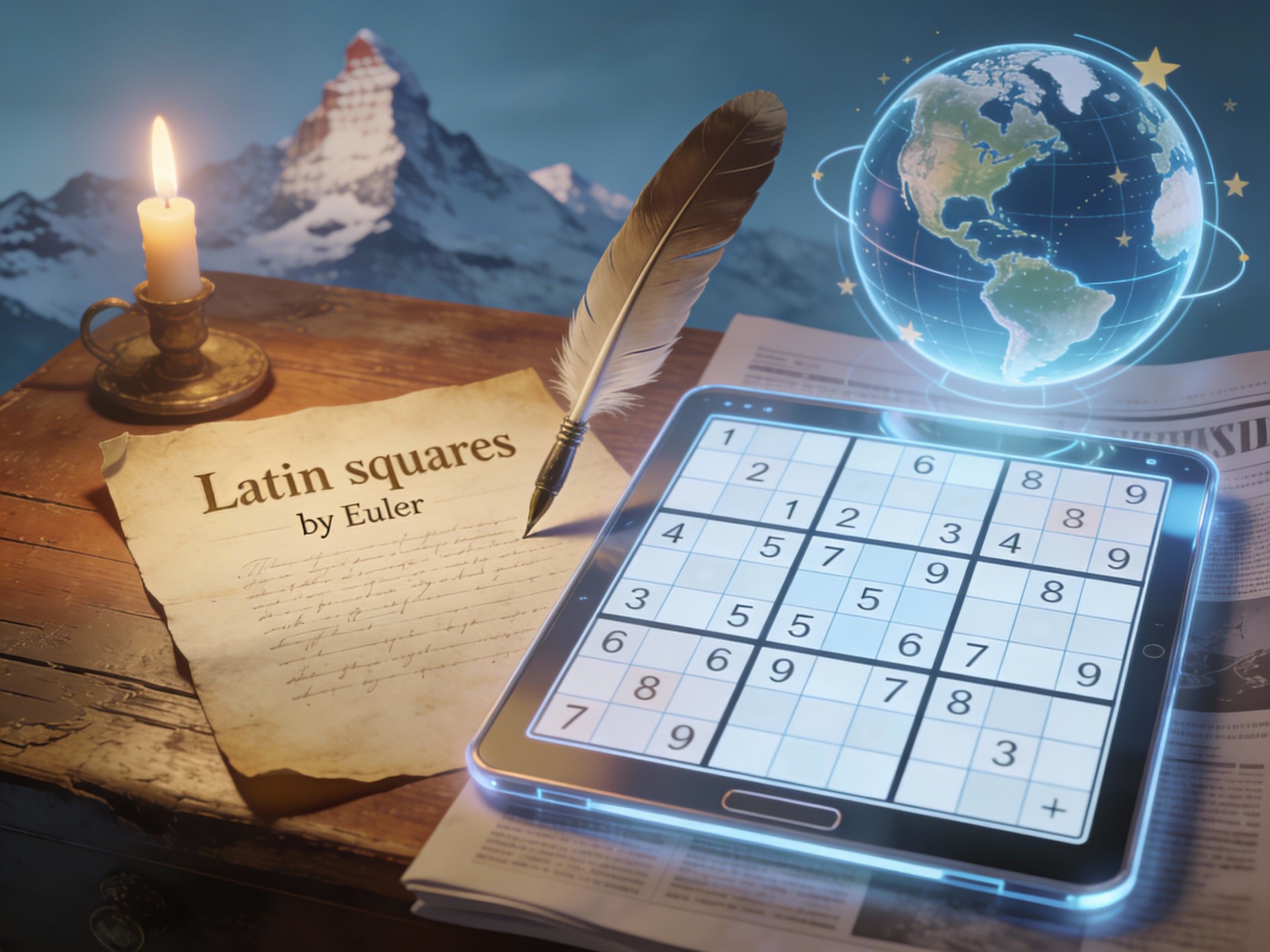
When you open your morning Sudoku grid, it feels like you are tapping into ancient Eastern wisdom. The name, the Zen-like logic, the minimalist design—everything points to Japan.
But the truth is far more interesting. Sudoku is a “child of the world.” It has Swiss DNA, an American upbringing, a Japanese name, and—crucially—a New Zealand “godfather” who turned a niche puzzle into a global sensation.
Here is the true story of how a simple grid of numbers conquered the planet.
1783: Grandfather Euler and Latin Squares
The story begins not in Tokyo, but in St. Petersburg and Berlin with the legendary Swiss mathematician Leonhard Euler. In 1783, he explored a concept he called “Latin Squares”.
The idea was simple: arrange symbols in a grid so they do not repeat in any row or column. This was the foundation. However, Euler’s version lacked the modern Sudoku’s defining feature – the 3×3 blocks. Without them, it was pure mathematics rather than an addictive puzzle. Euler laid the logical groundwork, but the world had to wait two centuries for the game to evolve .
1979: The Architect Who Built “Number Place”
Fast forward to Indiana, USA, in the late 1970s. Howard Garns, a 74-year-old retired architect, loved creating puzzles. He took Euler’s concept and added a brilliant constraint: dividing the grid into nine 3×3 sub-grids. This changed everything -now the player had to scan the board not just linearly, but spatially.
In May 1979, Dell Pencil Puzzles and Word Games published Garns’ creation under the name “Number Place.” It became popular among American logic fans but remained a niche hobby. Sadly, Garns passed away in 1989, never knowing that his invention would eventually become the most popular puzzle in the world.
1984: The Japanese Rebrand
In the early 80s, a copy of the Dell magazine fell into the hands of Maki Kaji, the president of the Japanese puzzle publisher Nikoli. He loved the logic of “Number Place,” but the name felt too dry for the Japanese market.
Kaji-san gave the game a new identity, shortening the phrase “Sūji wa dokushin ni kagiru” (the digits must remain single) to the snappy Sudoku (Su = number, Doku = single).
Japan didn’t just rename the game; they refined it. Nikoli introduced symmetry rules (starting numbers must form a pattern) and limited the clues to ensure the puzzle required logic rather than guessing. Sudoku became a hit in Japan, but the West largely forgot about it.
2004: The Programmer Who “Infected” the World
This is where Wayne Gould enters history—a retired Hong Kong judge and, notably, a New Zealander.
In 1997, while visiting a bookstore in Tokyo, Gould found a book of Sudoku. He didn’t just solve them; as a technology enthusiast, he wanted to automate them. He spent six years writing a computer program (using C++) that could generate infinite unique puzzles of varying difficulty.
In November 2004, Gould walked into the offices of The Times in London. He had no marketing budget, but he had an algorithm. He told the editor, “I will give you these puzzles for free, just print them.”
The Times took the risk. The effect was instant. Within three days, readers were calling the newsroom demanding more puzzles. Other papers like The Daily Mail and The Guardian realized they were losing readers and scrambled to print their own grids.
Thanks to code written by a Kiwi, a game invented in the US, based on Swiss math, and named in Japan, became the definitive morning ritual of the 21st century.
Leave a Reply