

So you’ve mastered the basics of Sudoku – you can spot naked singles and fill in obvious numbers. But now you’re stuck. The puzzle seems impossible, with no clear moves. This is where your first real Sudoku technique comes in: Pointing.
Pointing is the gateway technique that transforms you from a beginner into an intermediate solver. It’s the first “aha!” moment where you realize Sudoku isn’t just about filling boxes – it’s about understanding how numbers interact across different regions.
What is Pointing?
Pointing (also called “box-line reduction”) happens when a candidate number in a box is restricted to a single row or column. When this happens, you can eliminate that candidate from the rest of that row or column outside the box.
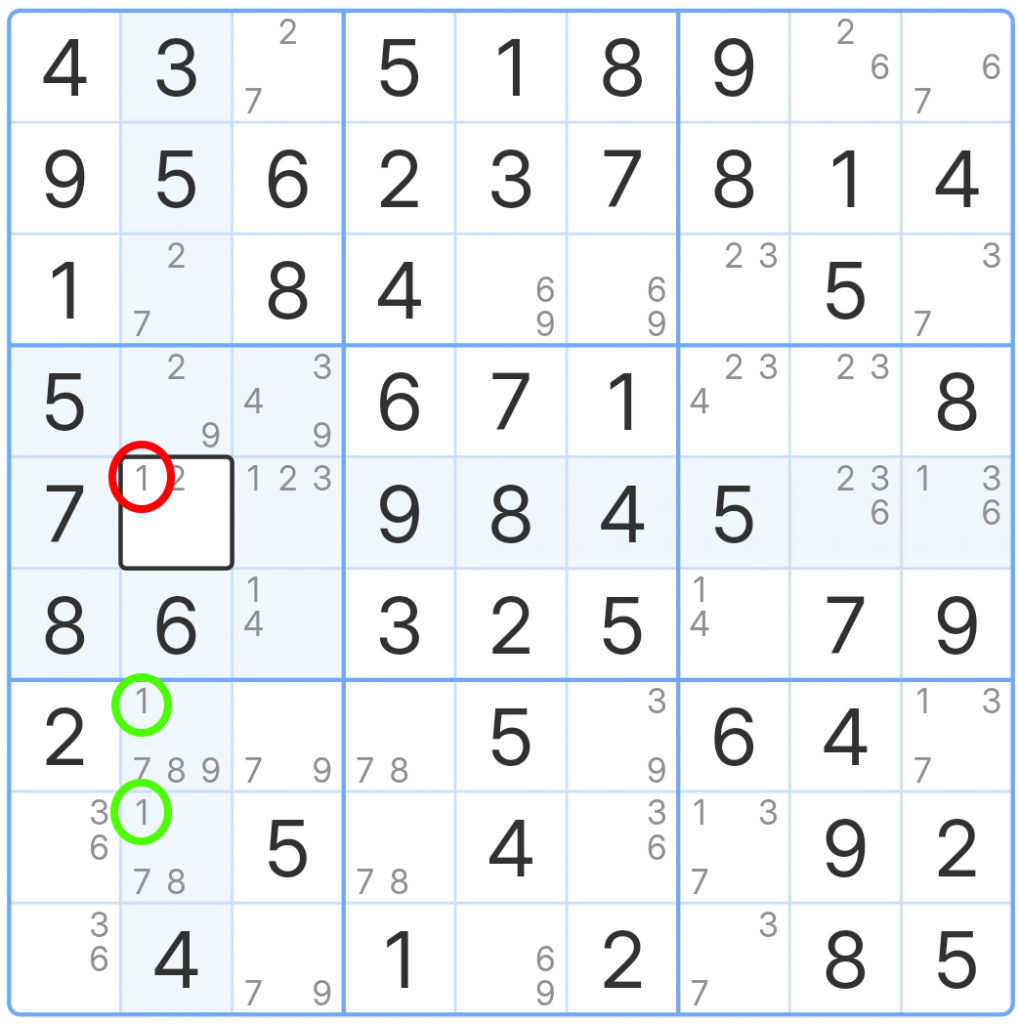
Think of it like this: if a number can only live in one specific hallway of a building (the box), it can’t also live in other parts of that same street (the row or column).
How Pointing Works
Sudoku has three types of regions that must each contain the digits 1-9:
- Nine 3×3 boxes
- Nine rows (horizontal lines)
- Nine columns (vertical lines)
Pointing exploits the overlap between these regions. When candidates in a box are confined to a single line, that line “claims” those candidates, preventing them from appearing elsewhere on that line.
A Simple Example
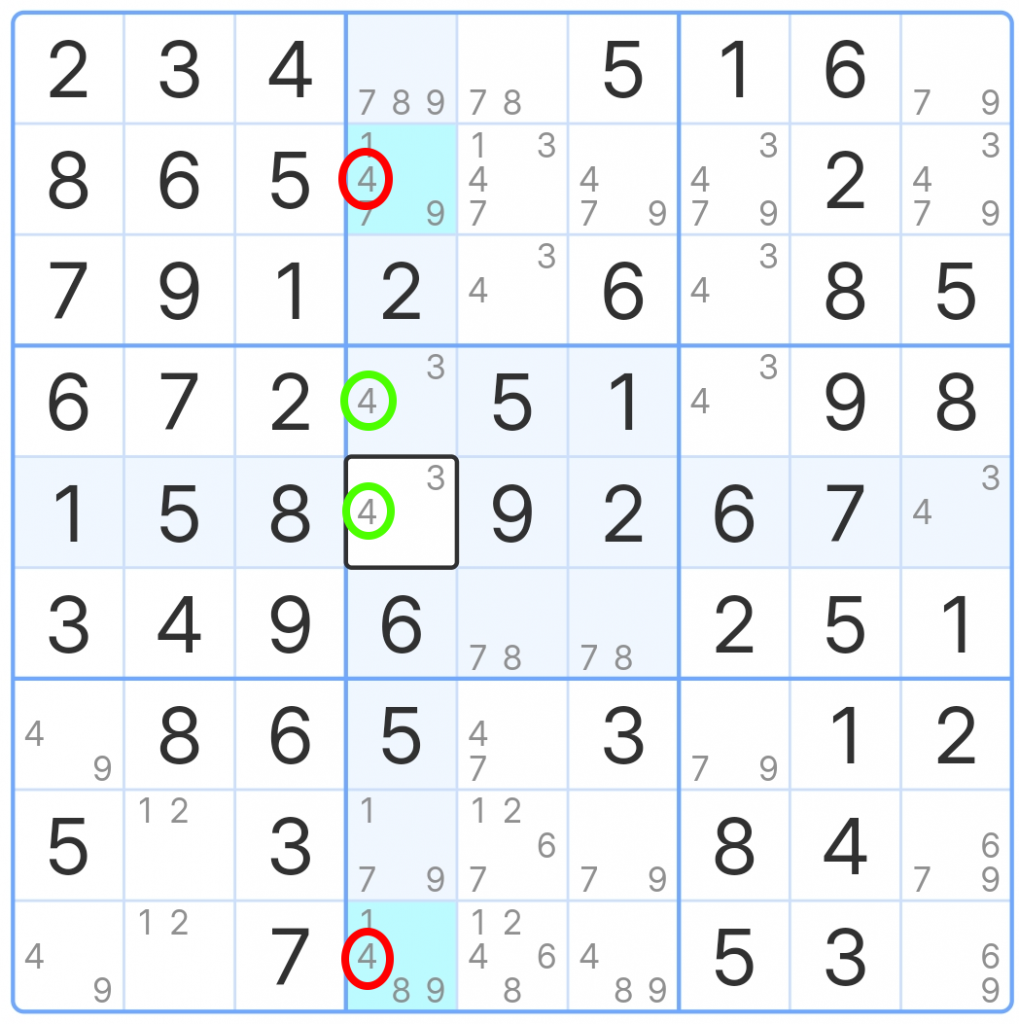
Imagine you’re looking at central box, and the number 4 can only appear in two cells – both in the same column. Here’s what you know:
- One of those two cells must contain a 4 (because the box needs a 4)
- Both cells are in the same column
- Therefore, column’s 4 must be in this box
- This means you can eliminate 4 as a candidate from all other cells in the column
That’s Pointing! The 4 is “pointing” along the column, claiming it for that box.
Why Pointing is Powerful
Pointing is your first technique that uses logical inference rather than direct observation. You’re not just seeing an obvious answer – you’re deducing where numbers can’t be based on structural constraints.
This technique often creates a chain reaction. One Pointing elimination might expose a naked single, which fills a cell, which creates another Pointing opportunity. This cascading effect is what makes advanced Sudoku solving so satisfying.
Common Mistakes to Avoid
Mistake 1: Forgetting to check the whole line
When you find Pointing candidates, make sure to eliminate from the ENTIRE row or column, not just the adjacent box.
Mistake 2: Confusing box and line boundaries
Only eliminate outside the box. The candidates inside the box that are pointing must stay (one of them is the answer!).
Mistake 3: Not checking all nine boxes
Pointing can happen in any box with any number. Check systematically: Box 1 for 1-9, Box 2 for 1-9, and so on.
Moving Forward
Once you’re comfortable with Pointing, you’re ready for its mirror technique called “Claiming” (or box-line reduction in reverse), and then harder techniques like “Hidden Pairs” or “Hidden Triples.”
But master Pointing first. It’s the foundation of logical Sudoku solving, and it will appear in virtually every medium and hard puzzle you solve.
Leave a Reply