3D Medusa: Advanced Sudoku Solving Strategy Explained
The 3D Medusa is a powerful, advanced Sudoku solving technique based on a two-color chaining system. It is highly effective for breaking through complex puzzles when standard logic stalls.
To start, find a cell in the Sudoku grid with exactly two candidates. Since one of them must be the correct answer, assign the two candidates different colors—for example, blue and orange. From there, extend the coloring through strong links: any spot where a digit has only two places left in a row, column, or 3×3 box, or any cell that contains only two candidates.
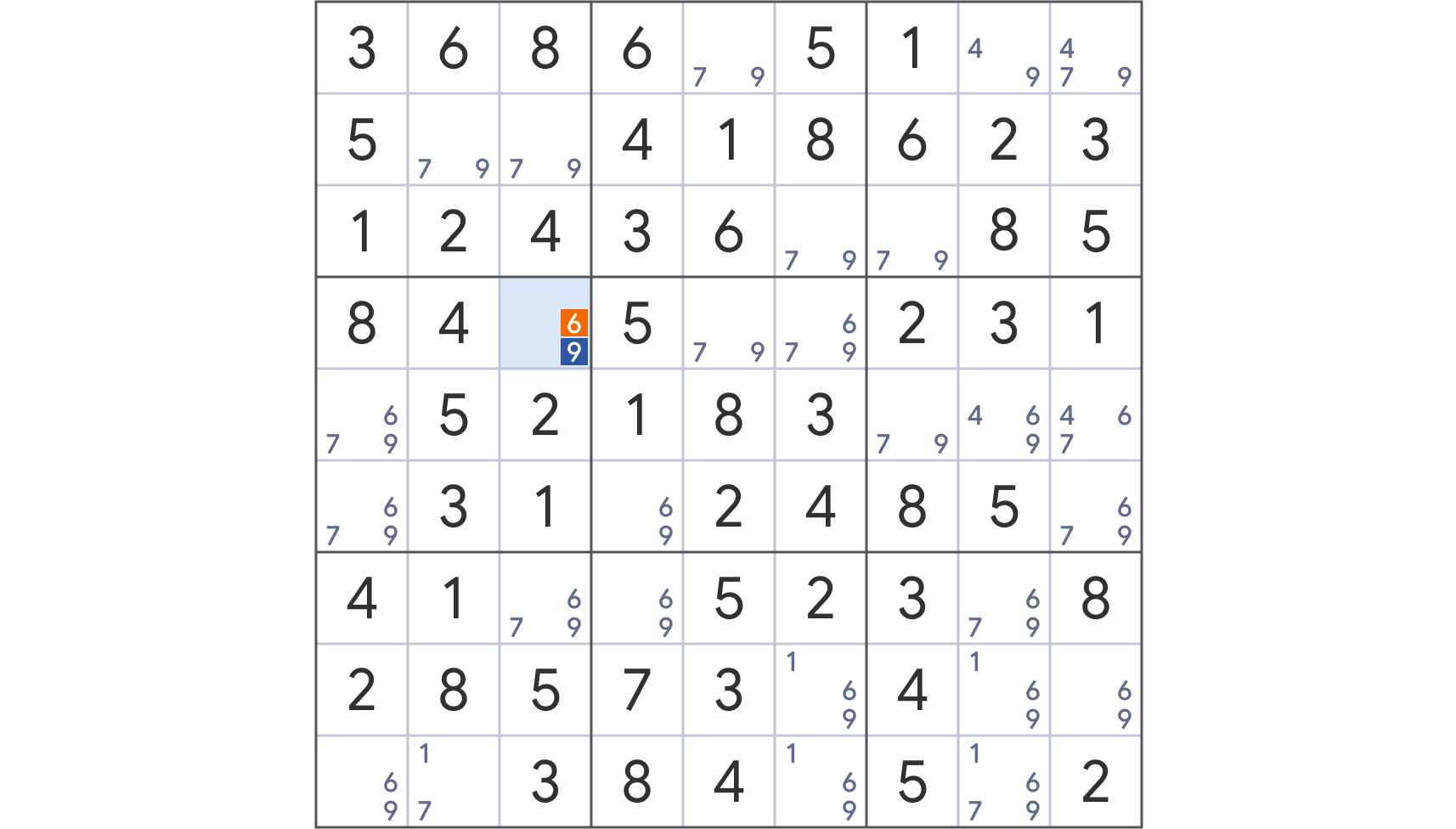
At each link, the connected candidate takes the opposite color. Keep going until you’ve built one connected network. Because these links can run through two-candidate cells, the network can jump from one digit to another across the grid—that is what makes this strategy “3D.”
The Core Principle of 3D Medusa
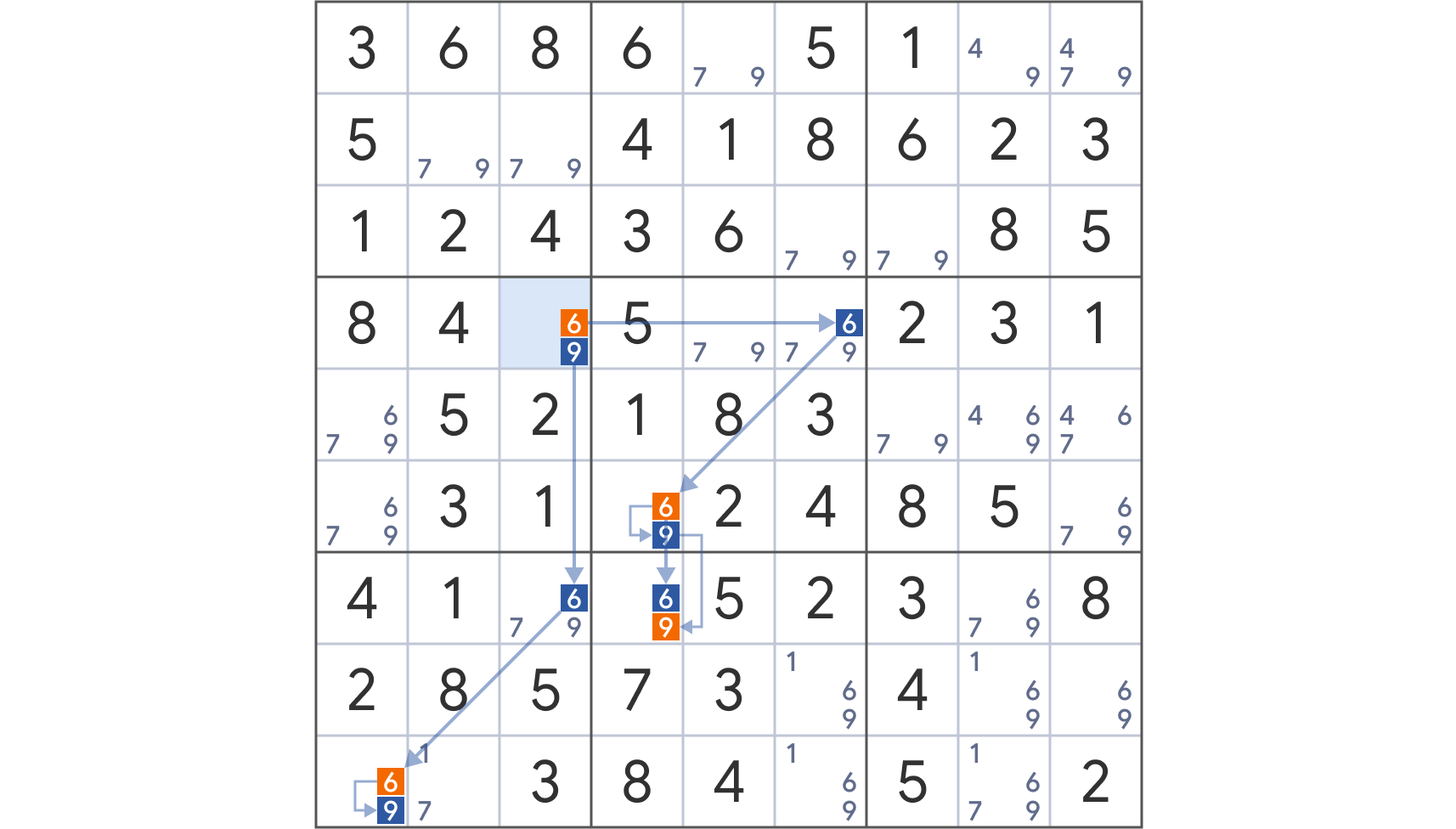
Once the network is complete, one color is entirely correct and the other is entirely incorrect across the entire Sudoku board. You don’t yet know which is which, but the coloring already allows you to make crucial candidate eliminations.
Patterns 1 and 2 below are contradictions: they prove one specific color is false, allowing you to remove every candidate of that color and confidently place the opposite color throughout the grid. Patterns 3, 4, and 5 allow you to remove individual uncolored candidates, regardless of which color ultimately turns out to be true.
Pattern 1: The Same Color Twice in One Unit
If a single digit appears in the same color twice within a single row, column, or 3×3 box, that entire color network is false. The opposite color is correct and provides the solution for those cells.
Pattern 2: The Same Color Twice in One Cell
If a single cell ends up with two candidates of the same color, that color cannot be correct, because a cell can only hold one digit. That color is therefore false everywhere, and the opposite color provides the solution.
Pattern 3: Two Colors in One Cell
If a cell contains both a blue candidate and a orange candidate, the final solution for that cell must be one of those two (since one of the colors is guaranteed to be true). Therefore, every other uncolored candidate in that specific cell can be safely removed.
Pattern 4: A Candidate That Sees Both Colors
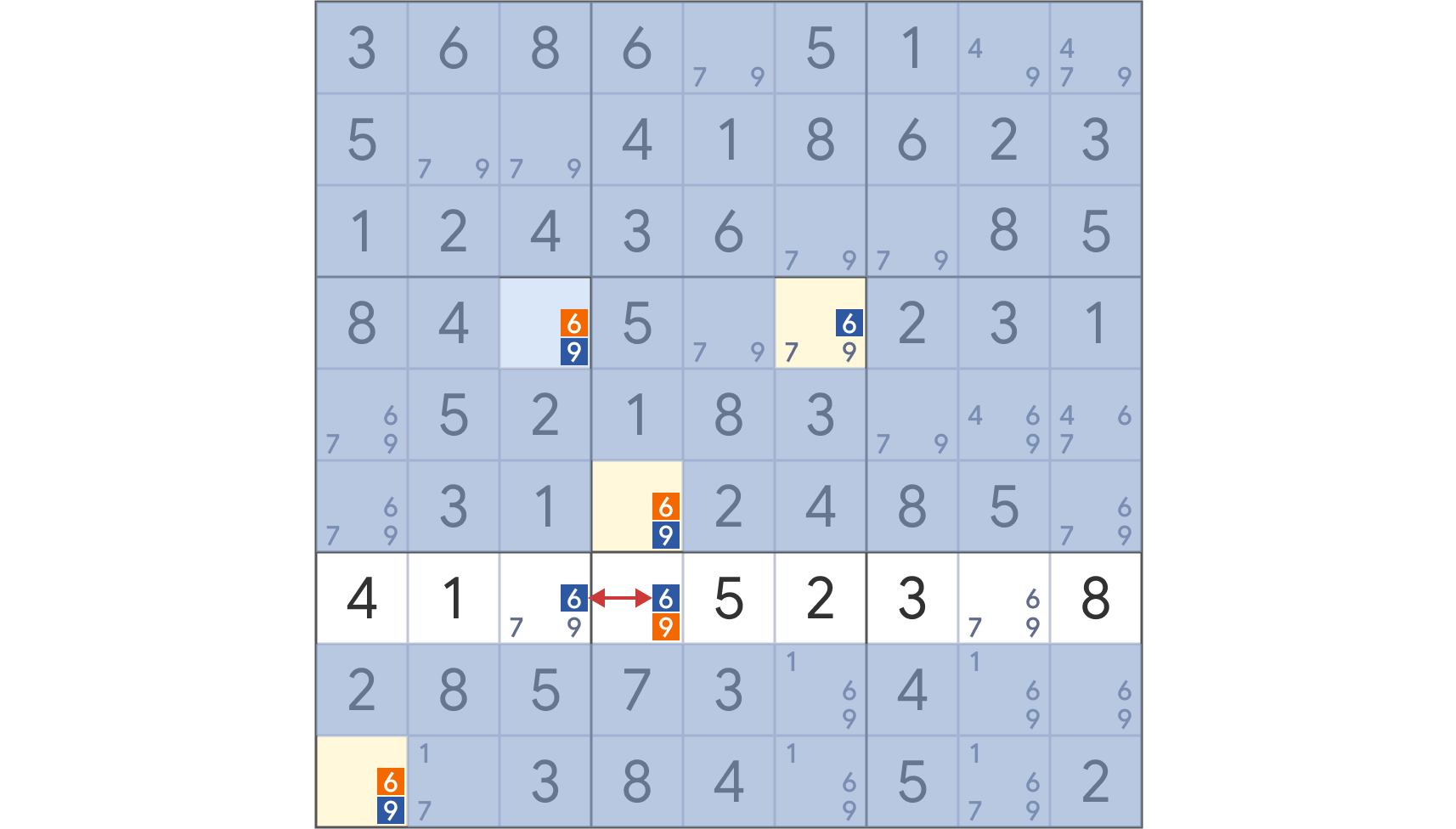
If an uncolored candidate of a given digit shares a unit (row, column, or box) with both a blue and a orange instance of that same digit, it cannot be correct. Since one of the two colored instances will always be the real solution, the uncolored candidate can be eliminated.
Pattern 5: The Unit-and-Cell Case
If an uncolored candidate sees a colored instance of its own digit, and its own cell contains another candidate of the opposite color, it is excluded either way. Whether blue or orange turns out to be true, this uncolored candidate will be blocked, so it can be eliminated