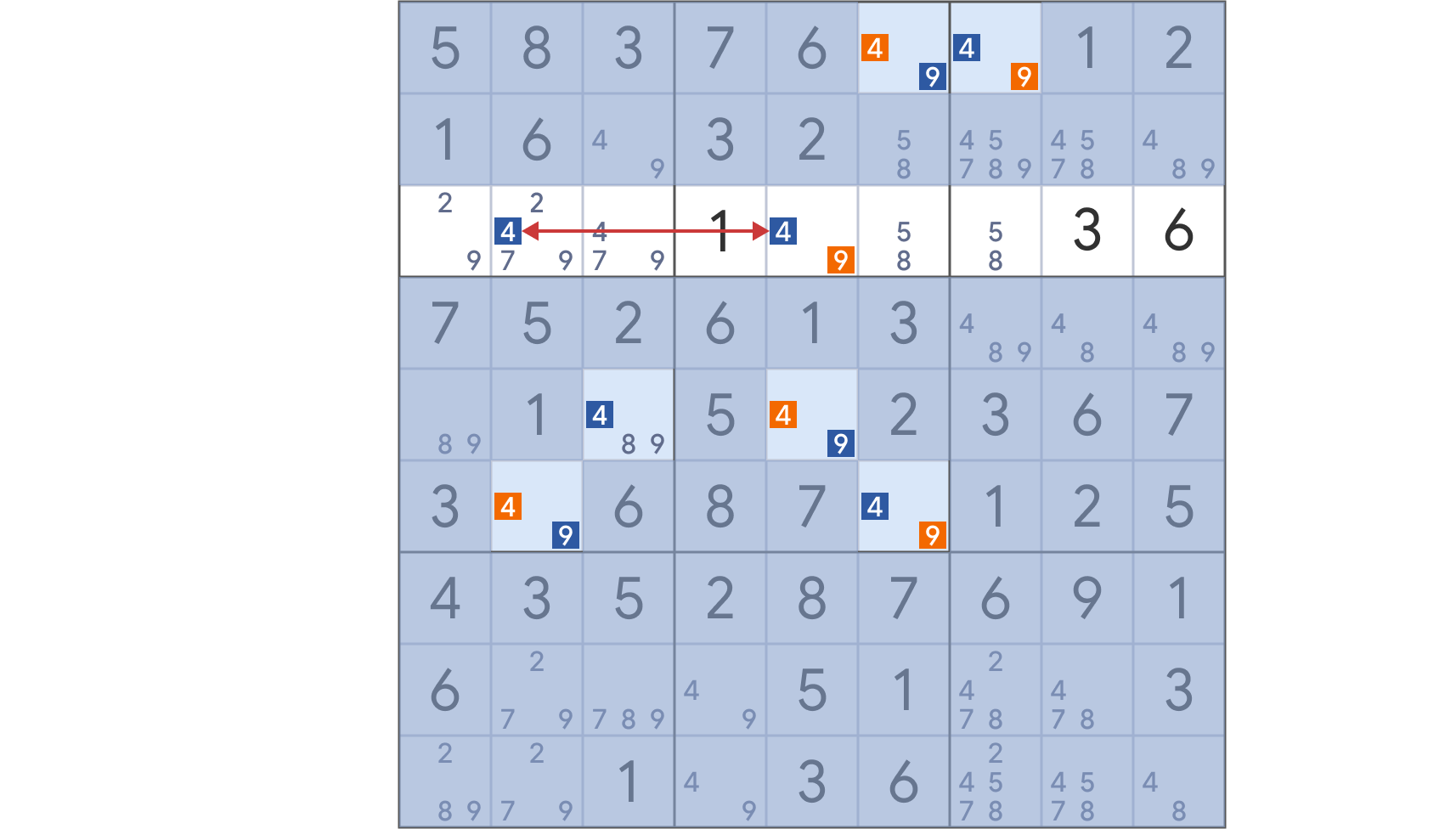
Dual Medusa
Dual Medusa is an advanced Sudoku solving technique that is virtually identical to the 3D Medusa. Both strategies rely on the same two-color network logic and use the exact same elimination rules. They differ in one crucial aspect only: where the coloring process begins.
The Starting Point: 3D Medusa vs. Dual Medusa
- 3D Medusa starts inside a single bi-value cell (a cell with exactly two candidates). It assigns those two candidates opposite colors, forming a strong link between two different digits within one cell.
- Dual Medusa starts from a conjugate pair (a single digit that has exactly two possible cells remaining in a specific row, column, or 3×3 box). It assigns that specific digit opposite colors in those two cells, forming a strong link for one digit across two different cells.
Building the Color Network
Once you have your starting conjugate pair colored (e.g., blue and green), spread the two colors across the Sudoku grid along every strong link. Always assign the connected candidate the opposite color:
Through bi-value cells: If your colored chain lands on a cell with only two candidates, color that cell’s second candidate the opposite color. This is the mechanism that allows the Dual Medusa chain to cross from one digit to another.from one digit to another);
Through conjugate pairs: Whenever a colored digit has only two possible spots left in any unit (row, column, or box), color the candidate in the second cell the opposite color.
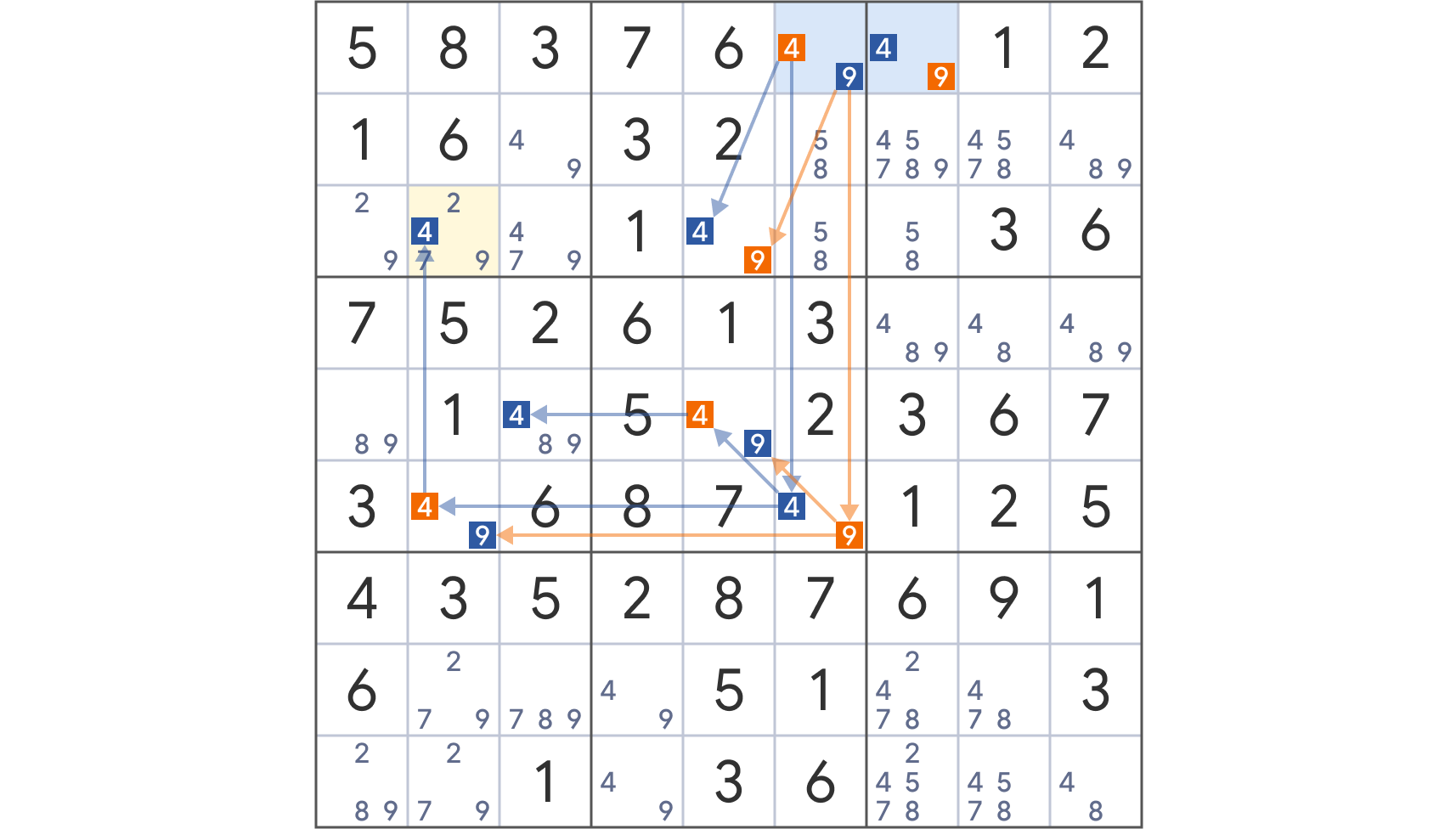
Keep extending the chain until no new candidates can be colored. The result is a single, connected network that can span several different digits across the board.
The Core Principle and Eliminations
Just like the 3D Medusa, exactly one color in your completed network is entirely correct, and the other is entirely wrong.
Because the underlying logic is the same, the exact same five elimination rules apply:
- A color repeated in a single cell or a single unit creates a contradiction. That entire color is false, confirming the opposite color as the solution.
- Any uncolored candidate that ends up seeing both colors in its unit—or shares a cell containing both colors—is logically trapped and can be safely eliminated.