
How to Spot and Use It to Crack Hard Sudoku
Have you ever reached a point in a Sudoku puzzle where you have filled in all the easy numbers, scanned every row and box, and hit a complete wall? You know the solution is there, but basic logic just isn’t working anymore.
Welcome to the world of intermediate Sudoku strategies. Today, we are breaking down the X-Wing.
The X-Wing is one of the most popular pattern-based techniques. It allows you to eliminate candidates that you couldn’t otherwise remove, often cracking the puzzle wide open.
The Concept
The X-Wing is based on a “locked candidates” theory. It occurs when you look at a specific number (let’s say, the number 5) and find that:
- In exactly two rows, the number 5 appears as a candidate in the same two columns.
- (Or vice versa: In exactly two columns, the number appears in the same two rows).
When you spot this rectangle pattern, you form an “X”. Because of the logic of the grid, you can eliminate that candidate from the rest of the columns (or rows) involved.
The Logic: Why It Works
Let’s look at a practical example. Imagine we are hunting for the candidate 7.
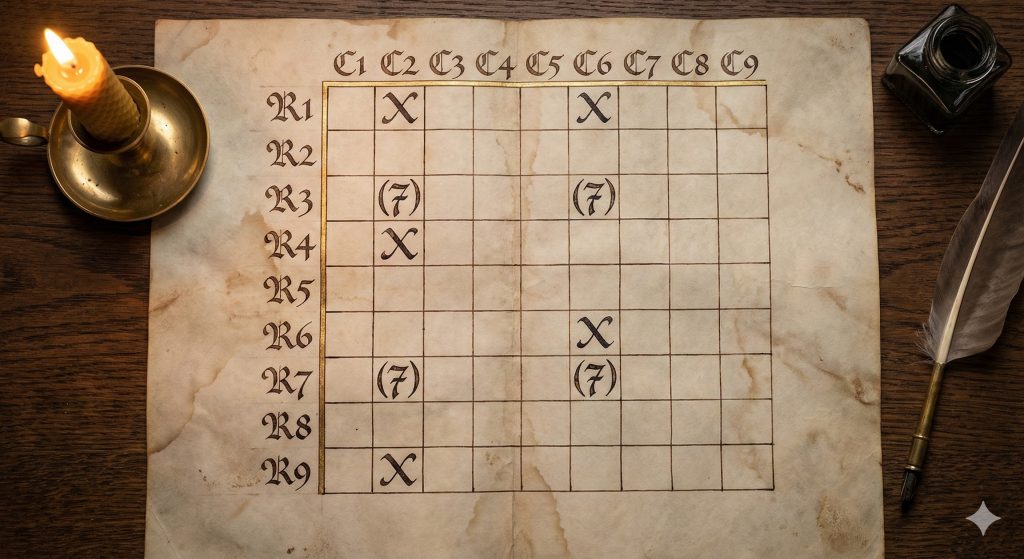
We scan the rows and find a pattern in Row 3 and Row 7.
- In Row 3, the candidate 7 can only go in Column 2 or Column 6.
- In Row 7, the candidate 7 can also only go in Column 2 or Column 6.
This creates a rectangle. Here is the logic:
- If R3C2 is a 7, then R3C6 cannot be.
- If R3C6 is a 7, then R3C2 cannot be.
In either scenario, one 7 will be in Column 2, and one 7 will be in Column 6. Therefore, no other cell in Column 2 or Column 6 can contain a 7.
How to Spot an X-Wing
Spotting an X-Wing takes practice because our eyes are trained to look at 3×3 boxes, not long-distance relationships between rows. Here is the best way to practice:
- Use Pencil Marks: This strategy is nearly impossible without full candidate notation.
- Focus on One Number: Don’t look for “any” X-Wing. Cycle through numbers 1-9. Ask yourself: “Where can the 4 go in this row?”
- Look for Pairs: Scan horizontal rows first. If a number only appears twice in a row, highlight those two spots. Then, scan down to see if another row has the exact same two spots for that number.
Conclusion
The X-Wing is a powerful tool in your Sudoku arsenal. It transitions you from guessing to true logical deduction. Next time you are stuck on a hard puzzle, stop looking at the boxes and start looking for the rectangles!
Happy solving!
Leave a Reply