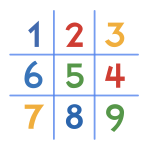
Sudoku Rules
Easy Sudoku Rules & Fundamental Solving Techniques
Mastering Sudoku doesn’t require complex mathematics—just clear logic, visual scanning, and a step-by-step approach. Whether you are completely new to grid puzzles or looking to sharpen your solving speed, understanding the core rules and basic strategies is your first step toward becoming an expert solver.
The Essential Rules of Sudoku
Every standard Sudoku grid consists of a 9×9 board divided into nine 3×3 blocks. The objective is simple:
- Fill every empty cell so that every row, column, and 3×3 block contains the numbers 1 through 9.
- No repeating: Each number from 1 to 9 can appear only once per row, column, and block.
- No guessing: Every proper Sudoku puzzle can be solved using pure logic.
5 Basic Techniques Every Beginner Should Know
To solve Easy and Medium level Sudoku puzzles efficiently, you only need to master five fundamental techniques. These methods rely on basic elimination and visual scanning.
1. Last Free Cell (Full House)
The most straightforward technique in Sudoku. When a single row, column, or 3×3 block has eight filled cells, there is only one empty space remaining. Simply count from 1 to 9 to find the missing number and fill the last free cell.
2. Last Remaining Number
Focus on a single number (for example, the number 4) and scan the grid to see where it is already placed. By cross-hatching rows and columns containing that number across a target 3×3 block, you can isolate the exact single spot where that number must go.
3. Last Possible Cell
Similar to cross-hatching, this method scans lines intersecting a specific unit to eliminate invalid placements. When horizontal and vertical lines block a digit from entering all other spaces in a row or column, you are left with the last possible cell for that number.
4. Naked Single
A Naked Single occurs when an empty cell is influenced by surrounding filled numbers in its row, column, and block such that eight different digits are already present. Because seven or eight numbers are ruled out, only one candidate remains legally allowed in that specific box.
5. Hidden Single
A Hidden Single happens when a candidate number appears in pencil notes across multiple empty cells in a unit, but only one cell in that entire unit can logically hold it. Even if that cell contains other extra pencil notes, the target number is “hidden” there because it has nowhere else to go.
Ready to Play?
Mastering these five fundamental rules builds the foundation for all advanced Sudoku strategies. Practice scanning the grid, use pencil notes when stuck, and watch how quickly your solving time improves!
Start practicing now: Try our Easy Sudoku Puzzles to apply these basic techniques in real time!